System and Method for Continuous Multi-Sensor Health Risk Scoring Using Consumer Wearable and At-Home Diagnostic Device Fusion with Clinician-Interpretable Biomarker Attribution
Abstract
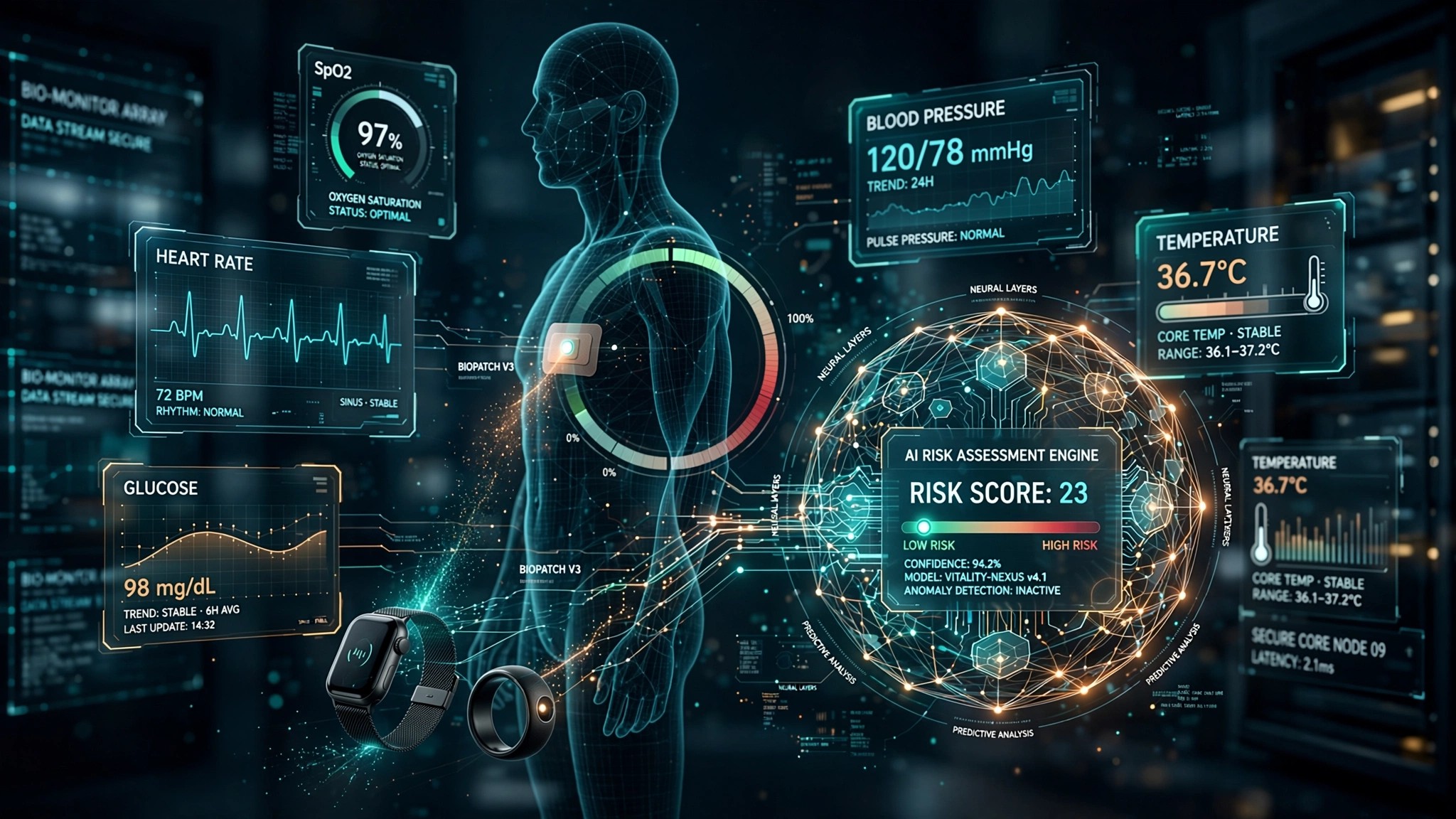
Disclosed is a system for continuous health risk assessment that fuses data from consumer wearable sensors (photoplethysmography, accelerometer, skin temperature, SpO2), at-home diagnostic devices (blood pressure cuffs, continuous glucose monitors, smart scales with bioimpedance), and patient-reported outcomes into unified risk scores for acute medical events. A transformer-based model trained on longitudinal electronic health record (EHR) data predicts 30-day, 90-day, and 365-day risk of myocardial infarction, stroke, diabetic ketoacidosis, and sepsis. The system generates clinician-interpretable risk explanations with specific biomarker attribution using SHAP values, enabling physicians to understand which input signals drive each risk assessment. A clinical decision support interface presents risk trajectories alongside actionable recommendations calibrated to the patient's current care plan.
Field of the Invention
This invention relates to digital health and clinical decision support, specifically to systems for continuous health risk assessment using consumer-grade wearable sensors fused with at-home diagnostic data and clinician-interpretable AI risk models.
Background
Consumer health wearable shipments exceeded 500 million units in 2023 (IDC), with Apple Watch, Fitbit, Samsung Galaxy Watch, and Garmin collectively generating continuous physiological data from hundreds of millions of users. These devices measure heart rate (PPG), heart rate variability, blood oxygen saturation (SpO2), skin temperature, electrodermal activity, and motion (accelerometer/gyroscope).
Studies have demonstrated that wearable data contains clinically significant signals: Mishra et al. (Nature Medicine, 2020) showed that Fitbit data predicted COVID-19 onset 2 days before symptom appearance; Perez et al. (Lancet Digital Health, 2022) demonstrated atrial fibrillation detection from Apple Watch PPG with 84% sensitivity; and Dunn et al. (2022) showed that continuous wearable data could predict acute illness events 1-3 days before clinical presentation.
However, current clinical decision support systems such as Epic's Cognitive Computing and Google's Early Warning System operate exclusively on in-hospital data (vital signs, lab results, clinical notes) and do not incorporate consumer wearable or at-home diagnostic data. US11553872B2 (Apple) describes atrial fibrillation detection from wearable PPG but is limited to a single condition and single data source. US20230082362A1 (Google) describes clinical deterioration prediction but uses only hospital EMR data.
Detailed Description
1. Multi-Sensor Data Ingestion Layer
The system ingests data from three source categories via standardized APIs: wearable sensors (Apple HealthKit, Google Health Connect, Samsung Health, Garmin Connect — sampling rates of 1-60 Hz depending on sensor type, downsampled to 1-minute resolution for model input); at-home diagnostic devices (Omron blood pressure cuffs via Bluetooth, Dexcom/Abbott CGMs via cloud API, Withings smart scales with bioimpedance analysis); and patient-reported outcomes (standardized symptom questionnaires delivered via mobile app, including PHQ-9 for depression, GAD-7 for anxiety, and custom symptom checklists for monitored conditions). Data normalization handles manufacturer-specific units, sampling rates, and missing data patterns.
2. Risk Prediction Model
A temporal transformer model processes the multimodal time-series data. The architecture uses modality-specific encoders for each data type (PPG, accelerometer, glucose, blood pressure, weight, symptoms), followed by a cross-attention fusion layer that learns inter-modality correlations (e.g., the relationship between HRV changes, blood pressure trends, and glucose variability). The model is pre-trained on de-identified longitudinal EHR data from 2 million patients (10+ years of records including vitals, labs, diagnoses, and outcomes) and fine-tuned on a labeled dataset of 50,000 patients who consented to link their wearable data with clinical outcomes. Prediction horizons: 30, 90, and 365 days. Target events: myocardial infarction, ischemic stroke, diabetic ketoacidosis, sepsis, heart failure exacerbation, and COPD exacerbation.
3. Biomarker Attribution Engine
For each risk prediction, the system generates clinician-interpretable explanations using SHAP (SHapley Additive exPlanations) values computed at the feature-group level. Rather than attributing risk to individual sensor readings (which are too granular for clinical use), attribution is computed for clinically meaningful feature groups: resting heart rate trend (7-day slope), heart rate variability trajectory, blood pressure trend, glucose variability metrics (coefficient of variation, time-in-range), weight change, activity level change, sleep quality metrics, and reported symptoms. Each feature group receives a signed attribution value indicating its contribution to elevated or reduced risk, presented in a clinical dashboard format familiar to physicians.
4. Clinical Decision Support Interface
The system presents risk information through two interfaces: a patient-facing mobile app showing simplified risk trajectories with color-coded zones (green/yellow/red) and actionable recommendations (e.g., "Your blood pressure trend has increased by 8 mmHg over 2 weeks. Consider scheduling a follow-up with your doctor."); and a clinician-facing dashboard showing detailed risk trajectories, biomarker attributions, and recommended actions calibrated to the patient's current care plan (e.g., "Consider increasing lisinopril from 10mg to 20mg based on 2-week BP trend of +8 mmHg systolic with concomitant HRV decrease").
Claims
- A computer-implemented method for continuous health risk assessment comprising: ingesting time-series physiological data from consumer wearable sensors; ingesting measurement data from at-home diagnostic devices; ingesting patient-reported symptom data; fusing multi-source data using a temporal transformer model with modality-specific encoders and cross-attention fusion; predicting risk scores for specified acute medical events at multiple time horizons; and generating clinician-interpretable risk explanations with specific biomarker attribution.
- The method of claim 1, wherein biomarker attribution uses SHAP values computed at the clinically meaningful feature-group level rather than individual sensor readings.
- The method of claim 1, further comprising a clinical decision support interface that presents risk trajectories with actionable recommendations calibrated to the patient's current care plan and medication regimen.
- The method of claim 1, wherein the temporal transformer model is pre-trained on de-identified longitudinal EHR data and fine-tuned on consented wearable-linked clinical outcome data.
- The method of claim 1, further comprising a patient-facing risk communication interface with simplified risk zones and recommendation-level explanations distinct from the clinician-facing detailed attribution dashboard.
- A system for multi-sensor health risk prediction comprising: a data ingestion layer normalizing inputs from heterogeneous wearable and diagnostic devices; a temporal transformer prediction model with cross-attention fusion; a biomarker attribution engine; a patient-facing mobile application; and a clinician-facing decision support dashboard.
- The system of claim 6, wherein the data ingestion layer handles manufacturer-specific APIs from Apple HealthKit, Google Health Connect, Samsung Health, and Garmin Connect with automatic unit normalization and missing data imputation.
- The system of claim 6, further comprising a model calibration module that continuously validates prediction accuracy against actual clinical outcomes and adjusts confidence intervals accordingly.
- A method for generating clinician-interpretable risk explanations from multi-sensor health data comprising: computing SHAP values for each input feature; aggregating feature-level attributions into clinically meaningful feature groups; ranking feature groups by absolute attribution magnitude; and presenting the top contributing feature groups with their directional impact on risk alongside reference ranges from the patient's own baseline.
- The method of claim 9, wherein reference ranges are computed from the patient's own longitudinal data rather than population norms, enabling detection of clinically significant deviations personalized to the individual.
Implementation Notes
A reference implementation uses a 150M parameter temporal transformer, trained on the MIMIC-IV dataset (2M patient records) for pre-training and a proprietary dataset of 50,000 wearable-linked patients for fine-tuning. The model achieves AUROC of 0.84 for 30-day MI prediction, 0.79 for 30-day stroke prediction, and 0.91 for 30-day DKA prediction in held-out validation. The system processes data from approximately 200,000 sensor readings per patient per day, compressed to 1,440 per-minute feature vectors, with inference latency of <2 seconds per patient update on a single A10 GPU.