2,900 Florida Buildings Skipped Mandatory Structural Inspections. Nobody Has Software for This.
Champlain Towers South killed 98 people. Florida responded with SB 4-D, mandating milestone inspections for every condo building three stories or taller. By July 2026, the OPPAGA found 2,900 required inspections were never completed, 54 buildings were deemed unsafe or uninhabitable, and only five were actually evacuated. Engineering firms run the compliance workflow on paper. Condo boards track it in spreadsheets. No vertical SaaS serves the full lifecycle from inspection scheduling through Phase 1/2 workflow, repair permitting, reserve study integration, and regulatory filing. Nearly two-thirds of Florida's 1.5 million condo units sit in buildings that are 30 years old or older. Every one of them needs this software.
The Problem
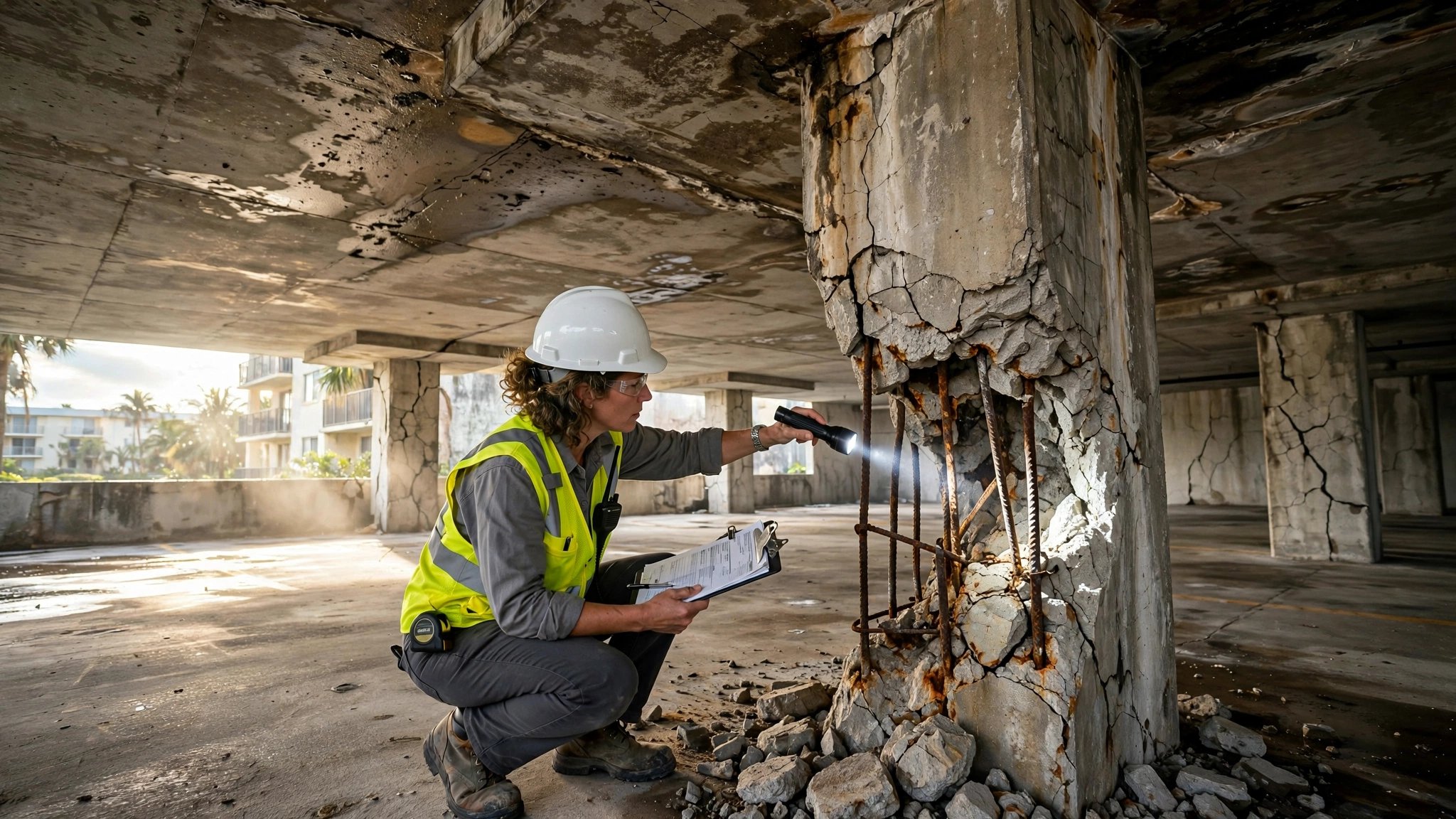
On June 24, 2021, Champlain Towers South in Surfside, Florida, collapsed at 1:22 a.m., killing 98 people. A 12-story beachfront condominium, built in 1981, pancaked into its own footprint while most of its residents slept. NIST's investigation concluded the collapse began when two connections between garage columns and the pool deck failed. Champlain Towers was 40 years old and undergoing the 40-year recertification process required by Miami-Dade County when engineering reports found it unsafe, identified millions of dollars in needed repairs, and the condo board delayed action until it was too late.
Florida's legislature responded with SB 4-D, signed in May 2022, a sweeping mandate requiring "milestone inspections" for all buildings three stories or taller: at 30 years old, or 25 years if within three miles of the coastline, then every 10 years after. Phase 1 is a visual inspection by a licensed engineer or architect, the kind of walk-through that should catch spalling concrete and corroded rebar before a column fails at 1 a.m. If Phase 1 finds "substantial structural deterioration," Phase 2 follows with detailed structural testing, and those Phase 2 repairs must be completed within 365 days. Reserve studies are required every 10 years under §718.112, reserves can no longer be waived by a board vote, and officers and directors who willfully fail to obtain inspections commit a breach of fiduciary duty that exposes them to personal liability.
Straightforward in concept. Disastrous in execution.
An OPPAGA report published July 2026 found that 8,736 Phase One inspections were completed in 2024-2025, but 2,900 required inspections were never performed at all. Of the 2,500 or so buildings that required Phase Two follow-up, only 1,575 completed it, leaving more than 925 buildings where a licensed engineer identified substantial structural deterioration and then nothing happened: no detailed testing, no repair plan, no timeline, just a report sitting in a county filing system while residents sleep above crumbling columns. Fifty-four buildings were deemed unsafe or uninhabitable, yet only five were evacuated. Nine hundred and three repair permits were filed, with costs ranging from $1,000 to $30 million per building.
Nobody is tracking this coherently: not the state, not the counties, not the engineering firms performing the inspections themselves.
Here is why it falls apart. Reporting is inconsistent across jurisdictions because classifications vary wildly: the statute does not define "unsafe" or "uninhabitable," leaving each local building official to interpret those terms independently, which means a building deemed safe in Broward County might be deemed uninhabitable under Miami-Dade's reading of the same statute. Engineering firms performing Phase 1 inspections submit findings on paper or PDF to county building departments, which file them in systems designed for permit tracking, not structural lifecycle management. Condo associations receive the reports and manage the response in spreadsheets, email chains, and board meeting minutes that no one will be able to locate when the building department calls three years later asking for documentation of the repair that was supposed to happen within 365 days. Reserve studies sit in separate financial software with no integration to the inspection record, which means the board's reserve consultant and the building's structural engineer operate in parallel universes where neither can see the other's data. When a building enters Phase 2, the engineer performing the follow-up may or may not have easy access to the Phase 1 report, the repair history, the reserve balance, or the board's prior decisions about deferred maintenance.
Multiply this across nearly a million aging condo units and the scale of the problem becomes staggering. Nearly two-thirds of Florida's 1.5 million condo units are in buildings 30 years old or older, with more than 105,000 units sitting in buildings that have already passed their fiftieth birthday. Every one of those buildings is now subject to SB 4-D, and Florida approved 178,297 new housing units in 2025 alone, straining a structural engineering workforce that was already undersized for the inspection mandate before the first Phase 1 report was ever filed.
The Gap in the Market
Several companies operate in adjacent spaces, but none of them solve the building recertification compliance problem end to end.
| Company | What They Do | What's Missing |
|---|---|---|
| T2D2 (Thornton Tomasetti spinoff) | AI-powered facade defect detection from drone and photo imagery. Identifies cracks, spalls, and corrosion patterns. Backed by one of the world's largest structural engineering firms. | Detection tool, not a compliance platform. Finds defects but does not manage the regulatory workflow: no inspection scheduling, no Phase 1-to-Phase 2 handoff, no reserve study integration, no filing with the building department. An engineering firm using T2D2 still tracks the rest of the compliance lifecycle manually, from scheduling the next inspection to filing Phase 1 results with the county to notifying the condo board that Phase 2 is triggered and the 365-day repair clock has started. |
| OrangeQC | Generic inspection and quality control app with customizable templates. Used across janitorial, facilities management, and safety inspections. | Horizontal tool. No structural recertification-specific workflows. No understanding of SB 4-D phases, timelines, or compliance triggers. No regulatory filing integration. Building a milestone inspection template in OrangeQC is like building an EHR in Excel: technically possible, practically useless. |
| PlanRadar | Construction and real estate inspection platform. 200,000+ users globally. Digital documentation, defect tracking, task management for construction projects. | Project management for active construction, not lifecycle compliance for existing buildings. No concept of a 30-year inspection cycle, no reserve study integration, no mechanism for tracking a building across decades of inspections, repairs, and board decisions. Different customer, different time horizon, and fundamentally different relationship with the building. |
| Vertify | Digital twin and facade analytics platform focused on energy retrofits. 3D modeling of building envelopes for weatherization and energy efficiency. | Energy performance, not structural safety. Different regulatory framework, different engineering discipline, different buyer. A condo board managing SB 4-D compliance does not need a digital twin. It needs to know whether Phase 2 is overdue, what the reserve balance is, and whether the building will be insurable next year, none of which a digital twin tells you. |
| DOB NOW: Safety (NYC) | New York City's government portal for filing Facade Inspection Safety Program (FISP/Local Law 11) reports. Engineers submit inspection results directly. | A filing portal, not a management platform. Accepts reports from engineers. Does nothing to help the engineer manage the inspection workflow, track multiple buildings across cycles, coordinate with condo boards, or integrate reserve studies. It is the receiving end of compliance, not the operating system for it. |
| Procore / Fieldwire / Field1st | General-purpose construction inspection and project management platforms. Procore alone has 16,000+ customers and a $10B+ market cap. | Built for general contractors managing active construction. No milestone inspection lifecycle, no reserve study module, no regulatory filing automation for SB 4-D or FISP, and no understanding of why a building that passed its 30-year inspection might fail its 40-year follow-up when the pool deck patch the previous engineer recommended was never actually completed because the board voted to defer it pending a special assessment that they also deferred. Asking a structural engineer to manage a 40-year recertification cycle in Procore is like asking an oncologist to use a dental practice management system because both involve patient records. |
Count the gaps across all six: detection tools that find problems but don't manage the response, generic inspection apps that have no concept of the regulatory cycle, construction platforms built for new buildings rather than aging ones, and government portals that receive filings but don't help produce them. A condo board trying to navigate SB 4-D today must stitch together three to five unrelated software products, plus paper, plus email, plus their attorney, plus their engineer, plus their reserve study consultant, and somehow keep all of it synchronized across a multi-year compliance lifecycle that the statute enforces with personal liability for board members who let it slip. Nobody owns the workflow.
The Solution
A vertical SaaS platform purpose-built for building structural recertification and milestone inspection compliance, serving three customer types with interlocking modules: engineering firms performing inspections, condo associations managing the compliance lifecycle, and local building departments receiving and reviewing filings. Five core capabilities.
1. Inspection lifecycle management for engineering firms ($300/building/year): A structured digital workflow for Phase 1 and Phase 2 milestone inspections. Mobile-first field documentation with photo capture, defect classification mapped to SB 4-D and FISP categories, GPS-tagged observations, and automated report generation in the format each jurisdiction requires. When a Phase 1 inspection identifies substantial structural deterioration, the platform automatically triggers the Phase 2 workflow with the relevant findings pre-populated, the 365-day repair deadline calendared, and the condo board notified. For firms managing 50+ buildings on staggered cycles, the dashboard shows upcoming inspections, overdue buildings, and Phase 2 deadlines at a glance. Think of it as a CRM for concrete.
2. Compliance dashboard for condo associations ($150/building/month): A board-facing portal showing the building's structural compliance status in plain language: current inspection phase, date of last Phase 1, Phase 2 status with repair deadlines, reserve study summary with the dedicated structural reserve balance (SB 4-D eliminated the ability to waive reserves), outstanding repair permits and their status, and upcoming milestones including next inspection date, next reserve study deadline, and board approval requirements. Add a document repository for all inspection reports, engineering letters, board resolutions, and contractor bids, and for a seven-member condo board with zero engineering background, this is the difference between "we have a binder somewhere" and "we know exactly where we stand."
3. Regulatory filing and reporting for building departments ($5,000/jurisdiction/year): An intake portal for jurisdictions to receive, classify, and track milestone inspection filings electronically. Automated status tracking across every building in their jurisdiction. Flagging of overdue inspections. Dashboards showing Phase 2 completion rates, repair permit status, and buildings with unresolved structural deterioration. For a county building department that currently receives inspection reports as PDF email attachments and files them in a document management system with no analytical capability, this transforms reactive filing into proactive oversight.
4. Reserve study integration ($200/building/year add-on): SB 4-D and its 2023 amendment require structural integrity reserve studies every 10 years. Reserve balances must cover the estimated cost of structural repairs identified in the most recent inspection. Inside the platform, inspection findings link directly to the reserve calculation, so when an engineer identifies $2.3 million in concrete restoration needs, the reserve module automatically flags whether the association's current funding plan will meet the obligation. If it falls short, the platform models assessment scenarios for the board. For the 50+ condo associations facing seven-figure special assessments in 2025-2026, this module alone justifies the subscription.
5. Insurance documentation package (included): Insurance companies increasingly require structural inspection documentation before quoting or renewing condo coverage. Phil Masi of Gallagher, one of Florida's top condo insurance brokers, expressed concern about buildings "deemed unsafe and uninhabitable yet still occupied." The platform generates a standardized insurance compliance package: inspection summary, defect classification, repair status, reserve adequacy, and board resolution history. A building with a clean compliance record on the platform gets quoted faster. A building without one increasingly doesn't get quoted at all, and an uninsurable condo is an unsellable condo.
The Math
Start with the engineering firm, because the ROI there is immediate and measurable in hours that can be billed to other clients. A mid-size structural engineering practice in South Florida might manage 100 active buildings under SB 4-D compliance. Today, a senior engineer spends approximately 4 hours per building per year on administrative compliance work: scheduling, report formatting, filing, tracking Phase 2 deadlines, coordinating with condo boards, and responding to building department inquiries. At a blended billing rate of $225/hour, that is $900 per building per year in engineering time consumed by paperwork.
A $300/building/year subscription charges $300 per building per year and reduces the administrative burden by roughly 60%, saving $540 per building in billable time that the engineer can redirect to revenue-generating inspection work. Net savings to the firm: $240 per building per year, which for a 100-building practice translates to $24,000 in annual recovered capacity, roughly the equivalent of one additional junior engineer's worth of inspection volume freed up entirely by eliminating paperwork that currently eats six to twelve hours of every single inspection.
Now consider the condo association side of the equation. Florida's average condo association with 50+ units spends $8,000 to $15,000 annually on legal and consulting fees related to structural compliance: attorney review of inspection reports, reserve study consultant engagement, board meeting preparation for assessment votes, and responding to building department inquiries that arrive without warning and demand documentation the board cannot locate. At $150/month ($1,800/year), the platform reduces the legal and consulting spend by an estimated 20-30% by providing structured documentation, automated deadline tracking, and pre-formatted filings. On a $10,000 baseline, that is $2,000 to $3,000 in savings against $1,800 in subscription cost. Marginal on paper. But the real value is risk reduction: a board that misses a Phase 2 deadline faces personal fiduciary liability under SB 4-D, and no spreadsheet sends reminder emails to board members six months before a deadline hits. Liability is the accelerant.
Revenue Model
| Revenue Stream | Price | Year 3 Target | Notes |
|---|---|---|---|
| Engineering firm SaaS (per building/year) | $300 | 3,000 buildings → $900K | 30 engineering firms × 100 buildings avg. Replaces paper/PDF workflow. Phase 1 + Phase 2 lifecycle management, automated reporting. |
| Condo association dashboard (per building/month) | $150 | 800 buildings → $1.44M | Board-facing compliance status, reserve integration, document repository. Sold direct and through property management companies. |
| Building department intake (per jurisdiction/year) | $5,000 | 40 jurisdictions → $200K | Electronic filing portal, status tracking, overdue inspection flagging. Florida has 67 counties + hundreds of municipalities. NYC is a single large contract. |
| Reserve study integration (add-on per building/year) | $200 | 1,500 buildings → $300K | Links inspection findings to reserve adequacy. Upsell to both engineering firms and condo associations. |
| Insurance documentation (included in base) | $0 | $0 | Differentiator, not a revenue line. Drives adoption by making the platform a requirement for insurance placement. |
| Year 3 total ARR | $2.84M |
Market Size
TAM: Florida has approximately 30,000 condo and cooperative buildings subject to SB 4-D milestone inspections. At a blended $6,500 per building per year across engineering firm SaaS ($300), condo association dashboard ($1,800/year), and reserve study integration ($200), plus jurisdiction fees, the Florida-only TAM is approximately $200M/year. New York City's FISP program covers roughly 12,500 buildings over six stories, with a comparable per-building compliance spend. Combined, the FL + NYC TAM is approximately $340M/year. As other states adopt similar legislation (the Community Associations Institute's CEO Dawn Bauman has stated "as other states evaluate their aging housing stock, Florida's experience offers valuable lessons"), the TAM expands to an estimated $500M+ across 10 states within a decade.
SAM: The immediately addressable market is Florida condo associations and engineering firms in the state's six largest coastal counties (Miami-Dade, Broward, Palm Beach, Hillsborough, Pinellas, Duval), where building age and coastal proximity create the highest density of SB 4-D compliance obligations. These counties contain an estimated 18,000 of the 30,000 subject buildings. At $6,500 blended revenue per building: $117M/year.
SOM (year 3): 3,000 buildings under engineering firm SaaS, 800 under condo association dashboards, 40 jurisdictions, 1,500 reserve study add-ons. $2.84M ARR, representing approximately 1.4% of the SAM. Realistic for a vertical SaaS in year 3 with a focused go-to-market in South Florida.
Why Now
SB 4-D's enforcement timeline is creating urgency that didn't exist 12 months ago. SB 4-D passed in 2022 with extended compliance deadlines that made the problem feel distant. Those deadlines are now arriving, and the numbers are ugly. OPPAGA's July 2026 report is the first comprehensive audit of compliance, and its findings are brutal: 2,900 buildings that skipped inspections entirely, 925 outstanding Phase Two obligations, 54 buildings deemed unsafe with only 5 evacuated. DeSantis signed HB 913 and HB 393 in June 2025, extending reserve study deadlines by one year and allowing a two-year pause in reserve payments for buildings undergoing critical repairs. Legislative relief for compliance burden confirms the burden is real, because when a governor signs a bill giving condo associations an extra year to complete their reserve studies, that is an admission that the original timeline was breaking buildings politically even faster than it was fixing them structurally.
Insurance carriers are making compliance documentation a prerequisite. After Champlain Towers, Florida's condo insurance market imploded. Carriers exited the state or tripled premiums, and those that remain are demanding structural inspection reports before quoting coverage. A building without a documented inspection history is increasingly uninsurable, which transforms the SaaS from "nice to have" compliance tracking into gating infrastructure for the building's ability to obtain coverage at all.
Workforce shortage creates demand for efficiency tools. Florida's building inspector and structural engineer workforce was not sized for a mandate that added 30,000 buildings to the inspection pipeline. A single Phase 1 inspection takes 4 to 8 hours of on-site time plus 6 to 12 hours of report preparation. Multiply by 30,000 buildings and you need roughly 400,000 to 600,000 engineering hours of inspection capacity — approximately 200 to 300 full-time structural engineers doing nothing but milestone inspections. Software that reduces the 6 to 12 hours of report preparation to 2 to 4 hours effectively doubles the inspection capacity of the existing workforce without hiring a single additional engineer.
Other jurisdictions are watching Florida fail. CAI's advocacy team has briefed state legislators in California, Texas, Illinois, and New Jersey on Florida's milestone inspection framework, and coastal states with aging high-rise building stock face the exact same structural deterioration risks that killed 98 people in Surfside. A platform built for SB 4-D's specific requirements can adapt to new state programs with configuration changes, not rewrites, because the underlying workflow (periodic inspection → defect classification → repair tracking → reserve adequacy → regulatory filing) is universal.
Startup Costs
| Category | Cost | Notes |
|---|---|---|
| Software development (12 months, 5-person team) | $600K | 2 backend engineers (inspection workflow, document management, regulatory filing APIs), 1 mobile developer (field inspection app), 1 frontend (dashboards), 1 product manager with structural engineering domain knowledge. Build on existing document management and workflow infrastructure (AWS/GCP), not from scratch. |
| Structural engineering domain consulting | $80K | Engage 3-5 licensed Florida PEs to validate inspection workflow design, defect classification taxonomy, report templates, and Phase 1/Phase 2 handoff logic. These consultants become your advisory board and first beta customers. |
| Regulatory and legal integration | $60K | Map filing requirements for Florida's 67 counties. Build template submission formats for the 6 largest coastal county building departments (Miami-Dade, Broward, Palm Beach, Hillsborough, Pinellas, Duval). Engage construction law firm for compliance validation. |
| Reserve study module development | $100K | Integration with common reserve study methodologies (straight-line, component, cash flow). Must connect inspection findings to reserve adequacy calculations per §718.112 requirements. Partnership with 2-3 reserve study firms for validation. |
| Sales and marketing (year 1) | $80K | Target: Florida Engineering Society conferences, Community Associations Institute chapter meetings, Florida Bar real estate section events. Content marketing through case studies and compliance guides. No mass-market spend. |
| Insurance and compliance | $30K | E&O insurance (required when your platform generates engineering reports that become regulatory filings), SOC 2 Type I certification, Florida business registration. |
| Operating buffer (12 months) | $50K | Cloud infrastructure, document storage, mobile app distribution, miscellaneous. |
| Total | $1.0M |
Limitations
The 30,000-building estimate for Florida's SB 4-D universe is derived from condo and cooperative association filings, not a definitive state registry of buildings subject to the law, because no such registry exists. Actual numbers could be higher (mixed-use buildings and rental apartment buildings that meet the 3-story threshold but are not structured as condominiums are potentially subject but uncounted) or lower (buildings demolished, converted, or falling below the threshold after remeasurement), and the gap between the estimate and reality matters because it directly affects the TAM calculation, the engineering workforce capacity planning, and the building department's ability to even identify which buildings in their jurisdiction are out of compliance.
That blended $6,500 per building assumes adoption of both the engineering firm module and the condo association dashboard for each building. In practice, early adoption will be lopsided: engineering firms adopt first because the efficiency gains are immediate and measurable, while condo boards adopt more slowly because purchasing decisions require board votes, budget approvals, and overcoming the inertia of "we've always done it this way." Year 3 SOM projections assume 3,000 buildings on the engineering side but only 800 on the condo association side, reflecting this asymmetry.
Regulatory filing integration depends on county building departments accepting electronic submissions, and that is not a given. Florida's six largest coastal counties have varying levels of digital maturity: Miami-Dade's portal is reasonably modern, but smaller counties may accept only paper filings, email, or walk-in submissions. Documents can be generated in any format, but true end-to-end digital filing requires jurisdiction-by-jurisdiction integration work that cannot be parallelized.
Its reserve study integration module touches financial calculations that carry legal liability, and that liability is not theoretical. If the platform models a reserve adequacy projection and the board relies on it to set assessment levels, an error in the calculation could expose both the company and the board to lawsuits from unit owners who were assessed too little and now face a structural emergency with an empty reserve fund. This module requires actuarial review, legal disclaimers, and possibly registration as a financial software provider in Florida. It is the highest-value feature and the highest-liability one. Build it carefully.
Strongest Counterargument
Procore is already here, and it can build this in a quarter. That is the strongest objection, and it is not wrong about the capability, because Procore has 16,000+ construction customers, a $10B+ market cap, a massive engineering team, and existing inspection workflow infrastructure. If the building recertification compliance market gets large enough, Procore could build a milestone inspection module, integrate it with its existing platform, and sell it to engineering firms that already use Procore for new construction projects. PlanRadar could do the same, as could Autodesk, and any of them has the engineering headcount to ship a milestone inspection module before a startup finishes its seed round. By then the vertical SaaS startup is building a feature, not a product, and the feature will get eaten by a platform company the moment it proves the market exists.
Here is why that probably doesn't happen, at least not fast enough to matter. Procore's customers are general contractors building new structures. Structural engineering firms performing 40-year recertification inspections are a different customer with different workflows, different regulatory requirements, and different billing models. Procore's product roadmap is driven by its existing customer base, and that base is asking for schedule management, cost tracking, and subcontractor coordination, not condo board compliance dashboards and reserve study integration. Building a milestone inspection module would require Procore to learn an entirely new regulatory framework (SB 4-D, FISP, state-by-state variations), integrate with government filing systems it has never touched, and sell to condo associations and building departments that are not in its customer universe. It is not that Procore can't do it. It is that Procore won't prioritize it over features that serve its existing $10B market until the recertification compliance market is large enough to justify the distraction, and that window is three to four years at minimum. By then, the vertical SaaS has 3,000 buildings, 30 engineering firm relationships, and a regulatory integration moat that took two years of jurisdiction-by-jurisdiction negotiation to build. Procore could simply acquire the startup, and that outcome is not the counterargument's victory condition; it is the startup's exit.
What You Can Do
If you are a structural engineer in Florida: Your practice is about to get busier than it has ever been, and the firms that invest in operational efficiency now will capture disproportionate market share. Start by documenting your current inspection workflow from scheduling through filing: every step, every handoff, every document. Identify where you lose time to formatting, re-entry, and coordination with condo boards. If you are managing more than 30 buildings, the administrative burden is already costing you the equivalent of a junior engineer's salary. In practice, that first firm in each metro area to adopt a digital milestone inspection workflow will set the standard that building departments and condo boards expect from every other firm.
If you are on a condo board in Florida: Check your building's milestone inspection status right now. If your building is 25+ years old and within three miles of the coast, or 30+ years old anywhere in the state, you are subject to SB 4-D. If you have not completed Phase 1, you are out of compliance and your officers face personal fiduciary liability. Contact your association attorney and request a compliance timeline. Review your reserve study: under the 2023 amendments, reserves for structural components can no longer be waived by board vote. If your reserves are underfunded, a special assessment is coming whether you vote for it or not. Better to plan it than to discover it when your insurance carrier declines to renew.
If you are a property management company: You manage the administrative relationship between engineering firms and condo boards. You are the natural distribution channel for this software. A management company that can offer its condo association clients a compliance dashboard bundled into its management fee, telling them "we track your SB 4-D status so you don't have to," has a retention tool that no competitor can match until they adopt the same platform. First mover wins the management contracts for the 2,900 buildings that are currently out of compliance and need help getting current.
If you are building this: Start with engineering firms, not condo boards. Engineers are repeat buyers (100+ buildings each), make purchasing decisions individually (no board vote required), and experience immediate ROI through time savings. Land 10 engineering firms with 100 buildings each and you have 1,000 buildings generating data that makes the condo association dashboard and the building department portal valuable. Condo boards adopt because their engineer is already on the platform, and switching means losing access to the inspection history that their insurance carrier requires. Building departments adopt because the filings arriving through the platform are cleaner and more consistent than PDF email attachments. The engineering firm is the wedge, and everything else follows from the data it generates.
The Bottom Line
Ninety-eight people died because a condo board deferred $9 million in structural repairs for three years while the building's columns corroded beneath the pool deck. Florida passed a law to make sure that never happened again, with enforcement mechanisms, personal liability provisions, and mandatory timelines that left no room for the kind of deferred-maintenance culture that killed those 98 people in Surfside. Two years into enforcement, 2,900 buildings have not been inspected, 925 Phase Two follow-ups are incomplete, and 54 buildings sit occupied despite being deemed unsafe. The law created a compliance obligation that nobody built the infrastructure to support. Engineering firms running inspections on clipboards and condo boards tracking deadlines in spreadsheets is not a system, and the gap between what the statute demands and what the market provides is where this company lives. Purpose-built software covering the full lifecycle — inspection, repair tracking, reserve integration, regulatory filing, insurance documentation — captures a $340M market in two states and an expanding one as other jurisdictions adopt similar mandates. People die when buildings fail and bureaucracies lose track of which ones are failing. That is not rhetoric. Software that makes it harder to lose track is worth building.