Ready-Mix Concrete QC and DOT Mix Design Compliance SaaS
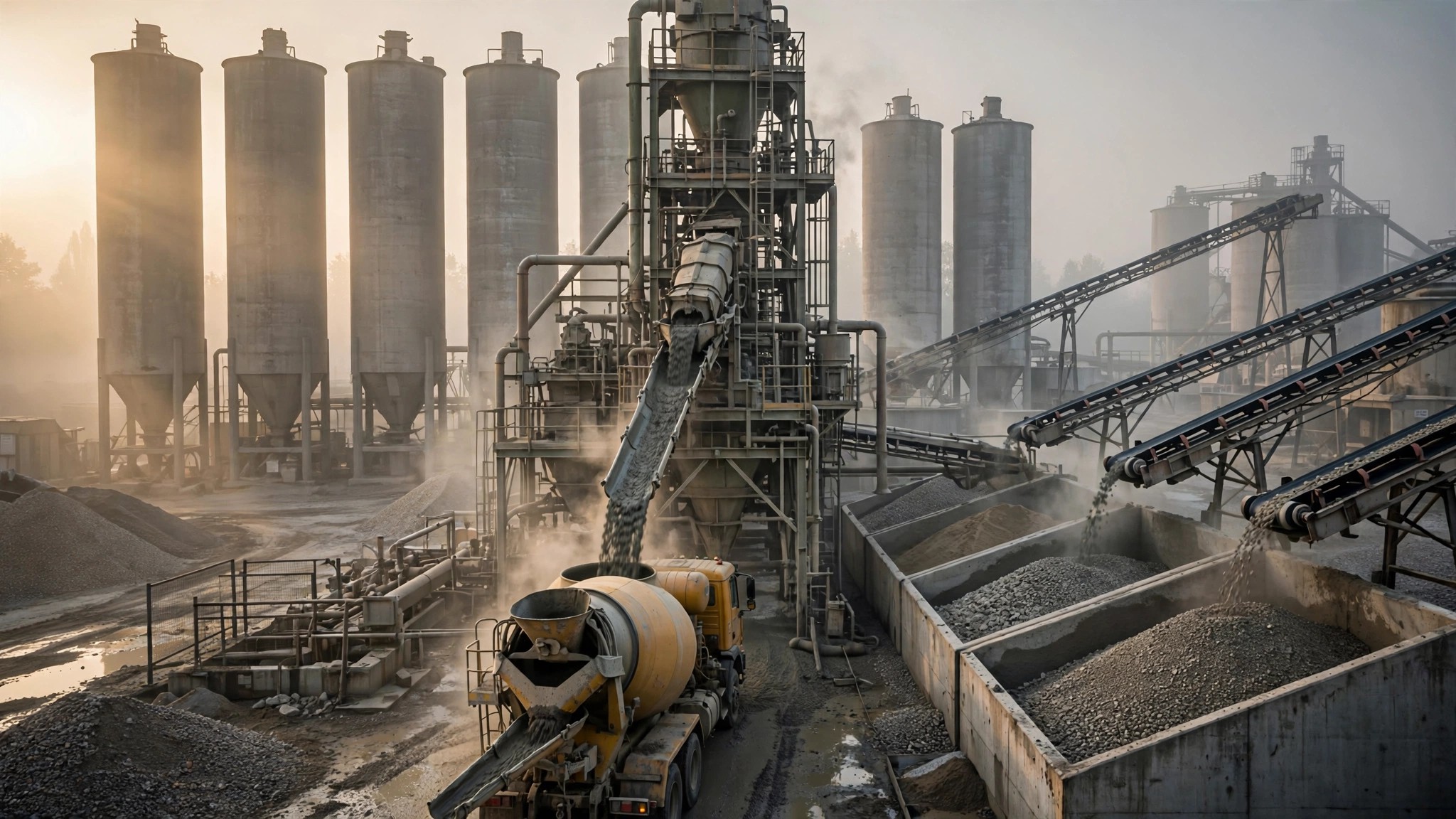
The U.S. pours 380 million cubic yards of ready-mix concrete every year through roughly 5,500 batch plants, generating $47.8 billion in revenue. Command Alkon, the industry's dominant software provider, serves the largest producers. The other 4,400 single-location plants tracking cylinder break results in spiral notebooks and managing DOT-approved mix designs in binder tabs are the ones building your roads, your bridges, and your wastewater treatment plants.
The Problem
Every cubic yard of concrete placed on a federally funded highway, bridge, or water infrastructure project must meet a DOT-approved mix design. The approval process is state-specific: a producer submits a proposed mix with aggregate gradations, cement content, water-to-cementitious ratios, and admixture dosages to the state DOT lab for evaluation. If approved, that mix receives a design number. The producer must then batch every load to that exact design, within specified tolerances, and document compliance for every truck that leaves the plant.
The documentation chain is extensive. For a single pour on a DOT project, the producer generates batch tickets showing the actual weights of each material loaded against the design targets, records slump and air entrainment tests at the point of delivery, molds test cylinders per ASTM C31 that must be cured for 7 and 28 days, then broken in a certified lab per ASTM C39 to verify compressive strength. If the 28-day break falls below the specified strength, the producer faces rejection of the placed concrete, potential removal and replacement at their cost, and possible suspension from the DOT's approved producer list.
For producers operating in multiple states, the complexity multiplies. A concrete company in the Tri-State area might hold approved mix designs from the New Jersey DOT, PennDOT, and NYSDOT simultaneously, each with different submittal formats, tolerance thresholds, testing frequencies, and documentation requirements. Michigan DOT requires that field test results for temperature, slump, and air content be submitted to the engineer by end of day. PennDOT wants them in a different format, on a different timeline, through a different portal.
The industry's response to this documentation burden falls into two camps. Large multi-plant producers (CRH, Heidelberg Materials, Holcim, Cemex) use enterprise software from Command Alkon, which acquired Marcotte Systems in July 2024 to consolidate its dominance. COMMANDqc, their quality control module, handles mix design management, batch monitoring, and test result tracking. It's powerful, expensive, and designed for organizations running 10 to 200 plants. Everyone else uses spreadsheets, paper binders, and institutional memory. A QC technician at a three-plant independent producer in rural Ohio keeps mix designs in a filing cabinet, logs cylinder breaks in Excel, and hopes the DOT auditor doesn't show up on the day the intern is running the plant.
Market Size
Industry baseline: The U.S. ready-mixed concrete manufacturing industry generated $47.8 billion in revenue in 2025 (IBISWorld, NAICS 32732) across approximately 5,500 plants operated by roughly 2,800 companies. The North American market reached $76.47 billion in 2026 (Mordor Intelligence), growing at 5.29% CAGR through 2031. The Bipartisan Infrastructure Law's $550 billion in new federal spending on roads, bridges, and water systems is the largest concrete demand catalyst in a generation, and every dollar of that spending generates QC documentation requirements that the current tooling doesn't serve.
Addressable segment: The target is independent ready-mix producers operating 1 to 10 plants who sell to DOT and municipal projects. Based on NRMCA membership data and IBISWorld's industry structure analysis, approximately 2,200 companies (operating ~3,800 plants) fit this profile. These are not hobby operations. They average $4 to $12 million in annual revenue per plant, employ certified QC technicians, and compete for DOT contracts that require rigorous documentation. They simply cannot justify $150,000+ in annual software licensing for Command Alkon's enterprise stack.
At a subscription price of $495/month per plant for the core QC compliance module (mix design management, batch tolerance monitoring, cylinder tracking, and DOT-format report generation) and $895/month for the premium tier (adding multi-state compliance, aggregate source qualification tracking, and predictive strength modeling), with an estimated 60/40 standard/premium split, the blended ARPU is $655/month per plant. At 3,800 addressable plants, the TAM is $29.9 million in annual recurring revenue.
The secondary revenue layer is the testing laboratory market. Independent concrete testing labs that perform cylinder breaks, aggregate gradation testing, and petrographic analysis for producers and DOT agencies also need results management and reporting software. There are approximately 1,800 AASHTO-accredited or ASTM C09-aligned testing labs in the U.S. At $395/month, this adds $8.5 million in potential ARR. Combined realistic SAM: $38.4 million. Year 3 target: 500 plant subscribers plus 200 lab subscribers at blended rates = $4.9 million ARR.
The Product
A cloud-native QC compliance platform purpose-built for independent ready-mix concrete producers doing DOT and municipal work. Not a batch plant automation system (Command Alkon owns that). Not a general-purpose LIMS. A focused tool that sits between the batch controller and the DOT portal, managing the documentation chain that turns a physical load of concrete into a compliant, auditable record.
- Mix design library with state DOT mapping: Every approved mix design stored with its DOT design number, approval date, expiration, and the specific state requirements it satisfies. When a producer operates across state lines, the system maps equivalent mixes (a 4,000 PSI bridge deck mix approved in New Jersey versus PennDOT's equivalent AA concrete) and flags when an approval is expiring or when a DOT revises its specifications. Quarterly spec updates for all 50 state DOTs are baked into the subscription.
- Cylinder lifecycle tracker: From the moment a technician molds a cylinder at the jobsite through transport to the curing room, 7-day break, 28-day break, and result reporting. Each cylinder gets a QR code label at molding. Scan it at each stage. The system enforces ASTM C31 curing temperature requirements by integrating with wireless temperature loggers in the curing room. If the curing temperature drifts outside the 60-80°F window, the system flags the affected cylinders before they're broken, potentially saving the producer from reporting invalid test results.
- Batch ticket QC overlay: Imports batch data from any plant controller (Marcotte, Con-E-Co, Vince Hagan, manual plants) via CSV, API, or manual entry. Compares actual batch weights to the approved mix design tolerances in real-time. Flags out-of-tolerance loads before the truck leaves the plant, not after the concrete is placed and a DOT inspector pulls the ticket.
- DOT audit packet generator: When the DOT auditor arrives, the QC manager clicks one button and generates the complete documentation package for any project, date range, or mix design: batch tickets, material certifications, aggregate test results, cylinder break reports, and corrective action records. Formatted to the specific state DOT's requirements. What currently takes two to three days of binder assembly takes twelve seconds.
Unit Economics
| Metric | Value |
|---|---|
| Monthly subscription (Standard: QC compliance + cylinder tracking) | $495/plant |
| Monthly subscription (Premium: multi-state + predictive analytics) | $895/plant |
| Blended ARPU | $655/month |
| Infrastructure cost per subscriber/month | $32 |
| DOT spec maintenance cost per subscriber/month | $24 |
| Customer acquisition cost | $4,800 |
| Expected LTV (36-month avg retention, 91% gross margin) | $21,457 |
| LTV:CAC ratio | 4.5:1 |
| Gross margin | 91% |
| Startup cost (18-month runway) | $3.2M |
| Break-even | 22 months |
Methodology note: The 36-month average retention assumption reflects the compliance-driven nature of the product. Once a producer's QC workflow runs through the platform and their DOT audit history is stored there, switching costs are high. The closest analogy is construction project management software (Procore, Bluebeam), which sees 90%+ annual retention in the mid-market. CAC of $4,800 reflects a field sales model through NRMCA chapter meetings, state concrete association conferences, and DOT-hosted producer meetings, supplemented by inside sales. The industry has three major trade shows per year (World of Concrete, ConExpo, NRMCA Annual Convention) where 60% of buying decisions begin. LTV calculation: $655 × 36 months × 91% gross margin = $21,457. Payback period: 7.3 months (on gross revenue).
Go-to-Market
Phase 1 (months 1-8): Build the core product with three launch states. Pick DOTs with well-documented digital specifications and high volumes of independent producers: Texas (TxDOT, ~600 independent plants), Ohio (ODOT, ~350 plants), and Florida (FDOT, ~400 plants). Recruit 40 beta plants by attending state concrete association meetings and offering free access through the first DOT audit cycle. The pitch is simple: "Show me your current audit prep process." Every QC manager will pull out a binder, sigh, and give you 20 minutes. Simultaneously, hire two DOT specification analysts to build the state-specific compliance rule engine, starting with the three launch states and adding five per quarter.
Phase 2 (months 9-16): Monetize with the $495/month Standard tier. Expand to 12 states by prioritizing those with major infrastructure spending under IIJA: California (Caltrans), Pennsylvania, New York, Georgia, North Carolina, Illinois, Virginia, Michigan, and Washington. Build the testing lab module and sign integration partnerships with the top five independent testing lab chains. Launch the cylinder QR code labeling system with a hardware kit (thermal label printer + labels) sold at cost ($149) as an onboarding accelerant.
Phase 3 (months 17-24): Launch Premium tier with multi-state compliance engine and predictive strength modeling. The prediction model uses historical cylinder break data, batch proportions, ambient temperature, and aggregate moisture to predict 28-day strength at the time of batching, giving producers an early warning system for potential failures weeks before the actual break test. Approach state DOT agencies directly to position the platform as a digital submission portal for QC documentation, reducing their own paper processing burden. If a DOT adopts the platform as an accepted submission channel, adoption among that state's producers becomes a competitive necessity.
Competitive Landscape
| Company | What It Does | QC Compliance Focus? | Pricing |
|---|---|---|---|
| Command Alkon (COMMANDqc) | Enterprise QC, batch plant automation, dispatch, and fleet management for large producers | Yes, but bundled into a $100K+ enterprise suite; overkill for a 3-plant operator | $100-200K+/yr (enterprise) |
| Jonel Engineering (Concrete QC) | Legacy Windows-based QC software for mix design and test tracking | Yes, but on-premise, single-user, last UI update circa 2015 | $5-15K perpetual license |
| StonemontQC | Cloud QC for aggregates and asphalt, expanding into concrete | Aggregates-first; concrete module is secondary and lacks DOT-specific formatting | $300-600/mo |
| Procore / Bluebeam | Construction project management and document management | No: manages project documents but doesn't understand mix design specifications or ASTM testing protocols | $499-999/mo |
| Spreadsheets + binders | The incumbent "solution" at 80% of independent plants | Sort of: tracks whatever the QC tech remembers to type in | Free (plus auditor anxiety) |
| This startup | Purpose-built DOT QC compliance for independent ready-mix producers | Core product: mix design management, cylinder lifecycle, DOT audit packets | $495-895/mo per plant |
The competitive gap is not that QC software doesn't exist for concrete. Command Alkon's COMMANDqc claims savings exceeding $20,000 for every 100,000 cubic yards produced. The gap is identical to the one that Gusto exploited against ADP in payroll, or that Toast exploited against Oracle Micros in restaurant POS: the enterprise solution works beautifully for the enterprise customer and is absurdly wrong for the small operator. A three-plant producer in the Lehigh Valley doing $25 million in revenue does not need a six-figure software suite with fleet management, GPS truck tracking, and ERP integration. They need their cylinder breaks logged correctly, their mix designs current, and their DOT audit packet ready when the inspector walks through the door.
Why Now
Three structural shifts have made this business viable in 2026 when it wasn't in 2020.
First, the infrastructure spending wave. The Bipartisan Infrastructure Law is deploying $550 billion in new federal spending, with the concrete-intensive categories (highways, bridges, water systems, airports) representing the bulk of construction spending ramping through 2026-2030. Every dollar of this spending flows through DOT procurement processes that require approved mix designs and QC documentation from the concrete producer. The volume of DOT-governed concrete work is increasing at exactly the moment when DOT agencies are digitizing their own submission and audit systems, creating a natural pull for producers to move from paper to software.
Second, Command Alkon's consolidation play. The Marcotte Systems acquisition in July 2024 eliminated the strongest independent alternative in the enterprise segment. Command Alkon now controls an estimated 70% of the multi-plant producer software market, which gives them pricing power and reduces their incentive to build a cheaper product for the independent segment. This is the classic consolidation-creates-opportunity dynamic: when the leader moves upmarket, the bottom of the market gets abandoned. Jonel Engineering, the remaining legacy option, runs on-premise Windows software with a user interface that looks like it was designed during the Clinton administration. The independent producer's alternatives just got worse.
Third, the QC technician labor crisis. The American Concrete Institute reports persistent shortages of certified concrete testing technicians, with the ACI certification pass rate declining as experienced technicians retire and new entrants lack field experience. When the person doing your cylinder breaks has been on the job for four months instead of fourteen years, the system around them matters more. A software platform that enforces testing protocols, prevents common errors (breaking a cylinder on the wrong day, misidentifying a specimen, recording a result against the wrong mix design), and creates an auditable trail compensates for the institutional knowledge that walks out the door with every retiring QC technician.
Original Contribution: The Hidden Cost of a Failed Cylinder Break
A calculation the industry avoids: When a set of 28-day cylinder breaks comes back below the specified compressive strength, the consequences cascade in ways that no industry report quantifies because the data is scattered across individual project files, DOT penalty assessments, and insurance claims.
Start with the direct cost. A low-strength result triggers ASTM C42 core testing of the in-place concrete. Coring a bridge deck costs $800 to $1,500 per core, and the DOT typically requires three cores per suspect placement. If the cores confirm low strength, the producer faces one of three outcomes: acceptance at a reduced pay factor (typically 75-90% of the contract unit price), structural remediation (carbon fiber wrapping, additional reinforcement), or removal and replacement. On a DOT bridge project where concrete is placed at $180 to $250 per cubic yard, a single rejected 100-yard pour can cost $18,000 to $25,000 in direct price reduction, plus $3,000 to $5,000 in coring and testing, plus the schedule impact that ripples through the general contractor's critical path.
But the real cost is reputational. DOT prequalification systems track producer performance. Three low-strength results in a 12-month period can trigger enhanced testing requirements (every truck sampled instead of every fifth truck), a QC plan audit, or in extreme cases, temporary suspension from the approved producer list. Suspension means the producer cannot bid on DOT work until reinstated, which for an independent operator deriving 40-60% of revenue from public projects is existential.
Now run the numbers backward. COMMANDqc claims $20,000 in savings per 100,000 cubic yards through optimized mix designs and reduced over-batching of cement. A typical independent plant producing 50,000 cubic yards annually can thus save approximately $10,000 per year through better batch optimization alone. Add the risk-adjusted cost of a single failed cylinder set (conservatively $15,000 in direct costs with a 3% annual probability at plants using manual QC tracking, based on NRMCA quality benchmarking surveys), and the expected annual savings from reducing that probability to near-zero through systematic QC software is $10,000 plus $450 in risk reduction, for a total value of roughly $10,450 per year. Against a $5,940 annual subscription ($495/month), the ROI is 76% in the first year before counting the intangible value of audit readiness and DOT relationship preservation.
Limitations
Several weaknesses in this analysis deserve candor.
First, the market size calculation assumes that 80% of independent plants currently lack dedicated QC software. This figure is an estimate based on Command Alkon's publicly stated market position and conversations reported in industry trade publications, not from a rigorous survey. It is possible that a larger fraction of independents use some form of digital QC tracking (even basic database applications built by a technician who knew Access) that would reduce the effective addressable market. We could not find a published survey of QC software adoption rates among independent ready-mix producers.
Second, the $495/month price point is positioned above what many small operators currently spend on software of any kind. A two-plant producer grossing $8 million might view $12,000/year in QC software as a significant line item, particularly if they have passed DOT audits for years using their current manual system. The value proposition depends on the producer either experiencing a compliance failure (reactive buying) or believing one is likely enough to justify prevention (proactive buying). Construction industry software sales skew heavily toward reactive.
Third, the DOT specification maintenance engine is the product's moat but also its highest ongoing cost. Fifty state DOTs, plus dozens of municipal agencies and toll authorities, each with their own specifications that update on different cycles. Keeping the rule engine current requires dedicated staff reading specification revisions, interpreting ambiguous language, and updating the software. If the team falls behind on spec updates, the product becomes worse than a spreadsheet because it gives producers false confidence that their documentation is compliant when the underlying rules have changed. This is the same challenge that legal compliance software companies face, and it's the reason most of them eventually build a content team larger than their engineering team.
Strongest Counterargument
The most serious objection is that Command Alkon will simply build a cheaper product and crush this startup the moment it shows traction.
Command Alkon is a monopoly in heavy building materials software. They acquired Marcotte Systems in 2024 to eliminate competition, not to serve a market segment they were ignoring. Their Thoma Bravo-backed ownership structure (PE acquired Command Alkon in 2020) is oriented toward margin expansion, not market expansion into lower-ARPU segments. When a PE-backed software monopolist sees a startup selling to their customers' smaller cousins at one-tenth the price, the rational response is to buy the startup, not to build a competing product that would cannibalize their own pricing power.
This counterargument is strong because it's probably right. The most likely successful exit for this startup is acquisition by Command Alkon or one of the heavy construction software consolidators (HCSS, Trimble, Hexagon). The question is whether the independent-producer segment is large enough and sticky enough to build a $5-10M ARR business before the acquirer comes calling, which is the zone where the acquisition price justifies the startup investment. The answer depends on execution speed: can the startup reach 500+ plant subscribers before Command Alkon decides the segment matters? If yes, the acquisition is a good outcome for founders and investors. If no, Command Alkon adds a "lite" tier to COMMANDqc and the startup dies in the cradle.
The structural defense is the DOT specification engine. Building and maintaining compliance rules for 50 state DOTs is tedious, unglamorous work that enterprise companies systematically underinvest in because their large customers typically operate in 3 to 5 states and can absorb the compliance complexity internally. A startup that builds the most comprehensive DOT spec database in the industry has an asset that is genuinely hard to replicate and that gets more valuable with every state added, because each new state makes the multi-state compliance story more compelling for producers near state borders.
The Bottom Line
The U.S. is about to pour more federally funded concrete than at any point since the Interstate Highway Act of 1956. Every yard of it requires QC documentation that 80% of producers still manage with paper and spreadsheets. The enterprise software monopolist serving the top 20% just consolidated further by acquiring its closest competitor. The independent producers building America's bridges and water treatment plants are stuck between a $150,000 enterprise suite and a three-ring binder, in the exact moment when DOT agencies are digitizing their submission systems and the QC technicians who held institutional knowledge in their heads are retiring. A $495/month compliance tool that makes a DOT audit a 12-second button click instead of a three-day binder assembly exercise is not a hard sell. It's the answer to a question every independent concrete producer already asks every time the inspector's truck pulls into the lot.
What You Can Do
If you run a ready-mix plant doing DOT work: pull every batch ticket and cylinder break report from your last three DOT projects. How long did it take to assemble? Did you find any gaps? Missing cylinder results, untraceable batch tickets, material certifications that expired between the time the aggregate was stockpiled and the time it was batched? Each gap is a potential audit finding. Now time yourself generating the same documentation package for a project from two years ago. If it takes more than an hour, you have a $495/month problem. If you cannot do it at all because the QC tech who ran that project left the company, you have a bigger problem than software can solve, but software is where you start.
If you work at a state DOT or a consulting engineering firm that performs QC oversight: look at how your agency receives and stores producer QC documentation. If the answer involves manila envelopes, fax machines, or a shared drive full of unsearchable PDFs, the producer-side compliance tool described here has a natural complement in a DOT-side receiving module. The agency that standardizes digital QC submission creates a procurement advantage for producers who use compliant software, which accelerates adoption without requiring a mandate.
Related
📰 Construction Stormwater Compliance SaaS — another paper-to-software compliance gap in the construction vertical, targeting NPDES permit documentation
📰 C&D Waste Diversion Documentation SaaS — 600 million tons of debris, 25 states mandating diversion, compliance proven with scale tickets and spreadsheets
📰 Stone Fabrication Silica Compliance SaaS — OSHA's respirable crystalline silica standard meets an industry where exposure monitoring is manual and inconsistent