Equipment Rental Rate Intelligence SaaS for Independent Fleet Operators
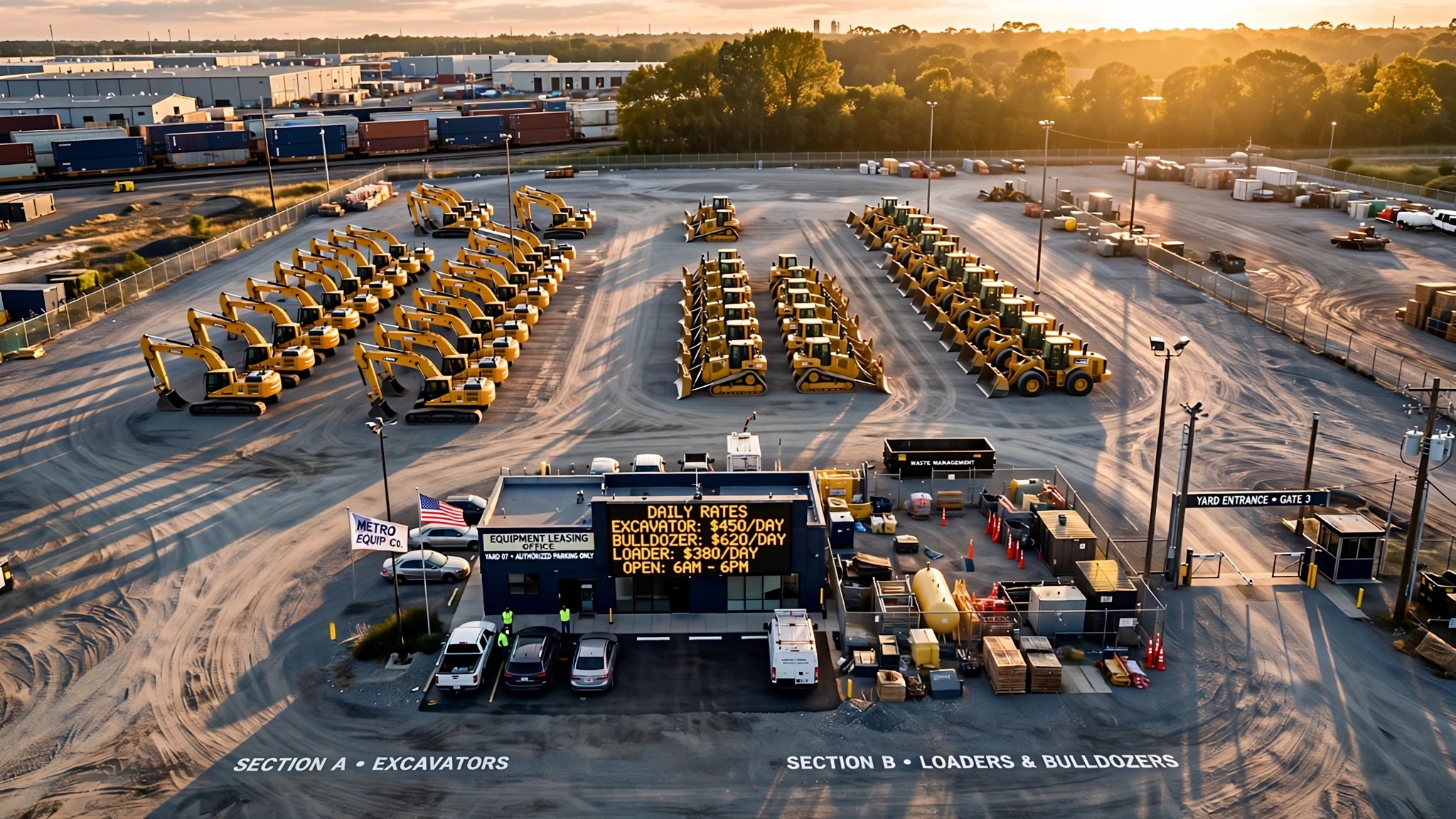
United Rentals uses zip-code-level pricing algorithms across 1,360 locations to extract maximum yield from a $15.5 billion fleet. Sunbelt Rentals runs 75% dollar utilization with dynamic rate optimization. Together they control roughly 30% of the $37 billion North American equipment rental market. The other 12,000+ independent operators, who collectively move the remaining $26 billion, price their excavators, skid steers, and boom lifts using last year's rate card, a phone call to a competitor's counter, and gut instinct. Nobody has built the STR or CoStar for equipment rental.
The Problem
The North American construction equipment rental market generated $36.8 billion in 2025 (Mordor Intelligence), growing at 4.15% CAGR toward $46.9 billion by 2031. Infrastructure Investment and Jobs Act funding is flowing into 56,000+ transportation projects, data center construction is accelerating exponentially, and a 439,000-worker labor shortage (AGC, 2024) is pushing contractors toward rental models that eliminate the burden of owning, maintaining, and staffing heavy equipment. Rental penetration in North America has climbed from roughly 50% in 2015 to an estimated 57% today, and every percentage point of penetration shift represents billions flowing into rental fleets rather than dealership sales floors.
But here is the structural asymmetry that creates the opportunity. United Rentals, with $15.5 billion in revenue, 16% market share, and 1,360 locations, has invested heavily in data-driven fleet management and pricing analytics that optimize rates at the zip-code level based on local utilization, competitor density, seasonal demand curves, and project pipeline data. Morningstar's analysis calls this a "cost advantage" rooted in scale, and the company's 10-year revenue CAGR of 10% — triple the industry average — validates the assessment. Sunbelt Rentals ($11.15 billion, fiscal 2026) runs at 75% dollar utilization across its fleet, a number that implies sophisticated rate-setting because utilization and pricing exist in direct tension: price too high and the machine sits idle, price too low and the machine is busy but unprofitable, and the optimal point requires granular market data that most operators simply do not have.
Independent operators, which number more than 12,000 companies across the U.S. and Canada according to the American Rental Association, lack this data infrastructure entirely. They price by photocopying a competitor's rate card, calling around for quotes, attending regional ARA chapter meetings where rate discussions happen informally over bad coffee, or defaulting to whatever they charged last season plus an inflation bump. The result is predictable: independents leave 8-15% of potential revenue on the table during demand spikes because they are slow to raise rates, and they lose utilization during soft periods because they are slow to cut them. No centralized, real-time rate benchmarking product exists for this segment of the market, which is remarkable given that the hotel industry solved this exact problem with STR decades ago and the commercial real estate industry solved it with CoStar.
Market Size
Original TAM calculation: 12,000+ independent equipment rental operators in North America, each managing fleets worth $2-50 million in original equipment cost. The addressable segment is operators with 50+ units, roughly 4,000 companies, where the revenue impact of rate optimization justifies a software subscription. At $299/month per location for basic rate benchmarking (comparable to STR's hotel pricing at $200-400/month per property), with an average of 1.8 locations per operator, the base TAM is $26 million in recurring revenue. A premium tier at $799/month adding predictive demand signals and automated rate recommendations expands the SAM to $69 million. The broader opportunity includes contractor-side rate benchmarking subscriptions (100,000+ general contractors wanting to verify they are paying fair rental rates), which could add $40 million in additional recurring revenue. Total SAM: $109 million. Realistic Year 3 target: 800 subscribers at blended $449/month = $4.3 million ARR.
The Product
A rate intelligence platform that aggregates rental transaction data from participating operators (anonymized, like STR for hotels) and combines it with public signals — building permit filings, infrastructure project databases, equipment auction results from Ritchie Bros. and IronPlanet, manufacturer production data, and weather patterns — to produce real-time rental rate benchmarks by equipment class, market, and rental duration. Core capabilities:
- Rate benchmarking dashboard: See how your daily, weekly, and monthly rates compare to the market median, 25th percentile, and 75th percentile for each equipment class in your geographic market, updated weekly as participating operators contribute anonymized transaction data through the platform
- Demand forecast signals: Building permit data, DOT project lettings, and utility capital plans aggregated by county to predict equipment demand 30-90 days out, enabling preemptive rate adjustments before a competitor's counter person notices the phones ringing more than usual
- Rate optimization recommendations: Machine-learning models trained on historical rate-vs-utilization curves that suggest specific rate changes by equipment class to maximize fleet-level revenue — not just rate, but the product of both. That product is what actually drives profitability
- Competitive intelligence: Automated mystery-shopping of competitor published rates, auction price tracking for replacement cost signals, and fleet age estimation from public filings and dealer intelligence to understand when competitors will need to raise rates to cover depreciation on newer iron
Unit Economics
| Metric | Value |
|---|---|
| Monthly subscription (Standard — benchmarking) | $299/location |
| Monthly subscription (Premium — optimization) | $799/location |
| Blended ARPU | $449/month |
| Data infrastructure cost per subscriber/month | $35 |
| Data acquisition cost per subscriber/month | $22 |
| Customer acquisition cost | $2,800 |
| Expected LTV (24-month avg retention, 85% gross margin) | $9,158 |
| LTV:CAC ratio | 3.3:1 |
| Gross margin | 87% |
| Startup cost (18-month runway) | $2.4M |
| Break-even | 18 months |
Methodology note: CAC is estimated from B2B SaaS benchmarks in construction technology ($2,000-4,000 per customer for SMB-focused products). Retention assumes 24 months average, which is conservative relative to STR's hotel benchmarking product (which has multi-year retention exceeding 90% because customers become dependent on the data). The LTV calculation uses the blended ARPU of $449 × 24 months × 85% gross margin = $9,158. At a $2,800 CAC, the payback period is 6.2 months — well within the rule-of-thumb threshold of 12 months for healthy SaaS economics, though the real risk is whether the data network reaches critical mass before the cash runs out.
Go-to-Market
Phase 1 (months 1-8): Recruit 200 independent operators in three dense metro markets — Dallas-Fort Worth, Houston, and Atlanta, which collectively represent the highest concentration of construction activity in the United States — to share anonymized transaction data in exchange for free access to rate benchmarks. This is the classic data-network bootstrap: the product is worthless with 5 participants and invaluable with 200, so the first 200 must be free. Target operators through ARA regional chapters, equipment dealer relationships, and direct sales at industry events like The ARA Show and CONEXPO-CON/AGG.
Phase 2 (months 9-14): Monetize the established data networks with the $299/month Standard tier. Expand to 8 additional markets. Begin developing the Premium tier with predictive demand modeling. Integrate building permit feeds from Dodge Construction Network and DOT project letting databases.
Phase 3 (months 15-24): Launch Premium tier at $799/month. Open the contractor-side product — rate verification for general contractors who want to confirm their rental vendors are charging fair market rates. This creates a two-sided network effect: more operators contributing data improves the benchmarks, which attracts more contractors, which validates the data, which attracts more operators.
Competitive Landscape
| Company | Approach | Rate Intelligence? | Pricing |
|---|---|---|---|
| EquipmentShare | Rental marketplace + fleet management SaaS | Internal only | Transaction-based |
| BigRentz | Asset-light rental brokerage | No — matches demand to supply | Commission |
| Point of Rental | Rental management ERP | No — tracks your rates, not the market's | $300-800/mo |
| Wynne Systems (RentalMan) | Legacy ERP for large fleets | No — operational, not analytical | Enterprise |
| This startup | Rate intelligence platform (STR model) | Core product — anonymized market-rate benchmarks | $299-799/mo |
The critical observation: EquipmentShare and BigRentz are marketplaces. Point of Rental and Wynne are ERPs. None of them are rate intelligence products. EquipmentShare has the most sophisticated internal pricing engine, but they use it to optimize their own fleet — they are a competitor to independent operators, not a vendor serving them. The opportunity sits in a gap that nobody occupies because building it requires solving the data chicken-and-egg problem, which marketplace companies have no incentive to solve for their competitors and ERP companies lack the data science capability to attempt.
Why Now
Three forces converging simultaneously. First, the IIJA created the largest infrastructure spending cycle since the Interstate Highway System, generating multi-year demand visibility that makes rate optimization newly worthwhile — there is no point optimizing rates in a bust cycle, but in a sustained boom the difference between the 25th percentile rate and the 75th percentile rate on a 40-ton excavator can exceed $800 per week, and over the course of a 3-year infrastructure build that compounds into hundreds of thousands of dollars in captured or forfeited revenue per machine. Second, consolidation is accelerating: Herc Holdings acquired H&E Equipment Services in 2025, United Rentals continues bolt-on acquisitions at a pace of 5-10 per year, and Sunbelt added numerous locations through greenfield and acquisition. Independent operators who cannot match the pricing sophistication of these consolidators will either get acquired at a discount or slowly lose share. Third, the same independent operators are already adopting telematics and fleet management software (GPS tracking, maintenance scheduling, utilization monitoring), which means they have digitized the operational data that rate intelligence needs as input; the software plumbing exists, it just lacks the analytical layer.
Original Contribution: The Rate Opacity Tax
A calculation nobody has published: United Rentals achieves 75% dollar utilization (trailing twelve months, fiscal Q4 2025 filing). The ARA's Cost of Doing Business survey reports that the median independent operator achieves 62-65% dollar utilization. If we attribute half that 10-13 percentage point gap to scale advantages (purchasing power, branch density, fleet diversity) and half to pricing sophistication (rate optimization, demand forecasting, dynamic pricing), the pricing-intelligence gap alone represents 5-6.5 percentage points of dollar utilization. Applied to the $26 billion in independent operator revenue: that is $1.3-1.7 billion in revenue that independent operators forfeit annually because they lack the rate intelligence infrastructure that the top two players built internally. We call this the "rate opacity tax" — and at $299-799/month, a SaaS product that captures even 5% of the gap pays for itself 40 times over for the average 200-unit independent fleet.
Limitations
This analysis rests on several assumptions that could be wrong. The 62-65% utilization figure for independents comes from ARA survey data, which is self-reported and skews toward operators engaged enough to participate — the true median for all 12,000+ operators could be lower, which would widen the gap, or higher among non-respondents who simply do not fill out surveys, which would narrow it. The attribution of half the utilization gap to pricing sophistication versus operational scale is an estimate, not a measured quantity; the real split could be 30/70 or 70/30. Furthermore, the STR analogy has limits: hotel rooms are fundamentally interchangeable within a quality tier (a king room is a king room), but a 2024 Cat 320 excavator and a 2019 Deere 350G are differentiated products whose rates reflect condition, attachment packages, and brand preference in ways that complicate benchmarking. The data chicken-and-egg problem is real and may prove fatal: STR took years to reach critical mass, and it had the advantage of a highly consolidated hotel ownership structure where a few REITs could seed the network; equipment rental is more fragmented, which means more sales calls per data point contributed.
Strongest Counterargument
The strongest case against this startup is that independent operators do not actually want rate transparency — they benefit from opacity. A veteran equipment rental operator in Dallas running 300 units knows exactly what to charge for a skid steer in July because he has been doing this for 30 years, and his rates reflect relationships, credit terms, bundled services, and local market knowledge that no algorithm captures. If rate benchmarking becomes widespread, it could compress margins industry-wide by giving contractors ammunition to negotiate rates down ("the benchmark says the 75th percentile for a 40-ton excavator in DFW is $2,800/week, so why are you charging me $3,200?"). The hotel industry experienced exactly this: STR data, while invaluable to operators, also empowered corporate travel managers and OTAs to demand rate parity and enforce pricing discipline that squeezed hotel margins for decades. Independent rental operators might rationally prefer the current system, where their local knowledge constitutes a competitive advantage, over a transparent system where that advantage is eroded and replaced by the kind of data-driven optimization that favors the large players who already have it.
The Bottom Line
The $37 billion North American equipment rental market is split between a few data-rich giants and thousands of data-poor independents. The gap is not about equipment quality or customer service — it is about pricing intelligence, and it costs independents an estimated $1.3-1.7 billion annually in foregone revenue. Building the STR of equipment rental means solving the cold-start data problem in a fragmented market, which is hard, but the structural tailwinds are strong: a multi-year infrastructure boom creates real incentive to optimize, accelerating consolidation creates existential urgency for independents, and the adoption of telematics means the raw data already flows through digital systems that can feed a benchmarking layer.
What You Can Do
If you are an independent equipment rental operator managing 50+ units: start tracking your own rate-versus-utilization curves by equipment class and month. Export your transaction data from Point of Rental, Wynne, or whatever ERP you run, and build a simple spreadsheet that shows your average daily rate and time utilization for each equipment class by week. You will likely discover that your best-utilized machines are underpriced and your least-utilized machines are overpriced — and that simply rebalancing rates across your fleet, without any external benchmarking data, can recover 3-5% of revenue. If you are a construction technology founder looking for a defensible B2B SaaS opportunity: the ARA's regional chapter network provides a ready-made distribution channel of operators who already attend quarterly meetings, already trust ARA as a neutral industry body, and already wish they had better market data. Partner with ARA, not against it.
Related
📰 Dynamic Pricing SaaS for Independent Self-Storage — the same playbook applied to another fragmented, asset-heavy industry