Non-Revenue Water Audit and Loss Reduction SaaS for Small Community Water Systems
Nearly one in five gallons of treated drinking water in the United States never reaches a customer. According to Bluefield Research, that leakage, theft, metering error, and administrative slippage costs utilities $6.4 billion in unrealized revenue every year. The industry-standard tool for measuring the problem is a free Excel spreadsheet published by the American Water Works Association. The 45,000 small community water systems that serve 24 million Americans and lose water at the highest rates have no modern software platform that fits their budgets, their staffing, or the state audit mandates now bearing down on them.
The Problem
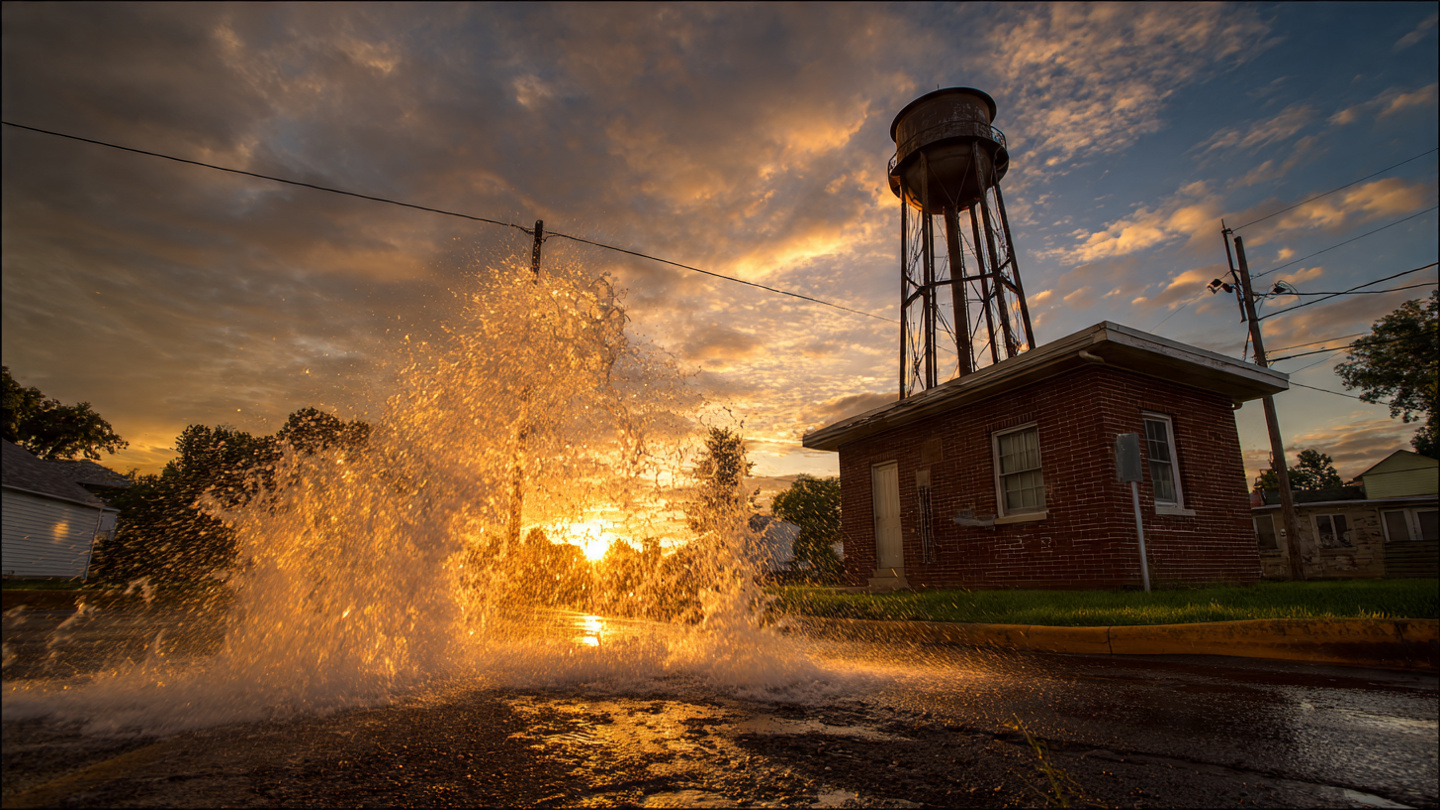
The United States distributes drinking water through 2.2 million miles of underground pipe, a network vast enough to wrap around the Earth 88 times, and much of that pipe was installed when Eisenhower was president. The American Society of Civil Engineers gave drinking water infrastructure a C- on its 2025 Infrastructure Report Card. Somewhere in the country, a water main breaks every two minutes. That's 240,000 breaks per year.
The water that escapes those pipes (or vanishes through metering errors, data-entry mistakes, unauthorized connections, and unbilled municipal uses like fire hydrant flushing) carries an industry name: non-revenue water. A 2025 report from Bluefield Research put the US NRW rate at 19.5%, meaning that for every five gallons of treated water a utility pumps into its distribution system, one gallon is treated, chlorinated, pushed through miles of distribution main, and lost into the soil before anyone opens a faucet. Nationally, that adds up to 2.7 trillion gallons per year, costing utilities $6.4 billion in revenue they produced but never collected.
Real losses, meaning actual physical leaks and breaks, account for 87% of that total. The remaining 13% is apparent loss: meters that undercount because they're aging or improperly sized, billing databases with ghost accounts, and unauthorized consumption nobody has bothered to investigate, all of which bleed revenue through mechanisms completely different from a cracked pipe, demanding completely different interventions that most small utilities can't even begin to distinguish, let alone quantify.
The US has approximately 49,400 community water systems, according to EPA's Safe Drinking Water Information System, and 92% of them are classified as small. The very smallest category, systems serving 500 or fewer residents, accounts for 26,682 of them, more than half the national total, each typically run by a part-time operator or village clerk who also handles roads, parks, and code enforcement. Together, small and very small systems serving 3,300 or fewer people represent 82% of all community water systems and deliver treated water to 24.4 million Americans who depend on infrastructure that rarely makes the news until something breaks catastrophically enough to interrupt service.
These systems face a structural disadvantage that no amount of dedication from a two-person staff can overcome. A typical small water utility has one to three full-time employees who handle treatment, distribution, meter reading, billing, maintenance, and regulatory compliance all at once, often with a budget under $1 million, equipment older than most of the staff, and no data analyst, no GIS department, and no IT team to call when the billing system crashes during an audit. When the state asks them to submit a water loss audit, they open AWWA's Free Water Audit Software, a Microsoft Excel workbook with locked cells, manual data-entry fields, and precisely zero integrations with any other system on Earth, and spend two full days pulling numbers from paper logs, trying to reconcile production meters with billing records that live in a completely separate piece of software nobody remembers purchasing.
The Gap in the Market
Water loss management software exists. But the market splits into three tiers, and none of them serves the small community water system well.
| Company | What They Do | What's Missing |
|---|---|---|
| AWWA Free Water Audit Software (FWAS) | Free Excel-based water balance tool and the de facto industry standard, used by state regulators as the official submission format. Version 6.1 was released in 2025. | It is fundamentally a spreadsheet with no integration with billing systems, SCADA, or meter data, no multi-year trending capability, no automated data validation, and no alerts when loss rates spike, which means every audit is a manual, multi-day exercise that begins with the operator hunting for the right numbers in three different systems. |
| Siemens SIWA / Xylem / Itron | Enterprise-grade leak detection, AMI analytics, and hydraulic modeling platforms used by large municipal utilities with 100,000 or more connections. | Priced and scoped for large utilities, with implementations that take months and require dedicated IT staff that small systems simply don't have. A system serving 800 connections with two employees and a $1.2M annual budget cannot deploy Siemens SIWA any more than it can deploy SAP. |
| Autodesk Info360 | Cloud-based water analytics including water loss, pressure management, and demand analysis, targeting mid-to-large utilities and the consultants who serve them. | Subscription pricing starts in the thousands per year, and while the platform is powerful, it is designed for utilities with engineering staff who can configure analytics, not self-serve for a rural operator who needs to file a compliant audit by August 1. |
| Engineering consultants | Firms like Tata & Howard, Hazen and Sawyer, and regional engineering firms perform water loss audits as billable consulting engagements. | Typical cost: $5,000-15,000 per audit for a small system. The audit is a point-in-time snapshot, not continuous monitoring. The consultant leaves, and the utility is back to spreadsheets until next year's audit deadline. |
The pattern is familiar from other compliance-heavy industries: the free government tool is manual and disconnected, the enterprise platforms are overbuilt and overpriced for anyone without a six-figure IT budget, the consultants are expensive and episodic, and the 45,000 small operators caught in the middle, the ones actually losing the most water, get nothing purpose-built for the way they actually work.
The Solution
A cloud-based water loss audit and reduction platform built specifically for community water systems with 500-10,000 service connections:
1. Automated AWWA water balance ($79/month base tier): The platform connects directly to the utility's billing system (most small systems use one of about six vendors: Tyler Technologies/Incode, Harris Northstar, US Water Services Corporation, SilverBlaze, Cayenta, or municipal-specific billing packages) and to their production meter/SCADA data. It pulls billed consumption, production volumes, and operational data automatically, then computes the AWWA-standard water balance without anyone touching a spreadsheet. The output is an AWWA FWAS v6.1-compliant audit, ready for state submission.
2. Data validation and grading ($79/month, included in base): AWWA's M36 methodology assigns data grades (1-10) to each input, and those grades determine how much trust to place in the results. The Texas Water Development Board found that a substantial portion of audit submissions contain suspect data producing technically impossible water loss scenarios. The platform auto-grades inputs based on source reliability (manual read vs. SCADA vs. AMI), flags anomalies (production less than consumption, negative apparent losses, Infrastructure Leakage Index below 1.0), and walks the operator through corrections. Georgia, Indiana, California, and now Texas require Level 1 validated audits. This platform makes validation achievable without hiring a certified third-party validator at $2,000-5,000 per engagement.
3. Continuous loss monitoring ($49/month add-on): For systems with SCADA or AMI infrastructure, the platform ingests production and distribution data daily rather than annually. Monthly trend dashboards show whether the NRW rate is improving or deteriorating, which distribution zones are losing the most water, and whether a recent main break repair actually reduced losses. A sudden spike in minimum nighttime flow (the standard proxy for real losses in distribution) triggers a push notification to the operator's phone. This transforms water loss from an annual compliance exercise into an operational management tool.
4. State regulatory submission ($29/month add-on): A growing number of states mandate water loss audit submission. Indiana requires every metered community water system to submit an annual audit, with validated audits due biennially to the Indiana Finance Authority. Texas now requires validation for utilities receiving state financial assistance. California and Georgia have their own programs. The platform generates the exact file format each state requires, tracks submission deadlines, and provides an audit trail for regulators. For the operator, "submit your water loss audit" becomes a one-click action instead of a two-day ordeal.
5. Loss reduction planning and ROI modeling ($49/month add-on): Once the audit quantifies the loss, the platform models interventions: What's the payback period on replacing 2,000 feet of cast-iron main? How much revenue would the utility recover by testing and replacing its oldest 10% of meters? If the state revolving fund offers a 1.5% loan for pipe replacement, what's the net present value? These calculations exist in engineering textbooks, but no small utility operator has time to build the models. The platform does it automatically using the utility's own loss data, local construction costs, and current SRF financing terms.
The Math: What a 5% NRW Reduction Saves a Small Utility
Take a typical small community water system in rural Indiana. The system serves 2,400 connections, produces 180 million gallons per year, and sells water at $6.50 per thousand gallons. Its current NRW rate is 28%, in line with the average for small systems.
Current loss: 180M gallons × 28% = 50.4 million gallons lost per year. At $6.50 per thousand gallons, that's $327,600 in unrealized annual revenue, money the utility spent to produce water that generated exactly zero dollars of income.
Scenario: Reduce NRW from 28% to 23%: five percentage points, achievable through meter replacement, one targeted leak repair campaign, and accurate billing data cleanup.
Recovered volume: 180M × 5% = 9 million gallons per year. Revenue recovered: 9,000 × $6.50 = $58,500/year. Plus reduced treatment and pumping costs on 9 million gallons the utility no longer needs to produce: at a national average of $2.50/thousand gallons for treatment and distribution, that's an additional $22,500/year in operational savings.
Total annual benefit of a 5-point NRW reduction: $81,000. The platform costs $2,472/year at full add-on adoption, yielding a 33:1 benefit-to-cost ratio, which means the platform could be wrong about 97% of its recommendations and still break even on subscription fees alone.
But the bigger number is the one the utility doesn't see until they run the audit: the cumulative infrastructure gap that turns nickel-and-dime leaks into a slow financial catastrophe nobody can quite put a figure on until the data is assembled in one place. If this system's real losses are running at 22% (with apparent losses at 6%), the minimum nighttime flow analysis might reveal that 60% of real losses come from a single 1.2-mile segment of 1940s cast-iron main that's been patched nine times, the one that wakes the operator at 2 AM every February when the ground shifts. Replacing that segment ($180/linear foot × 6,336 feet = $1.14M) would drop real losses by 13 percentage points and recover $170,000/year in revenue and operational savings, and at a 1.75% State Revolving Fund loan rate over 20 years, the annual debt service of $67,400 is less than half the annual recovery, and the project literally pays for itself while eliminating the $35,000-50,000 per year the utility currently spends on emergency repair callouts involving overtime, materials, and road restoration.
No small utility operator runs this analysis today. They know the old main leaks. They don't know the annual cost of not replacing it, or that the SRF math makes replacement a revenue-positive investment that improves their bond rating while it improves their service. The platform makes that case with their data, their rates, and their loss profile.
Revenue Model
| Revenue Stream | Amount | Notes |
|---|---|---|
| Base tier (automated audit + validation) | $79/month | Core product. Connects to billing/SCADA, produces AWWA-compliant audit. Minimum viable subscription. |
| Continuous monitoring add-on | $49/month | Daily loss tracking, nighttime flow analysis, anomaly alerts. Requires SCADA or AMI data feed. |
| State regulatory submission add-on | $29/month | Auto-format for state-specific requirements, deadline tracking, submission audit trail. |
| Loss reduction planning add-on | $49/month | Intervention modeling, SRF financing scenarios, capital improvement prioritization. |
| Validation services (annual) | $500-1,500/audit | Level 1 validated audit service for states that require third-party validation. Blended human + automated review. Far below the $5,000-15,000 consulting alternative. |
| SRF application support (per project) | $2,500-5,000 | Guided preparation of state revolving fund applications with loss data, project justification, and environmental compliance documentation. Phase 2 product. |
Unit economics on a typical customer: Average monthly subscription at full add-on adoption: $206/month ($2,472/year). At base-only: $79/month ($948/year). Blended average assuming 60% base-only, 40% full stack: $1,558/year. Gross margin on SaaS: 85%. Customer acquisition cost via state association partnerships, AWWA conference presence, and SRF program referrals: $800. Estimated churn: 8% annually (regulatory mandates create sticky retention). LTV at 10-year average lifespan (water utilities don't switch software often): $15,580. LTV:CAC ratio: 19.5x.
Market Size
TAM: All 49,400 community water systems in the US. At a blended $1,558/year average subscription: $77M/year recurring. Adding validation services, SRF application support, and consulting revenue: ~$120M total addressable.
SAM: The 44,900 small and medium systems (≤10,000 connections) that lack enterprise analytics. Excluding the ~8,000 very small systems (≤100 connections) that may lack the budget or infrastructure for any SaaS tool, the serviceable market is approximately 37,000 systems. At blended $1,558/year: $57.6M/year.
SOM (year 3): 1,200 systems across 8-10 states with active water loss audit mandates (Indiana, Texas, California, Georgia, and expansion targets). At blended $1,558/year: $1.87M ARR, plus ~$400K in annual validation service revenue. 3.2% penetration of SAM.
Why Now
The $55 billion infrastructure investment creates both demand and funding. The Bipartisan Infrastructure Law allocated $55 billion for water infrastructure, including $23.4 billion through the Drinking Water and Clean Water State Revolving Funds, the largest federal water investment since the 1972 Clean Water Act. To access that money, utilities increasingly must demonstrate they've quantified their water loss and have a plan to reduce it. Texas now requires validated water loss audits as a precondition for state financial assistance. Other states are following the same pattern: the SRF money is the carrot, water loss documentation is the gate, and utilities that can't produce a compliant audit simply cannot access the funding their infrastructure desperately needs.
State mandates are expanding faster than utility capacity to comply. Georgia has required water loss audits since 2010. Indiana mandates annual audits from every metered community water system, with Level 1 validated audits due biennially to the Indiana Finance Authority. California's requirements cover large systems and keep expanding. Texas added validation requirements effective January 2025. Utah passed legislation to study statewide water loss accounting implementation. Each new mandate creates thousands of customers overnight, utilities that suddenly need a tool more capable than an Excel spreadsheet and more affordable than a $10,000 consulting engagement, and need it before a deadline that's already on the calendar.
AWWA's own tool hasn't kept pace. The Free Water Audit Software v6.0 was released in 2020. The v6.1 update in 2025 added carbon emission calculations but changed nothing about how data gets into the spreadsheet: manually, cell by cell, from numbers the operator hunted down in three disconnected systems. No cloud storage. No integrations. No multi-year trending. No automated validation. AWWA has deliberately kept it free and simple to maximize adoption, the right call for a standards body whose job is setting the floor, not building the ceiling. That leaves an enormous gap for a commercial platform that automates everything the spreadsheet requires a human to do by hand.
AMI and SCADA adoption among small utilities is finally reaching critical mass. Advanced metering infrastructure penetration in US water utilities crossed 40% in 2024, nearly double the 22% rate in 2019, driven partly by BIL funding for meter replacement programs across all 50 states. Even basic SCADA systems are now common in small utilities that had nothing five years ago. This creates, for the first time, the persistent data layer that continuous water loss monitoring requires, the raw material that makes a SaaS platform fundamentally more valuable than a once-a-year spreadsheet exercise.
Startup Costs
| Category | Cost | Notes |
|---|---|---|
| Platform development (12 months, 4-person engineering team) | $520K | Core water balance engine, billing system integrations (6 major vendors), SCADA data ingestion, state-specific export formats, web dashboard, mobile alerts. Backend: Python/Django. Frontend: React. |
| Billing system API integrations | $60K | Tyler/Incode, Harris Northstar, and 4 other common small-utility billing platforms. Most use flat-file exports or ODBC connections rather than REST APIs; integration is bespoke per vendor. |
| Pilot program (20 utilities across 4 states) | $40K | Free subscriptions for pilot utilities in exchange for feedback, case studies, and state association introductions. Travel for on-site setup at 10 utilities that need hands-on help. |
| AWWA and state conference presence (year 1) | $35K | AWWA ACE, state-level AWWA section conferences (Indiana, Texas, California, Georgia). Booth, travel, demo materials. |
| Regulatory and compliance consulting | $30K | Retaining water loss control specialists to validate the platform's calculations against AWWA M36 methodology. Ensuring outputs are defensible when regulators review submitted audits. |
| Security and compliance (SOC 2 Type I) | $25K | Government-adjacent customers require demonstrable data security. SOC 2 is the minimum credible standard for a SaaS platform handling utility operational data. |
| Operating buffer (12 months) | $40K | Cloud hosting (AWS GovCloud for government customers), customer support staffing, insurance. |
| Total | $750K |
Limitations
The 19.5% national NRW rate cited by Bluefield Research is a top-down estimate derived from utility survey data and AWWA audit submissions. Individual utility NRW rates vary enormously, from under 8% for well-maintained systems with recent AMI deployments to over 50% for systems with aging infrastructure and no loss control program. The "average small utility loses more water" claim is directionally supported by AWWA research and state audit data, but there is no comprehensive national dataset comparing NRW rates by utility size. Some small systems in excellent condition may lose less water than some large systems in poor condition.
The $6.50/thousand-gallon rate used in the unit economics example is at the higher end for small rural systems. The national average water rate is closer to $4.50/thousand gallons, which would reduce the revenue recovery calculation proportionally. However, small rural systems often have higher rates than urban systems because they lack economies of scale, meaning the example rate, while high nationally, may be representative for the target customer segment.
The billing system integration strategy assumes that six vendors cover the majority of the small utility market. In practice, small water systems use hundreds of different billing approaches, including in-house Access databases, QuickBooks with custom invoicing, and in some cases, manual paper ledgers. The long tail of billing system fragmentation is a significant engineering and support cost that could exceed the estimate.
AMI penetration data at 40% includes large utilities that adopted early. The rate among small systems (≤3,300 connections) is likely below 25%, meaning the continuous monitoring add-on may not be viable for the majority of target customers at launch. The base product (automated annual audit) must work for utilities with manual meter reads to achieve market penetration.
Strongest Counterargument
Small utility operators don't buy SaaS. The 26,682 very small community water systems serving 500 or fewer people are often run by part-time operators or village clerks who manage water alongside roads, parks, and code enforcement. Their annual operating budgets may be $200,000-$500,000 total. A $79/month software subscription competes with actual pipe repair materials. Many of these operators are over 55, resistant to new technology, and accustomed to doing things the way they've always been done. The water industry is legendarily slow to adopt new tools. AWWA's Free Water Audit Software has been available since the mid-2000s, and as of 2024, only 68% of surveyed utilities have a water loss control program of any kind, down from 77% in 2020.
The counter to the counterargument is that compliance isn't optional anymore. State mandates eliminate the "we've always done it this way" defense. When Indiana tells every metered community water system to submit a validated audit by August 1, the operator's only question is how. The Excel spreadsheet is free but consumes 20-40 hours of staff time per audit cycle, and at a loaded labor cost of $35/hour for a small-utility operator, that's $700-1,400 in implicit cost per audit, more than the annual subscription that reduces the same exercise to four hours of data verification. The $948/year base tier doesn't need to be marketed as innovation; it needs to be marketed as the cheapest way to meet a deadline the state already set. And the state associations representing small utilities (Rural Water associations operate in every state, with 30,000+ member systems nationally) are the distribution channel, not the direct sale. The pitch doesn't go to the overwhelmed village clerk who answers the phone between meter reads and boil-water notices. It goes through the state Rural Water circuit rider who visits 50 systems per year and recommends tools that make regulatory compliance something a two-person shop can actually survive.
What You Can Do
If you operate a small water system: Start with the AWWA Free Water Audit Software v6.1. It's free, it's the standard, and completing even a rough audit will tell you whether your NRW rate is 12% (manageable) or 35% (bleeding money). If your state mandates annual audits, check whether the state Rural Water association offers training sessions on the FWAS. Most do, and they're free. When you run the numbers, pay attention to your Infrastructure Leakage Index (ILI): an ILI above 3.0 suggests significant real losses worth investigating with acoustic leak detection, even if the equipment rental is $500/day. One found leak on a 6-inch main can eliminate 100,000 gallons/day of loss.
If you're building this: Start in Indiana or Texas, where every relevant utility is now required to submit audits. Indiana's program is mature and covers all metered community water systems. Texas has large absolute numbers and recent mandate expansion. Partner with the state Rural Water association from day one: their circuit riders are trusted advisors who visit small systems monthly. Integrate with Tyler Technologies/Incode first (dominant small-utility billing vendor) and with SCADA platforms second. The first product should make the annual AWWA audit effortless. Continuous monitoring is the upsell after trust is established.
If you're evaluating water infrastructure investments: The Bipartisan Infrastructure Law's $55 billion for water has created a five-year window of unprecedented spending on water system upgrades. But the money flows through State Revolving Funds that increasingly require water loss documentation. The compliance tooling market is a picks-and-shovels play on federal infrastructure spending: regardless of which pipes get replaced or which meters get upgraded, every utility touching SRF money will need to demonstrate it has measured and is managing its water loss. The compliance mandate is the wedge. The operational value (finding and fixing losses that pay for themselves) is the retention mechanism.
The Bottom Line
The United States produces roughly 39 billion gallons of treated drinking water every day and loses 7.6 billion of those gallons before anyone drinks, cooks, or bathes in them: water that was drawn from aquifers and reservoirs, filtered through treatment plants at significant energy and chemical cost, tested against federal standards, chlorinated, fluoridated, and pumped through miles of distribution main by utilities that will never see a cent of revenue for any of it. In a country where water scarcity is no longer confined to Phoenix and Las Vegas but is now reshaping infrastructure planning in Atlanta, Indianapolis, and the Chesapeake Bay watershed, losing one-fifth of every gallon produced represents a failure with consequences that extend well beyond utility balance sheets into public health, environmental sustainability, and the long-term viability of communities that can't afford to waste the water they're already struggling to fund. The 45,000 small systems responsible for delivering water to small towns, rural communities, mobile home parks, and suburban subdivisions across every state don't need a six-figure enterprise platform to start solving the problem — they need a $79/month tool that does the math, files the paperwork their state now requires, and tells them which pipe to fix first, and nobody has built it yet.