Pet Cremation Chain-of-Custody Verification SaaS
Americans spent $158 billion on their pets in 2025. Roughly six million of those pets died and were cremated, generating over $800 million in cremation fees. In April 2025, Pennsylvania's Attorney General charged a Pittsburgh funeral home owner with defrauding more than 6,500 families who paid for private cremations but received the ashes of unknown animals while their pets were dumped in a landfill. In Baltimore County, a crematory operator received a 20-year prison sentence after forensic analysis proved the "ashes" returned to grieving families contained no animal bone at all, just building materials and dirt. The pet cremation industry processes millions of beloved family members every year with approximately the same chain-of-custody rigor as a pizza delivery. Nobody checks.
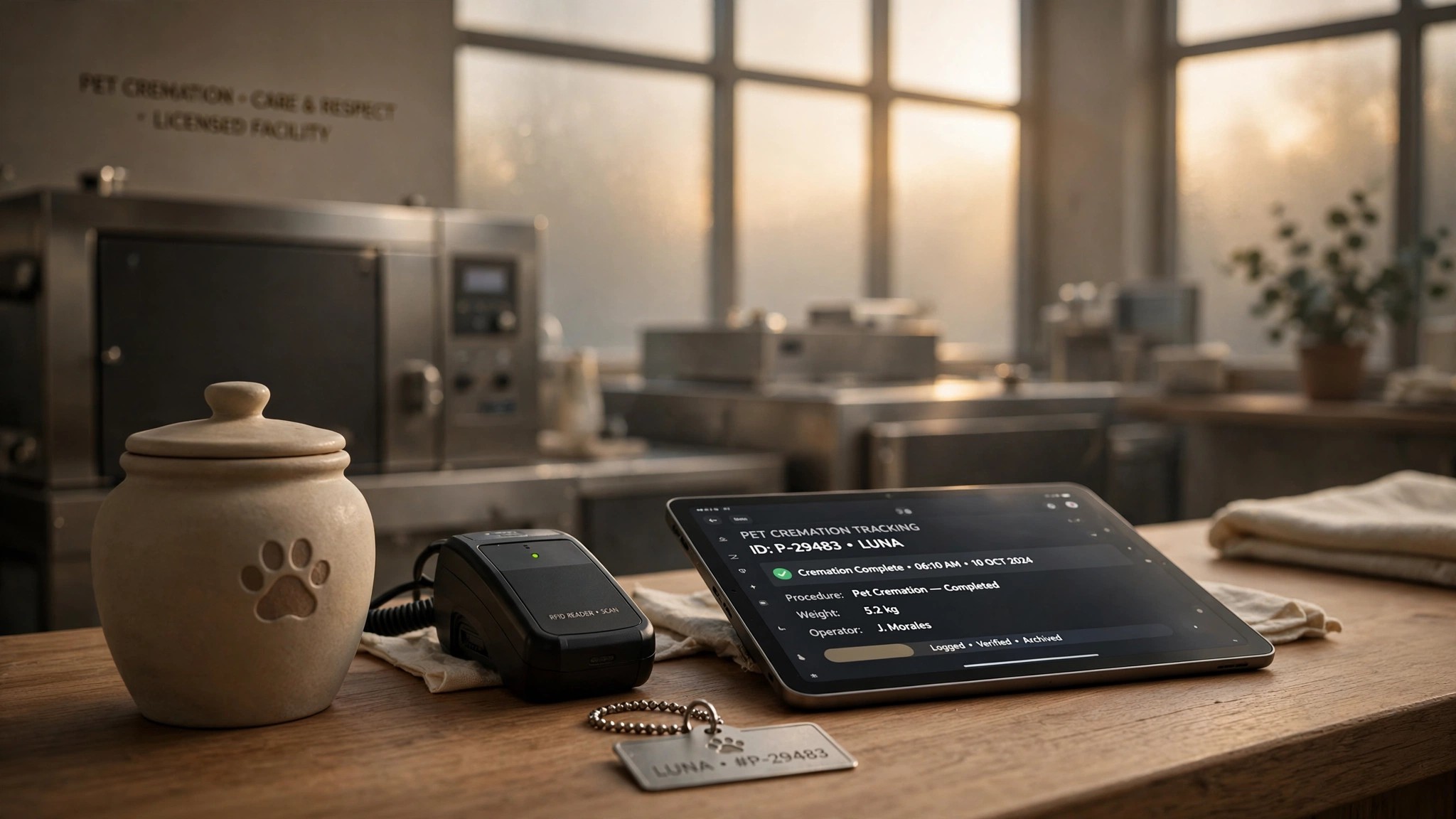
The Problem
Pet cremation fraud follows a pattern so consistent it reads like a template. Operator contracts with dozens of veterinary clinics, and those clinics send deceased animals, trusting the operator to perform private cremations and return individual ashes. Operator runs communal cremations, or no cremation at all, pockets the $150-$450 private cremation fee, returns generic ash material in a nice box, and nobody finds out for years because who DNA-tests their dead dog's ashes? Exactly.
The fraud cases that do surface are staggering in scale, and the ones we know about likely represent a fraction of total incidents. Patrick Vereb of Pittsburgh collected over $657,000 from pet owners between 2021 and 2024. Three years. According to the Pennsylvania Attorney General's criminal complaint. More than 6,500 victims across four counties. Six thousand families. Nearly a dozen veterinary practices unwittingly sent their clients' pets to a man who threw them in a landfill. In Baltimore County, a forensic anthropologist from Loyola University Maryland analyzed purported ashes using elemental analysis and alternate light sources, concluding they contained "no fragments of animal bone": just mixtures of building materials and substrate. Detectives found 38 pets decomposing in the back of a hearse on the property. The operator got 20 years in prison.
In Colorado, two veterinarians sued Precious Memories Pet Cemetery & Crematory in Larimer County District Court, alleging the company performed individual cremations when private was requested and paid for, buried animals in mass graves instead of performing communal cremations, and dumped remains in landfills. In California, the Levy v. Only Cremations for Pets case reached the Court of Appeal after a pet owner noticed her smaller dog's ashes weighed more than her larger dog's, which is physically impossible if both were individually cremated (cremated remains weigh approximately 3% of the living animal's weight).
These are the cases that got caught. Most don't. The detection mechanism in every single one was either a whistleblower, a suspicious weight discrepancy noticed by a grieving owner, or a tip to law enforcement. Not a single case was caught by a systematic verification process, because none exists.
Why Pet Cremation Is Uniquely Vulnerable to Fraud
The structural conditions are almost perfectly designed to enable deception. The customer hands over their deceased pet at the worst emotional moment of the relationship. They are grieving, they want the process to be over, and they are absolutely not thinking about quality assurance protocols. The "product" they receive back, a sealed container of ash, is visually indistinguishable whether it came from their specific animal, a different animal, a group of animals, or (in the Baltimore case) a bag of construction dust. Nobody checks. Verification would require forensic analysis costing more than the cremation itself, and no grieving family is going to send ashes to a lab.
The supply chain is opaque by design, and most pet owners never interact with the crematory directly. They hand the body to their veterinarian, who hands it to a pickup driver, who delivers it to a facility the pet owner has never visited. The vet trusts the crematory, the owner trusts the vet, nobody verifies the middle, and the result is a trust chain with no anchors. Until someone weighs the ashes.
Regulation is thin and wildly inconsistent across states: New York requires pet crematory licensing through the Department of State at $150 initial with two-year renewal, Iowa passed Chapter 566B establishing licensing with inspection authority and penalties for fraud, but the majority of states have nothing on the books. Florida's statutes require a written certification accompanying returned ashes, with fines of $1,001-$2,500 for false certification. Arizona mandates that crematories scan every dog and cat for microchips and attempt to contact the owner before cremation. The ASPCA doesn't oversee cremation, the FTC's Funeral Rule covers human remains but not animal remains, and there is no federal standard for pet aftercare operations anywhere in the country.
The Gap in the Market
| Company | What They Do | What's Missing |
|---|---|---|
| Gateway Services (Paws e-Track) | The closest thing to an industry standard. Gateway operates pet aftercare services in the US and Canada, and offers Paws e-Track, a software system for veterinary clinics to place cremation orders electronically. Clinics can select service type, track order status, and receive notifications when ashes are ready for pickup. | Paws e-Track is an ordering system, not a verification system. It tracks whether an order was placed and whether ashes were returned. It does not verify that a private cremation actually occurred privately, does not record chamber-level evidence (temperature logs, weight-in/weight-out, photos), and is available only to clinics that contract with Gateway's own aftercare service. It is a walled garden that serves Gateway's business model and locks clinics into Gateway's own aftercare network, not an independent verification platform that any crematory operator can adopt and any veterinary clinic can demand regardless of which cremation provider they use. |
| CodaPet | Online marketplace connecting pet owners with in-home euthanasia providers and cremation services. Handles scheduling, pricing transparency, and service coordination. Processes both communal and private cremations through partner crematories. | CodaPet is a marketplace and scheduling layer that solves discovery and booking but provides no chain-of-custody verification after the pet leaves the owner's home. The cremation itself is performed by partner facilities with whatever tracking they already use, which is typically paper-based. |
| Faithful Companion / Pet Angel World Services / Caring Pathways | Regional and national pet cremation service providers. Faithful Companion uses a proprietary "Faithful ID System" with numbered tags. Some facilities allow owners to witness the cremation process for an additional $50-$450 fee. | Tag-based tracking is better than nothing. Barely. A tag proves a number was assigned, not that a specific animal was cremated alone. Witnessed cremation is the gold standard but is offered to maybe 2% of customers (most people cannot bear to watch) and scales poorly. No provider offers an independent, technology-verified chain of custody that covers the full journey from intake to ash return. |
| CANA / ICCFA (industry associations) | The Cremation Association of North America and the International Cemetery, Cremation, and Funeral Association publish best-practice guidelines and offer voluntary certification programs for human cremation. CANA's certification requires documented identification procedures and process controls. | These programs cover human cremation exclusively, with pet cremation excluded from their scope entirely. No equivalent industry association certification exists for pet crematories, which means the roughly 2,500-4,000 pet cremation operators in the United States operate under whatever local regulations happen to apply in their jurisdiction, with no national standard for identification procedures, process controls, or chain-of-custody documentation that a consumer or veterinary partner could use to distinguish a trustworthy operator from the next Vereb. |
The Solution
A vertical SaaS platform that creates an independently verifiable chain of custody for every pet cremation, from intake to ash return, using a combination of RFID tracking, IoT sensor data, and automated documentation.
1. RFID-tagged intake and identification ($39/crematory/month base): When a deceased pet arrives at the crematory, whether from a veterinary clinic, a pickup route, or a walk-in family, the intake process generates a unique RFID tag attached to a heat-resistant ceramic band placed on the animal. The tag links to a digital record containing: species, breed, weight, microchip number (if present), referring clinic, owner contact information, service type requested, and a timestamped intake photo. Ceramic RFID tags rated to 1,200°C survive the cremation process (pet cremation chambers operate at 760-870°C), so the tag travels with the animal from intake through cremation to ash packaging. Passive UHF RFID tags cost $0.08-$0.15 each in volume. Ceramic-encapsulated high-temperature tags cost $2-4 each.
2. Chamber-level cremation verification ($79/chamber/month): IoT sensors mounted on each cremation chamber record: chamber temperature curve (time-series data proving a full cremation cycle occurred), chamber door open/close events with timestamps, weight of material placed in chamber vs. weight of ash recovered (cremated remains should be approximately 3-3.5% of the animal's body weight, and any deviation beyond ±15% flags for review), and an RFID scan confirming which tagged animal entered which chamber and when. For private cremations specifically, the system verifies that only one RFID tag was detected in the chamber during the entire burn cycle, which means a crematory operator cannot claim to have performed a private cremation for your German Shepherd while simultaneously running three other animals through the same chamber. This is the core technical differentiator: proof of single-occupancy cremation backed by sensor data, not a paper form signed by the operator. That distinction matters.
3. Veterinary clinic portal ($29/clinic/month): The referring veterinarian, the person whose reputation is on the line when they recommend a crematory to a devastated pet owner, gets a dashboard showing real-time status of every animal they've referred. Intake confirmed, cremation started, cremation complete, ashes packaged, ready for pickup or delivery. Each status change includes sensor-backed verification data. The vet can share a tracking link with the pet owner. Think FedEx tracking for cremation, except the "package" is someone's golden retriever and the emotional stakes make reliable tracking worth paying for.
4. Owner-facing verification certificate ($4/cremation transaction fee): Every completed cremation generates a verification certificate with: RFID tag number, intake photo, weight-in and ash weight (with expected range), chamber temperature curve summary, single-occupancy verification (for private cremations), timestamps for every custody transfer, and a QR code linking to the full digital record. This certificate is the product the owner receives. Not a piece of paper saying "we promise we did it right." A document backed by sensor data proving the process occurred as described. The difference between these two things is the entire value proposition.
5. Compliance and audit module ($149/crematory/month): For crematories operating in states with licensing requirements (NY, IA, FL, AZ, and the list is growing), the platform auto-generates compliance reports, maintains audit-ready records, and tracks regulatory deadlines. For crematories in unregulated states, the module generates voluntary compliance documentation that serves as a competitive differentiator: "We're verified. The place down the road isn't. Your call."
The Math: What a Fraud Case Costs
Consider a mid-size veterinary clinic in suburban Pennsylvania that refers 15 pet cremations per month (roughly one every two business days) to a local crematory. Average private cremation fee: $275. The clinic adds a $50 coordination markup, so the owner pays $325 and the clinic remits $275 to the crematory.
The Vereb case ran for approximately three years before detection. A clinic referring 15 cremations/month over 36 months sends 540 animals to the crematory. At $275 each, the clinic channeled $148,500 in cremation fees to a fraudulent operator. When the Attorney General's investigation became public, every one of those 540 families had reason to believe their pet's ashes were not real. The clinic's Google reviews cratered. Several pet owners filed complaints against the clinic itself, even though the clinic was also a victim.
The clinic's reputational damage is unquantifiable but real. Veterinary practices depend on trust more than almost any other local service business. A vet who unknowingly partnered with a cremation fraudster loses clients who can never be won back, because the betrayal occurred at the moment of maximum vulnerability.
Platform cost for that clinic: $29/month × 36 months = $1,044. Transaction fees on 540 cremations: $2,160. Total: $3,204 over three years to have caught the fraud in month one instead of month 36. The ROI calculation isn't revenue-based. It's reputation insurance, and reputation is the one asset a veterinary practice cannot rebuild once it's lost.
Revenue Model
| Revenue Stream | Amount | Notes |
|---|---|---|
| Crematory base subscription | $39/month | RFID intake system, digital record management, owner certificate generation. Per-facility pricing. |
| Chamber monitoring (per chamber) | $79/month | IoT sensors, temperature logging, weight verification, single-occupancy detection. The average independent crematory operates 1-3 chambers. |
| Veterinary clinic portal | $29/month | Real-time tracking dashboard, owner-shareable status links, referral analytics. Per-clinic pricing. |
| Compliance module | $149/month | Regulatory reporting, audit trail, license deadline tracking. Per-crematory add-on. |
| Transaction fee | $4/cremation | Covers verification certificate generation and owner-facing digital record hosting. |
| RFID tags (consumable) | $3.50/tag | Ceramic-encapsulated high-temp RFID tags. Cost to produce: ~$2.20 at volume. Sold in packs of 100. |
| Hardware kit (one-time) | $1,200 | RFID reader, 2 temperature sensors, scale integration module, mounting hardware. Per-chamber installation. |
Unit economics on a 2-chamber crematory processing 200 cremations/month, partnered with 8 vet clinics: Monthly SaaS: $39 (base) + 2 × $79 (chambers) + $149 (compliance) = $346. Clinic portal revenue adds 8 × $29 = $232, transaction fees contribute 200 × $4 = $800, and tag sales of 200 × $3.50 = $700 (with $260 margin) bring total monthly revenue per crematory ecosystem to $2,078. Annual recurring revenue per crematory ecosystem: $24,936, with hardware adding a one-time $600 margin contribution.
Market Size
TAM: The 2025 AVMA Pet Ownership and Demographics Sourcebook counts 87.3 million dogs and 76.3 million cats in the United States, across 77.5 million pet-owning households. Average dog lifespan is 10-13 years; average cat lifespan is 12-18 years. Using midpoint lifespans and current population figures, approximately 6-8 million dogs and cats die annually in the US. Industry sources estimate 70-80% are now cremated rather than buried, yielding roughly 4.5-6 million pet cremations per year. The North American pet cremation services market was valued at approximately $800 million in 2025 (360iResearch, 2026), growing at 5.7-9% CAGR. At $2,078/month per crematory ecosystem across an estimated 2,500-4,000 pet crematories nationwide, the full addressable SaaS market is $62M-$100M annually, with hardware adding another $6-10M in year-one revenue per cohort.
SAM: Focus on the 15 states with the highest pet ownership density and strongest regulatory frameworks or recent fraud cases (California, Texas, Florida, New York, Pennsylvania, Ohio, Illinois, North Carolina, New Jersey, Virginia, Colorado, Maryland, Arizona, Iowa, Georgia). These states contain approximately 60% of US pet crematories and account for the majority of documented fraud cases. Roughly 1,800 crematories at $24,936/year = $44.9M/year.
SOM (year 3): 150 crematory ecosystems (each with an average of 6 referring clinics) = 150 crematories + 900 clinics on the platform. At blended $1,850/month per ecosystem (lower initial module adoption): $3.3M ARR. 3.3% penetration of SAM.
Why Now
The fraud cases hit critical mass in 2025-2026. The Pennsylvania Attorney General's prosecution of Vereb (6,500+ victims, April 2025), the Baltimore County 20-year sentence (forensic evidence, 2025-2026), and the Colorado Precious Memories lawsuit created a cluster of high-profile cases covered by local and national media. Pet owners are newly aware that cremation fraud exists, and veterinarians are newly terrified that their referral partner might be the next Vereb. This awareness window is when buying intent peaks. A compliance product launched into a calm market has to spend its first two years and most of its seed funding educating buyers that a problem exists before it can even begin selling the solution, but launching after a wave of criminal prosecutions, attorney general press conferences, and local news coverage featuring sobbing pet owners holding boxes of construction dust means the market already understands the risk and is actively looking for someone to solve it.
State regulation is accelerating. Arizona's microchip-scanning mandate (§32-2297) signals a trend toward per-animal tracking requirements at the point of cremation. Florida's certification statute penalizes false documentation up to $2,500 per offense. Iowa's Chapter 566B established a full licensing and inspection framework. New York requires biennial licensing renewal with inspection authority. These are the early adopters, and when a major state like California or Texas passes pet cremation chain-of-custody legislation (which becomes more likely with every Vereb-scale scandal), every crematory in that state will need compliant tracking overnight. The SaaS platform that already exists wins that market by default.
The hardware got cheap. Finally. Passive UHF RFID tags cost $0.08-$0.15 in volume. High-temperature ceramic-encapsulated tags that survive cremation temperatures cost $2-4 each, down from $15-20 a decade ago. Industrial temperature sensors with wireless data logging cost under $50 per unit. The hardware stack required for chamber-level verification now costs roughly $600 per chamber in components, a price point that works at $79/month subscription pricing. Five years ago, the same hardware would have cost $2,500+ per chamber, making the subscription economics unworkable for small operators.
Pets are family now. Full stop. That changes everything. The APPA's 2026 State of the Industry Report documented $158 billion in US pet expenditures for 2025, up 3.7% year-over-year, with 95 million households owning at least one pet. Private cremation (the premium service most vulnerable to fraud) already represents 51.7% of pet cremation revenue. Pet owners are spending more because they care more, and caring more means they will pay for verification that their pet received the service they were promised, the same way they pay for premium pet food, pet insurance, in-home euthanasia with veterinarians who make house calls, custom urns, paw print keepsakes, and memorial jewelry made from cremation ashes.
Startup Costs
| Category | Cost | Notes |
|---|---|---|
| Platform development (6 months) | $280K | 2 backend engineers, 1 frontend/mobile developer, 1 IoT firmware engineer. Core system: RFID intake workflow, chamber sensor integration, clinic portal, owner verification certificates, compliance reporting engine. |
| IoT hardware prototyping and certification | $65K | Chamber sensor module design, RFID reader integration, UL/FCC certification for sensor hardware deployed in commercial cremation environments. Sourcing ceramic RFID tags from 2-3 suppliers for burn testing. |
| Crematory pilot program (10 facilities) | $40K | Free hardware installation, subsidized 12-month subscriptions, dedicated onboarding support, and case study rights for 10 pilot crematories across 4 states, including travel for on-site installation and hands-on training. |
| Veterinary conference presence (year 1) | $30K | Western Veterinary Conference, VMX (Veterinary Meeting & Expo), AVMA Convention, IAAHPC (hospice/palliative care). Budget covers booth space, live demos, and travel because the vet is the primary sales channel because they choose the crematory. |
| Legal and regulatory | $25K | State-by-state regulatory analysis, compliance template creation, privacy policy (handling pet owner PII and deceased animal records), veterinary practice partnership agreements. |
| Operating buffer (12 months) | $35K | Cloud infrastructure, RFID tag inventory float, customer support, insurance. |
| Total | $475K |
Limitations
The estimated 2,500-4,000 pet crematories operating in the US is derived from state licensing databases (in states that require licensing), industry association membership directories, and business listing aggregators. No comprehensive national registry exists, and the actual count could be substantially higher if including funeral homes that offer pet cremation as a side service (the Vereb case involved a human funeral home operator), or lower if significant consolidation has occurred in the last five years without being reflected in business databases.
The chamber-level verification system assumes crematory operators will install and maintain IoT sensors on their equipment. An operator determined to commit fraud could tamper with sensors, block RFID reads, or falsify weight data. The system raises the difficulty and detectability of fraud significantly, but does not make fraud physically impossible. A determined bad actor with physical access to the hardware can defeat any sensor-based verification, the same limitation faced by every IoT compliance system from fleet telematics to food safety temperature monitoring.
The $4/cremation transaction fee may face resistance from crematory operators who already operate on thin margins. A small crematory processing 100 animals/month at an average fee of $200 generates $20,000 in revenue. Adding $400/month in transaction fees plus $200-350/month in SaaS subscriptions represents a 3-3.75% revenue haircut. Operators will only absorb this if they can either raise prices (passing the cost to pet owners) or if verified status demonstrably increases their referral volume from veterinary clinics. The second mechanism is the intended business model, but it requires enough clinics on the platform in a given metro area to create the kind of network effects where crematories feel competitive pressure to adopt verification because their referral partners are asking for it and their competitors already have it, and building that density takes twelve to eighteen months of concentrated local sales effort in a single market before it becomes self-reinforcing.
Average pet cremation pricing varies dramatically by region. Private cremation for a large dog ranges from $175 in rural Iowa to $600+ in coastal metro areas. The platform's value proposition (trust premium enabling higher pricing) resonates more strongly in higher-priced markets where customers are already spending $300-$500 and expect professional-grade service verification. In lower-priced rural markets where communal cremation dominates and private cremation costs $150, the incremental cost of verification may exceed the operator's willingness to pay.
Strongest Counterargument
Veterinary clinics could solve this problem themselves without a third-party platform. Large veterinary chains (Mars Veterinary Health operates 2,000+ clinics through VCA, Banfield, and BluePearl; NVA operates 1,400+) have the scale and procurement leverage to impose chain-of-custody requirements on their cremation partners through contract terms rather than software. A corporate veterinary group that mandates witnessed random audits of their cremation partners, requires photo documentation of each cremation, and conducts periodic weight-check verification of returned ashes would catch fraud without paying for a SaaS platform. If Mars Veterinary Health sent a memo to every VCA clinic saying "audit your cremation partner quarterly or find a new one," the problem would shrink dramatically for the corporate segment of the veterinary market, which now represents a growing majority of US clinics, though it would do nothing for the independent practices, the mobile vet services, the rural clinics with one veterinarian and no admin staff, or the twenty thousand veterinary practices that are too small to negotiate contract terms with anyone.
The counterargument to the counterargument: corporate veterinary chains have known about cremation fraud for decades and have not implemented systematic verification, because it is not their core business and the liability exposure from cremation fraud falls primarily on the crematory operator, not the referring clinic. The clinic is a victim, not a defendant, in every fraud case to date, which means Mars Veterinary Health has no financial incentive to build cremation verification infrastructure when the legal risk sits elsewhere. More importantly, approximately 50% of US veterinary clinics remain independently owned, and no independent clinic owner with three employees and 12-hour days is going to build their own cremation audit program. They will buy a subscription that does it for them. The corporate chains might eventually mandate verification, and when they do, they will mandate that their cremation partners use a platform rather than building one internally, because building compliance software is not what veterinary companies do.
What You Can Do
If you're a pet owner about to arrange cremation: Ask the crematory three questions before signing anything. First: "Can I see the chamber where my pet will be cremated?" A legitimate operator will say yes without hesitation. Second: "How do you ensure my pet's ashes aren't mixed with another animal's?" Listen for specifics (numbered tags, separate chambers, weight verification) versus vague reassurances ("we take great care"). Third: "Will you provide a certificate stating the cremation type, the weight of ashes returned, and the date and time of cremation?" A crematory that won't commit these basics to paper is telling you something. You should also weigh the ashes you receive, because cremated remains should weigh approximately 3-3.5% of your pet's living weight. If your 70-pound dog's ashes weigh 8 ounces instead of the expected 33-37 ounces, that is a red flag worth investigating. Something went wrong.
If you're a veterinarian who refers cremations: Visit your cremation partner's facility at least once. See the chambers, ask about their identification process, and if they can't walk you through it clearly and confidently, find a partner who can. Your reputation is downstream of their integrity, and when a client discovers that the ashes on their mantelpiece are not their beloved cat's remains, they are not going to blame the crematory operator they have never met or heard of before today, they are going to blame you, their trusted veterinarian, regardless of what the law says about liability. Consider requiring basic documentation from your cremation partner for every private cremation: intake weight, ash weight, and a timestamped photo. This costs them nothing. Zero. And it gives you evidence that the process occurred as described.
If you're building this: Start with veterinary clinics, not crematories. The vet is the customer with the strongest motivation (reputation protection), the clearest budget authority (practice owner), and the most influence over which crematory gets the referral. Sign up 50 clinics in a single metro area, which is enough density that every crematory in the region will hear about the platform from multiple referral partners within the same quarter. Then go to the crematories those clinics currently use and say: "Your referral partners want verification. Here's the hardware kit, the monthly subscription starts at $39, and your competitor across town just signed up." The crematory's alternative is losing referral volume to a competitor who already signed up. Network effects work in your favor once you have density in a single market. Do not try to go national from day one. You will fail. Pick one metro with a recent fraud case (Pittsburgh, Baltimore, Fort Collins) and saturate it. Own it. Then expand.
The Bottom Line
Six million pet cremations a year in the United States, zero federal standards for chain-of-custody tracking, and a detection rate for fraud that depends entirely on whether a grieving pet owner happens to notice a weight discrepancy or whether a forensic anthropologist happens to get a phone call from animal control. The technology to fix this (RFID tags that survive cremation temperatures, IoT sensors that verify single-occupancy burns, digital certificates that trace every custody transfer) costs less per cremation than the difference between communal and private pricing. The crematories doing honest work should want this system because it proves they are honest. The veterinary clinics referring into the system should want it because their reputation depends on their partners' integrity. The pet owners paying $300+ for private cremation should want it because they deserve to know they got what they paid for. What nobody should want is the status quo, where the only verification mechanism is a forensic scientist analyzing a box of construction dust three years after a golden retriever was thrown in a landfill while its owner grieved over a ceramic urn full of building materials on their mantelpiece, believing they were keeping their best friend close. Build this.