Wildfire Smoke Now Blankets Every U.S. County at Least 16 Days a Year. Three States Require Employers to Track It. The Other 47 Use the Honor System.
Per-person wildfire smoke exposure in the United States quadrupled between 2019 and 2024. California, Oregon, and Washington have permanent regulations forcing employers to monitor air quality, provide respirators, document decisions, and train every outdoor worker. The compliance workflow for those mandates runs on AirNow screenshots texted to foremen, training sign-in sheets kept in three-ring binders, and N95 inventories tracked on whiteboards. Forty-seven states have no standard at all, but the smoke doesn't check jurisdiction before it crosses the border.
The Problem
On June 7, 2023, wildfire smoke from Quebec turned the sky over New York City orange, pushing the AQI to 484 and forcing schools to cancel outdoor recess while offices told workers to stay inside. But across the five boroughs, construction crews kept framing, roofers kept nailing, and landscapers kept mowing, because New York has no wildfire smoke workplace standard and the federal government doesn't either. OSHA's General Duty Clause theoretically covers "recognized hazards," but it was written in 1970, when wildfire smoke was a western problem that lasted two weeks in August and nobody in Congress had heard of PM2.5. Smoke season in Oregon now stretches five months, Canadian fires blanket the Midwest every summer, and the General Duty Clause has produced exactly zero wildfire smoke citations in its 56-year history.
Three states decided not to wait. California's Title 8 § 5141.1, Oregon's OAR 437-002-1081, and Washington's WAC 296-62-085 now impose specific, enforceable obligations on employers whenever wildfire smoke pushes PM2.5 above threshold levels. The requirements are detailed, time-sensitive, and documentation-heavy. And the tools employers use to comply are the same tools they used before the regulations existed: their eyes, their phones, and their best guess.
The Scale
Start with the workers. The Bureau of Labor Statistics reported in 2024 that 33% of American workers are exposed to outdoor conditions as a regular part of their job, roughly 53.7 million people out of a workforce of 162.8 million, a number that includes not just trench diggers and roofers but also utility workers, delivery drivers, police officers, and agricultural inspectors. The core outdoor-intensive occupations dominate the exposure: 12.1 million in construction, 2.2 million in agriculture and forestry, 1.2 million in grounds maintenance, 531,000 in mining and extraction, with firefighters, roofers, and construction laborers registering 99.5% outdoor exposure rates on BLS surveys.
Now count the smoke days. Climate Central's 2025 analysis, drawing on Stanford's Environmental Change and Human Outcomes Lab, found that per-person wildfire smoke exposure during 2020-2024 was four times higher than the 2006-2019 average, and the Chicago Fed's 2024 study put numbers on the trajectory: the pre-2020 national average was about 20 smoke days per person per year, climbing to 100 in 2022 and nearly 150 in 2023, which is seven times the baseline, with confidence intervals that don't overlap. Every single county in the contiguous United States now experiences at least 16 wildfire smoke days annually, which means this stopped being a California problem around the time New Yorkers started Googling "why is the sky orange."
Oregon's Department of Environmental Quality published its 2025 Wildfire Smoke Trends Report comparing two 12-year cycles, and the results demolish any notion that the current smoke exposure is temporary or cyclical. Bend recorded 101 days with AQI at "Unhealthy for Sensitive Groups" or worse during 2013-2025, versus 6 days during 2000-2012, a 1,583% increase that would be shocking if Portland hadn't simultaneously gone from 3 days to 29 and Medford from 22 to 143.
What Compliance Actually Requires
The three western state standards share a common architecture, with variations in thresholds and specifics that make multi-state compliance genuinely complicated for employers who operate across borders.
California (Cal/OSHA § 5141.1) kicks in when AQI for PM2.5 exceeds 150 due to wildfire smoke. Employers must monitor AQI before each shift and periodically throughout. When the threshold is crossed: provide N95 filtering facepiece respirators for voluntary use at no cost, train workers on smoke health effects and respirator use, and implement engineering or administrative controls when feasible. At AQI 500+, respirator use becomes mandatory, not voluntary. Cal/OSHA actively enforces this, issuing reminders during every major smoke event.
Oregon (OAR 437-002-1081) triggers at a lower threshold: AQI 101 for PM2.5. At that level, employers must begin monitoring, make N95 respirators available for voluntary use, and provide annual training covering ten specific elements, documented in writing. At AQI 201, engineering and administrative controls become mandatory. The standard requires employers to use one of four methods to assess exposure: EPA AirNow, Oregon DEQ advisories, direct PM2.5 measurement instruments, or (if none of those are available) a visual assessment using the 5-3-1 Visibility Index that estimates PM2.5 concentration from how far you can see.
Washington (WAC 296-62-085) mirrors Oregon's structure with its own threshold and documentation requirements. All three states require training documentation, exposure monitoring records, and evidence that respirators were available and offered.
For a general contractor running crews in Portland and Sacramento simultaneously, this means tracking two different AQI thresholds (101 vs. 151), two different training curricula, two different documentation standards, and two different enforcement agencies. Add a subcontractor from Nevada (no standard) sending workers to a California jobsite, and the compliance picture gets genuinely messy. The subcontractor is subject to Cal/OSHA's rules the moment their worker steps onto California soil, whether they know it or not.
The Current "Solution"
Talk to a safety manager at a mid-size construction firm in Sacramento and ask how they comply with California's wildfire smoke standard, and you'll hear a workflow that sounds like it was designed by someone who lost a bet.
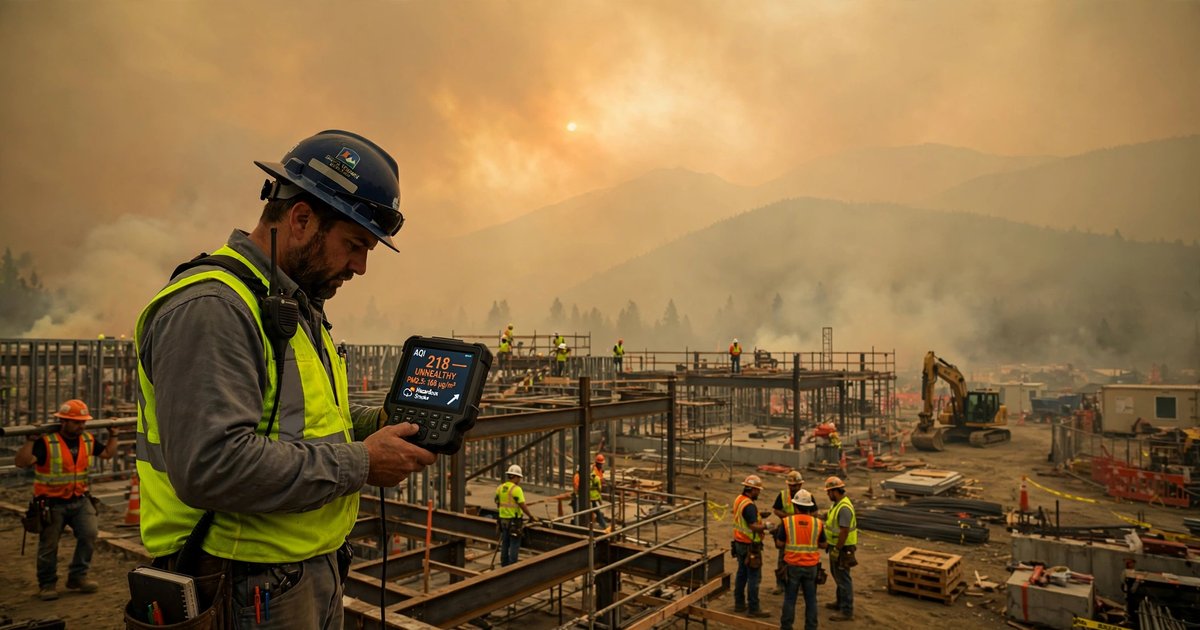
Morning routine: the superintendent opens AirNow on their phone, takes a screenshot, texts it to the project manager, and if AQI is above 150, pulls N95s from a box in the job trailer while someone writes the date and AQI reading on a clipboard log that may or may not get photographed before the screenshot lives in someone's camera roll until they clear storage six months later, at which point the compliance documentation vanishes entirely.
Training happens at a Monday morning toolbox talk where the safety manager prints a Cal/OSHA fact sheet, reads it to the crew, passes around a sign-in sheet that goes into a binder in a filing cabinet in the office trailer, and if Cal/OSHA shows up asking for training records for a specific worker on a specific date, someone has to flip through 400 pages of sign-in sheets looking for a name that may have been written in illegible jobsite handwriting.
Respirator inventory lives on whiteboards, sticky notes, or nowhere at all, which means nobody can tell you how many N95s are on which jobsite right now, and when smoke rolls in unexpectedly the project manager drives to Home Depot to buy whatever they have left, which after the first day of a smoke event is usually nothing because every other contractor in the county had the same idea three hours earlier.
Existing Players and the Gap
Aeroqual sells hardware air quality monitors ranging from $2,000 to $15,000 per unit, paired with cloud dashboards and real-time alerts that work well for large industrial sites able to instrument every location permanently. Construction companies running 40 jobsites that relocate every three months are not buying $8,000 monitors for each one, and even if they were, Aeroqual solves the measurement problem without touching the compliance workflow problem: training records, decision documentation, respirator tracking, multi-state regulatory mapping, and OSHA inspection preparation all remain manual.
SafetyCulture (iAuditor) and similar general EHS platforms can theoretically be configured with custom checklists for wildfire smoke, but "can be configured" means someone at the company has to build the checklist from scratch, keep it updated when regulations change, integrate it with AQI data feeds, and train field staff to use it, which is roughly the same amount of work as building the vertical SaaS from scratch except you're doing it without a product team and charging yourself for the privilege.
Nobody has built the vertical SaaS that does all of it: automated AQI monitoring by GPS-located jobsite, threshold-triggered decision trees customized to the applicable state standard, push notifications to field supervisors with required actions, digital training modules with completion tracking and certificate generation, respirator inventory management by location, audit-ready compliance reports that aggregate all of it into the format a Cal/OSHA inspector actually wants to see.
The Product
A mobile-first SaaS platform that automates wildfire smoke compliance for employers with outdoor workers, built around four integrated modules that together eliminate the binder-and-screenshot workflow.
Automated monitoring ingests AQI data from EPA AirNow, state agency feeds, and optionally on-site PM2.5 sensors, maps each jobsite by GPS coordinates, calculates the applicable AQI at each site against the relevant state regulation's threshold, and when that threshold is crossed, pushes notifications to the responsible supervisor with exactly what they need to do under the applicable standard while simultaneously logging the notification, the AQI reading, the data source, and the timestamp as the compliance record that an inspector would actually want to see.
Decision documentation presents the supervisor with a regulatory decision tree when an alert fires: stop outdoor work, relocate to a filtered environment, provide N95s for voluntary use, or continue with enhanced monitoring. The supervisor taps a decision, the system records it with GPS, timestamp, and AQI at time of decision, and when an inspector asks "What did you do when the AQI hit 180 at your Folsom jobsite on August 14?" the answer is a timestamped record with the supervisor's name, the decision made, and the crew roster present, not a frantic search through a camera roll.
Training management delivers pre-built training modules mapped to each state's specific requirements, including California's fact sheet content, Oregon's ten required training elements, and Washington's curriculum, all completable on a worker's phone with completion records tied to their employee profile, stored indefinitely, and retrievable by name, date, jobsite, or regulation without anyone ever touching a sign-in sheet.
Respirator tracking lets managers scan N95 boxes into inventory by location, automatically checks whether an affected jobsite has sufficient stock when an alert fires, flags gaps and routes resupply orders when it doesn't, and tracks distribution to individual workers for fit-test and usage documentation that satisfies both Cal/OSHA and the employer's own liability protection.
Underneath all of it sits a multi-state compliance engine that maps every state's wildfire smoke requirements, current and proposed, to actionable thresholds and obligations, updating the rules database when Colorado or Minnesota inevitably passes their own standard so that employers don't need to read new regulations because the software reads them first.
Revenue Model and Unit Economics
Tiered SaaS subscription by employer size and number of active jobsites:
| Tier | Jobsites | Workers | Monthly Price | Annual |
|---|---|---|---|---|
| Starter | 1-5 | Up to 50 | $199 | $2,388 |
| Professional | 6-25 | Up to 250 | $499 | $5,988 |
| Enterprise | 25+ | 250+ | $1,200+ | $14,400+ |
Add-on revenue streams include on-site PM2.5 sensor hardware at $200-400 per unit with a monthly data subscription, API access for integration with existing EHS platforms, and compliance consulting for employers expanding into newly regulated states who need a baseline audit before smoke season arrives.
TAM / SAM / SOM
The novel calculation here concerns how many employers actually need this product and what the manual compliance cost they'd replace looks like at scale.
The Bureau of Labor Statistics counts approximately 12.1 million construction workers across roughly 920,000 construction establishments (Census Bureau, 2022 County Business Patterns), while agriculture adds 2.2 million workers at an estimated 130,000 farms with hired labor (USDA NASS), landscaping and grounds maintenance contributes approximately 120,000 businesses, and utilities, mining, outdoor recreation, and government outdoor operations add another 50,000-80,000 employers, bringing the total addressable employer count to roughly 1.25 million establishments with outdoor workers.
Not all of them face meaningful wildfire smoke exposure, but the smoke data says every county gets at least 16 days, so filtering to employers in counties averaging 30+ smoke days per year (roughly 60% of the U.S. by area, covering the West, Southwest, Northern Plains, and increasingly the Midwest and Northeast during Canadian fire years) yields an addressable count of about 750,000 employers.
At a blended average contract value of $4,200 per year, weighted toward smaller contractors on the Starter tier, the TAM comes to $3.15 billion, though that number assumes universal adoption across the entire addressable base, which is unrealistic even over a decade.
Restricting to the three states with current mandates (California, Oregon, Washington) plus states likely to adopt within three years (Colorado, Nevada, Montana, Minnesota), and filtering further to employers with 10 or more outdoor workers, yields a SAM of approximately $340 million across roughly 81,000 employers.
Year-3 realistic capture at 2-3% of SAM lands at $7-10 million ARR from roughly 2,000 paying accounts, which represents a fundable Series A trajectory from a standing start and a clear path to $50M+ ARR as additional states adopt standards over the following five years.
Why Now
Five forces are converging simultaneously, and their interaction makes the timing window narrow enough that waiting 18 months probably means competing against an incumbent rather than creating a category.
The smoke isn't going away, and the data says it's accelerating. The 2020-2024 quadrupling of per-person smoke exposure isn't a blip driven by one bad Canadian fire season. Climate models, fire suppression backlogs (the USFS estimates 63 million acres of national forest need prescribed burning that won't happen fast enough), and the continued expansion of the wildland-urban interface all point in one direction, and that direction is more smoke, covering more geography, for more days per year.
Regulatory expansion is inevitable because the political math has already tipped. California, Oregon, and Washington passed their standards because the smoke got bad enough that the political cost of inaction exceeded the political cost of new regulation, and Colorado, Montana, Nevada, and Minnesota are all experiencing the same inflection point. Federal OSHA initiated rulemaking for a heat illness standard under the Biden administration, and wildfire smoke is the logical next regulatory surface regardless of which administration occupies the White House, because the smoke crosses every congressional district and the three existing state standards were passed under both Democratic and Republican governors.
The insurance industry is paying attention in ways that create financial incentives independent of regulation. Workers' comp claims related to respiratory exposure are rising, insurers are starting to ask employers about their smoke exposure protocols during underwriting, and a documented compliance program will become a premium discount trigger the same way fall protection programs already are in construction insurance, which means employers in states without mandates will still have financial reasons to adopt.
Hardware costs have collapsed enough to make site-level monitoring economically feasible for mid-market contractors. A PM2.5 sensor module that cost $3,000 in 2018 costs $150-400 today through PurpleAir, Clarity, or IQAir, but the missing layer is software that turns sensor data into compliance documentation, not the sensor itself.
The construction workforce expects it and will select for it. A 28-year-old framing carpenter in Bend has lived through five consecutive smoke seasons that got worse each year, knows what AQI means, has seen the orange skies, and will choose the employer who has a visible safety protocol over the one who tells crews to tough it out, which in a tight labor market means smoke compliance doubles as a recruitment tool.
Startup Costs
Estimated seed-stage capital requirement: $2.2 million, broken across engineering for mobile, web, and AQI integration over 12 months ($1.2M), regulatory and legal work for multi-state compliance mapping ($200K), go-to-market with a California construction focus ($400K), hardware partnerships for sensor integration ($100K), and operations and overhead ($300K).
First-year target: 200 paying accounts in California construction, generating $480K ARR at the Starter/Professional blend, with break-even at approximately 800 accounts, achievable in 18-24 months with a focused California sales motion before expanding to Oregon and Washington in year two.
Risks and Limitations
This analysis relies on publicly available AQI threshold data and BLS employment statistics. Several assumptions deserve scrutiny:
Regulatory pace is uncertain. The "47 states will follow" thesis assumes a continued upward trend in smoke exposure and a political environment that favors new workplace safety standards. A federal administration hostile to OSHA rulemaking could slow the expansion. However, the three existing state standards were passed under both Democratic and Republican governors (Oregon's was initiated under Governor Brown but finalized as permanent under bipartisan legislative support), suggesting that wildfire smoke regulation is less politically polarized than heat illness or chemical exposure standards.
The employer count is an estimate. Census County Business Patterns counts establishments, not employers in the traditional HR sense. A general contractor with three active jobsites shows up as one establishment but needs monitoring at three locations. The 750,000 addressable employer number could be high if many small establishments are one-person operations, or low if multi-site employers need multiple subscriptions.
AirNow data is free, and employers can and do check AirNow.gov at no cost. The value proposition is not "we tell you the AQI" but "we document that you checked, log what you decided, prove your workers were trained, and produce the report the inspector needs." If employers perceive the regulatory risk as low (few citations, small fines), adoption will be slow regardless of how good the product is.
Smoke seasons vary wildly, which creates a churn risk for a monthly SaaS product. A SaaS product priced at $199/month needs to deliver value 12 months a year, not just during August and September. Off-season features (annual training management, respirator procurement planning, regulatory update tracking, pre-season preparedness audits) need to be compelling enough to prevent seasonal churn.
The Strongest Case Against
General-purpose EHS platforms will add wildfire smoke modules before a startup can scale. SafetyCulture, Intelex, VelocityEHS, and Cority all serve the construction and industrial safety market. They have existing customer relationships, established mobile apps, and engineering teams that could build a smoke compliance module in a quarter. When Colorado passes its standard, VelocityEHS will add a "Wildfire Smoke" template to their library, and their existing customers will toggle it on without switching vendors.
This is the classic vertical-vs-horizontal SaaS question, and the answer depends on how complex the compliance surface turns out to be. If wildfire smoke compliance is one checklist with five items, the horizontal platforms win. If it's a continuously updating multi-jurisdiction rules engine with real-time AQI integration, GPS-specific monitoring, and audit-specific reporting formats, the vertical wins because the horizontal platforms won't invest the engineering effort to get the details right. The dam safety, stormwater, and PFAS compliance markets all followed the vertical pattern: the general platforms built modules, the modules were mediocre, and the verticals captured the customers who actually faced regulatory scrutiny. Wildfire smoke compliance is more similar to stormwater (jurisdiction-specific, data-intensive, documentation-heavy) than to general safety checklists, but the outcome is not guaranteed and a startup entering this space needs to ship faster than VelocityEHS can prioritize a module.
The Playbook
If you're building this: start in California, which has the largest construction workforce, the most active enforcement agency (Cal/OSHA issued advisories during multiple fire events in 2025 alone), and the highest employer awareness. Partner with one of the construction trade associations (Associated General Contractors of California, or the California Building Industry Association) to get distribution. Offer a free 30-day trial that starts the week AQI first crosses 150 in a given fire season, because that's the moment the superintendent realizes the binder-and-screenshot approach isn't going to hold up.
If you're a general contractor reading this, you don't need to wait for software. Download Cal/OSHA's fact sheets today and set up AirNow alerts for your jobsite zip codes. Buy N95s before fire season starts, not after. Create a shared Google Sheet with columns for date, jobsite, AQI reading, data source, action taken, and supervisor name. Document your training with sign-in sheets that include the date, topic, trainer name, and a list of specific content covered. It's not elegant, but it's defensible, and the software will come even though the inspector might come first.
If you work at OSHA: the General Duty Clause has not produced a single wildfire smoke citation in 56 years. Three states have shown that specific, enforceable standards with clear AQI thresholds work. The EPA's own data shows this is a national air quality crisis, not a western regional quirk. The 2023 Canadian smoke season proved that New York, New Jersey, and Pennsylvania construction workers face the same exposure as Oregon workers. A federal standard doesn't need to be innovative; it just needs to exist.
Related
📰 Heat Illness Compliance SaaS — the same regulatory wave for outdoor worker safety, applied to temperature instead of air quality
📰 Construction Stormwater Compliance SaaS — another jurisdiction-specific, documentation-heavy compliance surface on construction jobsites
📰 Wildfire Defensible Space Compliance SaaS — the property-side wildfire compliance problem, where the regulated entity is the building owner rather than the employer