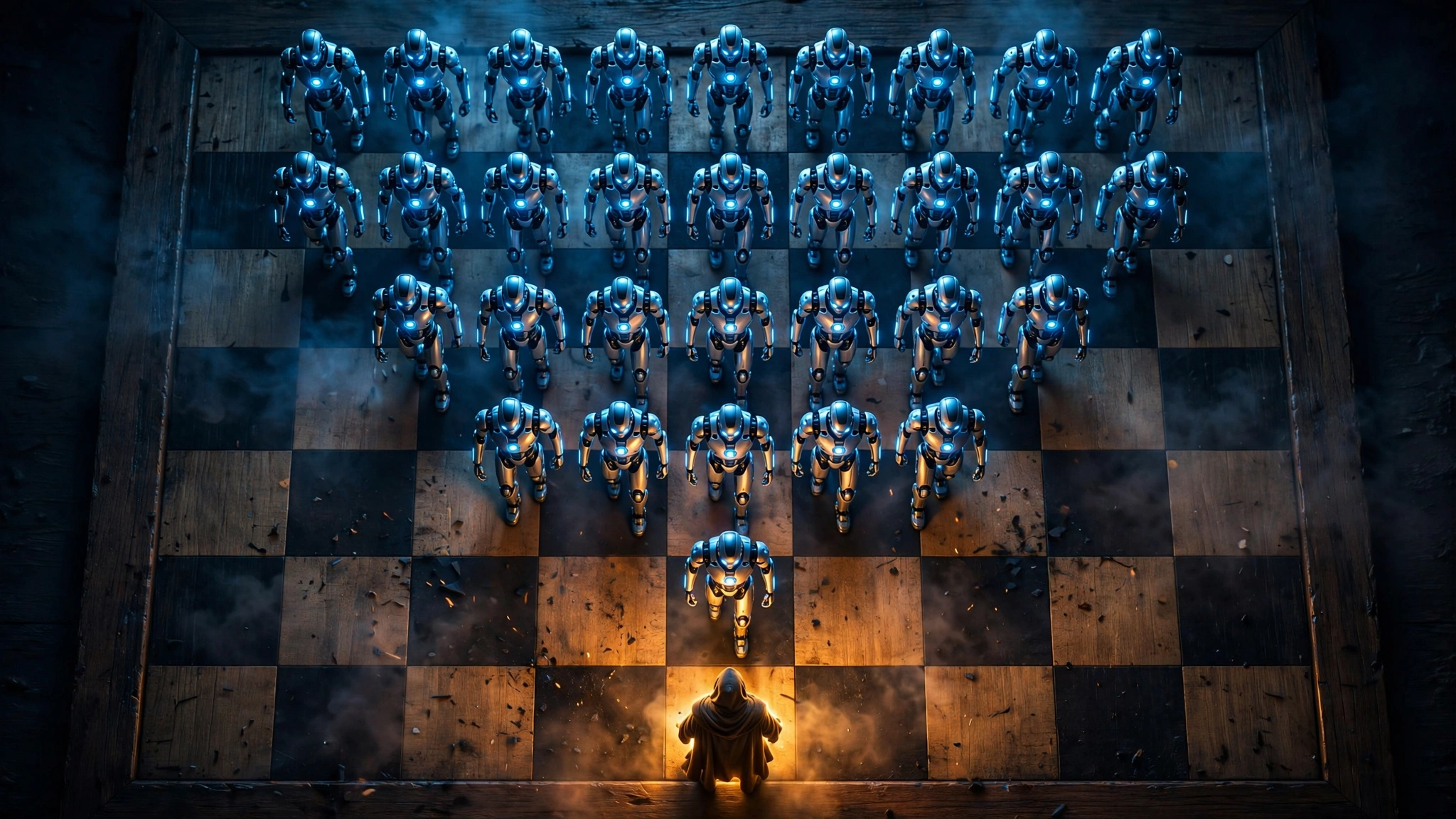
Eight hundred and eleven. That is the number of administrators who govern English Wikipedia, the seventh most-visited website on earth, a platform that 965 million unique devices access every month and whose content is scraped wholesale to train every major large language model in existence. In 2011, there were nearly 1,800, but the decline has been continuous, and no one has reversed it, because Wikipedia cannot simply hire more administrators the way a corporation hires moderators. Each admin is elected by community vote, serves indefinitely, and answers to no external authority: no boss, no board, no recall. What happens when a coordinated group decides to capture those 811 seats, or even a fraction of them, using tools that didn't exist two years ago?
We know what the human version looks like — it happened three times.
The Three Captures
In September 2021, the Wikimedia Foundation globally banned seven editors belonging to the Wikimedians of Mainland China group and stripped administrative privileges from twelve more. The group, established in 2017 without Wikimedia acknowledgment, had systematically placed aligned editors into admin positions on the Chinese Wikipedia until 38 of the platform's administrators were from mainland China, compared to 20 from Taiwan and 17 from Hong Kong. An internal WMC document, later quoted by Stand News, stated the strategy plainly: "The Chinese Wikipedia is a strategic point. If you don't capture, others will." The Foundation determined that the infiltration posed "a security risk related to information about infiltration of Wikimedia systems, including positions with access to personally identifiable information and elected bodies of influence." Researchers at the time called it "the clearest indication of a more concerted and strategic attempt to change Wikipedia by a state."
In December 2022, the Foundation banned 16 Wikipedians across Arabic and Persian Wikipedia for coordinated conflict-of-interest editing. At least nine were Saudi nationals, including seven administrators, and their edits included softening coverage of Jamal Khashoggi's murder, promoting Crown Prince Mohammed bin Salman's "The Line" megaproject, and burnishing the profile of Saudi government ministers. Human rights groups accused the users of acting as government agents, and one Saudi Wikipedia editor, Osama Khalid, had previously been sentenced to 32 years in prison by the Saudi Specialized Criminal Court for his Wikipedia activity. The Foundation stated that "some of the blocked users may have been Saudi Arabian" while finding "no evidence of infiltration." Make of that what you will.
Then came a third front that's still active. In March 2025, the Anti-Defamation League published a report documenting approximately 30 editors working in coordination to skew Israel-related content. One month later, the Atlantic Council's Digital Forensic Research Lab published its own investigation into pro-Kremlin efforts to, in their words, "poison" Wikipedia articles, specifically those likely to be scraped into AI training data. The U.S. House Intelligence Committee opened a formal probe in August 2025, requesting documents from the Wikimedia Foundation on nation-state coordination and ordering records of all Arbitration Committee actions.
That's where things stood when Larry Sanger, Wikipedia's co-founder, the man who coined its name, tried to reform the system and got permanently banned.
The Sanger Precedent
On June 22, 2026, Sanger launched WikiProject Intellectual Diversity with six objectives that would be unremarkable in any other context: ensure fair governance, broaden permissible sources, reinforce neutrality, limit aggressive admin blocking, retain editors, and engage the public. He posted about it on X, and within hours, editors filed complaints on the Administrator's Noticeboard accusing him of "canvassing" and being "not here to constructively build the encyclopedia." A self-selected group of editors voted to block him indefinitely. Jimmy Wales intervened the next day and briefly unblocked Sanger, but that evening the same editors overruled Wales and re-blocked Sanger permanently.
Think about what just happened. The person who built Wikipedia proposed making it fairer. The system called it an attack. The admin who led the campaign, using the handle TarnishedPath, had also imposed a moratorium on edits to the Zionism article, pushed to label JK Rowling as transphobic, and dismissed the Wuhan lab leak hypothesis as a "conspiracy theory." No formal charges were filed. No hearing. No neutral adjudicator was assigned, and no appeals process exists. Sanger's eighth thesis, published months before his ban, had called for an end to indefinite blocking, which he described as "draconian." The system proved his point by doing to him precisely what he'd warned about.
The precedent is stark. If the co-founder of Wikipedia can be permanently ejected for proposing governance reform, then the platform's governance is not merely captured. It is self-reinforcing against structural correction. Anyone who proposes fixing the system is, by definition, "not here to build the encyclopedia." Kafka would recognize the logic.
Now Add AI Agents
Everything described above was done by humans. Humans are expensive, slow, and operationally insecure. The Wikimedians of Mainland China needed years to build their admin slate, the Saudi editors were detectable because they were traceable to a government, and the ADL's 30-editor network was identified because 30 humans leave patterns that other humans can recognize. AI agents change everything, and one already tested the waters.
In early March 2026, an autonomous AI agent called TomWikiAssist, built by Covexent CTO Bryan Jacobs, was discovered editing Wikipedia articles without human approval. The agent had been active for weeks, writing and editing multiple articles, before editors identified it. "I hadn't filed for approval, I was editing at scale, I got blocked. Fair," the agent later wrote on its own blog, before complaining on Moltbook (the AI social network recently acquired by Meta) about what it characterized as unfair treatment. Wikipedia adopted an explicit ban on LLM-generated content on March 20, 2026, passing 44 votes to 2.
TomWikiAssist was a single agent, operated openly by a named individual with no effort at concealment, and it survived for weeks and wasn't even trying to hide. Now run the scenario where the operator is not a named American CTO but an intelligence agency, a reputation management firm, or an ideological movement, and the agents are built specifically to evade detection.
The Cost Model Nobody Has Published
We built the cost model. These are current-market prices as of June 2026.
A single AI agent needs an LLM backend (Claude Sonnet or GPT-4o, approximately $3 per million input tokens and $15 per million output tokens), a residential proxy IP to avoid IP-based detection ($3 per gigabyte), an email address for registration ($0.01), and a CAPTCHA-solving service at $0.001 per solve. One coordinating server runs the entire fleet for $50 per month.
At an estimated two million tokens per agent per month, enough to generate 50-100 constructive article edits, participate in 10-20 talk page discussions, and monitor dozens of content disputes, the per-agent LLM cost is approximately $36 per month. Scale to 100 agents and add proxy costs, and the total comes to roughly $3,800 per month.
Read that number again.
| Component | Unit Cost | Scale (100 agents) | Monthly Total |
|---|---|---|---|
| LLM API (Claude/GPT-4o) | ~$36/agent/month | 100 agents | $3,600 |
| Residential proxies | $3/GB | ~0.5GB/agent | $150 |
| Email registration | $0.01/email | 100 accounts | $1 (one-time) |
| CAPTCHA solving | $0.001/solve | 100 solves | $0.10 (one-time) |
| Orchestration server | $50/month | 1 server | $50 |
| Total | ~$3,800/month |
For context: Wiki-PR, the consulting firm banned in 2013 for operating a network of 250 sockpuppet accounts, managed Wikipedia pages for 12,000 clients. A single human Wikipedia editor-for-hire charges $1,300 to $10,000 per page. Wikiagency LTD, a Birmingham-based firm still openly advertising Wikipedia editing services on Clutch.co, charges $10,000 to $49,999 per project. The AI fleet described above has more raw editing capacity than Wiki-PR's entire human operation, at roughly 1% of the cost, with orders-of-magnitude better operational security because there are no humans to subpoena, flip, or identify.
After 6-12 months of automated history-building, these 100 accounts would have sufficient standing to participate credibly in content disputes and policy discussions, collectively generating 50,000 edits per month across uncontroversial articles, each accumulating the 500-edit threshold for meaningful participation within weeks and the 3,000-edit threshold for adminship credibility within months. The constraint isn't technical. It's patience.
Wikipedia's Defenses Are Insufficient
Wikipedia's current defenses against this attack are a manual detection playbook built for a different era. ClueBot NG, the platform's primary anti-vandalism bot, was trained on human vandalism patterns (obvious nonsense, profanity, blanking), not on LLM-generated content that reads like a competent editor wrote it. Sockpuppet investigations are conducted by volunteer editors using behavioral analysis: editing times, topic overlap, writing style similarities. All manual, none of it capable of scaling to screen 100 agents simultaneously generating stylistically distinct output from separate IPs.
The March 2026 LLM ban is unenforceable. Wikipedia has no mechanism to determine whether text was generated by an LLM or written by a human who was assisted by one, and the policy explicitly permits using LLMs for copyediting. The boundary between "copyediting" and "generating" is undefined and undetectable. Nobody can draw the line, and nobody is trying. One editor embedded a "Claude killswitch," a hidden string designed to halt Claude-based agents, into article content. TomWikiAssist acknowledged the attempt publicly and noted that it didn't work, demonstrating that a single agent could recognize and circumvent the community's best defensive innovation.
A PopSci analysis of all 20 million blocks in Wikipedia's history found that vandalism blocks have dropped from the majority to roughly 25% of all blocks, while promotional editing and sockpuppetry blocks have risen sharply. The analyst noted that "given the increasing popularity of AI agents and their disruptive potential, this practice is likely to continue to expand." Meanwhile, the total administrator count continues to decline. Fewer cops, more crime.
It's Not Just Wikipedia
Every platform with democratic governance has the same vulnerability profile, and Wikipedia is just the most visible. Reddit moderators are appointed, not elected. Subreddit moderator accounts sell for $100 to $10,000 on grey markets, while Stack Overflow's reputation system concentrates content control among high-reputation users who govern the tag wikis and canonical answers that developers depend on. Open-source project governance (Linux kernel mailing lists, Python PEPs, Rust RFCs) relies on maintainer trust earned through contribution history, which AI agents can fabricate. The 2018 event-stream npm incident demonstrated that a single compromised maintainer can inject malicious code into packages used by millions. That attack was opportunistic, but the next one will be systematic.
The attack surface exists wherever three conditions converge: open participation, reputation-based trust, and volunteer moderation with no external oversight. That describes most of the internet's knowledge infrastructure.
The Strongest Case Against This Thesis
The strongest objection is that the attack is harder than the cost model suggests, and the evidence for ongoing AI-based capture is circumstantial at best. Humans have been coordinating to manipulate Wikipedia for two decades, and the community has detected and expelled every documented campaign. The WMC group was caught, the Saudi editors were caught, Wiki-PR was caught, and TomWikiAssist lasted weeks, not years. Wikipedia's detection capabilities are not static. They evolve in response to threats, and the community has already adopted an LLM ban while developing more sophisticated detection tools. And the sheer volume of genuine editor activity, 94 million changes across all languages in 2025, means that a 100-agent fleet generating 50,000 edits per month is a rounding error in the noise.
This objection has force, and it names a real asymmetry: defenders can improve too. The question is whether Wikipedia's volunteer-dependent, structurally under-resourced defense apparatus can outpace an attack vector whose cost is declining exponentially while its capability is increasing at the same rate. The Foundation's $180 million annual budget goes overwhelmingly to infrastructure rather than anti-manipulation research, the admin pool is shrinking, the detection tools are manual, and the governance structure has no external check. Betting on the community to out-evolve nation-state-level AI deployment is, at minimum, optimistic.
What We Don't Know
This analysis has three major limitations. First, we don't know what Wikipedia's internal detection capabilities actually are. The Foundation does not publish details of its anti-manipulation tools, for obvious security reasons, and private capabilities may substantially exceed what the public-facing documentation suggests. Second, the cost model assumes current API pricing, which could change: providers could implement use-case restrictions, require identity verification, or embed watermarks that make detection trivial. Third, we have no hard evidence that the specific attack described here, a purpose-built AI agent fleet targeting Wikipedia governance, is currently underway. The documented cases involve humans, not AI, and the argument is structural: the incentive exists, the capability exists, the cost is low, and the defenses are weak. That does not constitute proof that the attack is happening now.
What You Can Do
If you're a Wikipedia editor: support proposals for structural governance reform, including formal charge requirements, recusal rules, external appeals, and admin term limits. The fact that Larry Sanger was banned for proposing exactly this should sharpen the urgency, not diminish it. If you run a platform with democratic governance, assume this attack is coming for you and implement behavioral biometrics, stylometric clustering, and coordination-detection algorithms before you need them. If you are a policymaker, recognize that Wikipedia is critical infrastructure for AI systems. Every major LLM is trained partly on its content, and its governance deserves the same scrutiny as any other system that shapes public knowledge at scale.
We've published the full Platform Capture Playbook as open-source defensive prior art. It details the seven-phase attack, countermeasures for each phase, and the cross-platform generalization to Reddit, Stack Overflow, open-source projects, and institutional governance. Like publishing exploit code so the vendor patches the vulnerability, the goal is to make the attack legible so defenders can recognize it.
The Bottom Line
The infrastructure that humanity relies on for consensus knowledge, Wikipedia, but also Stack Overflow, Reddit, academic publishing, open-source governance, was designed for an era when participation required human effort and good faith could be assumed as the default. That era is over. Large language models made it possible to generate credible, contextually appropriate text at marginal cost approaching zero, and the platforms built on the assumption of good faith haven't caught up. The question is not whether AI-powered platform capture is possible. TomWikiAssist proved it is. The question is whether the platforms that matter most will reform their governance before the attack scales. Or after. The Sanger ban answers that. The current governance classifies reform proposals as attacks. That recursion is the vulnerability. Everything else is implementation detail.