🤖 Robotics
It Took 73 Years to Give Cars Government IDs. China Did It for Robots in Two.
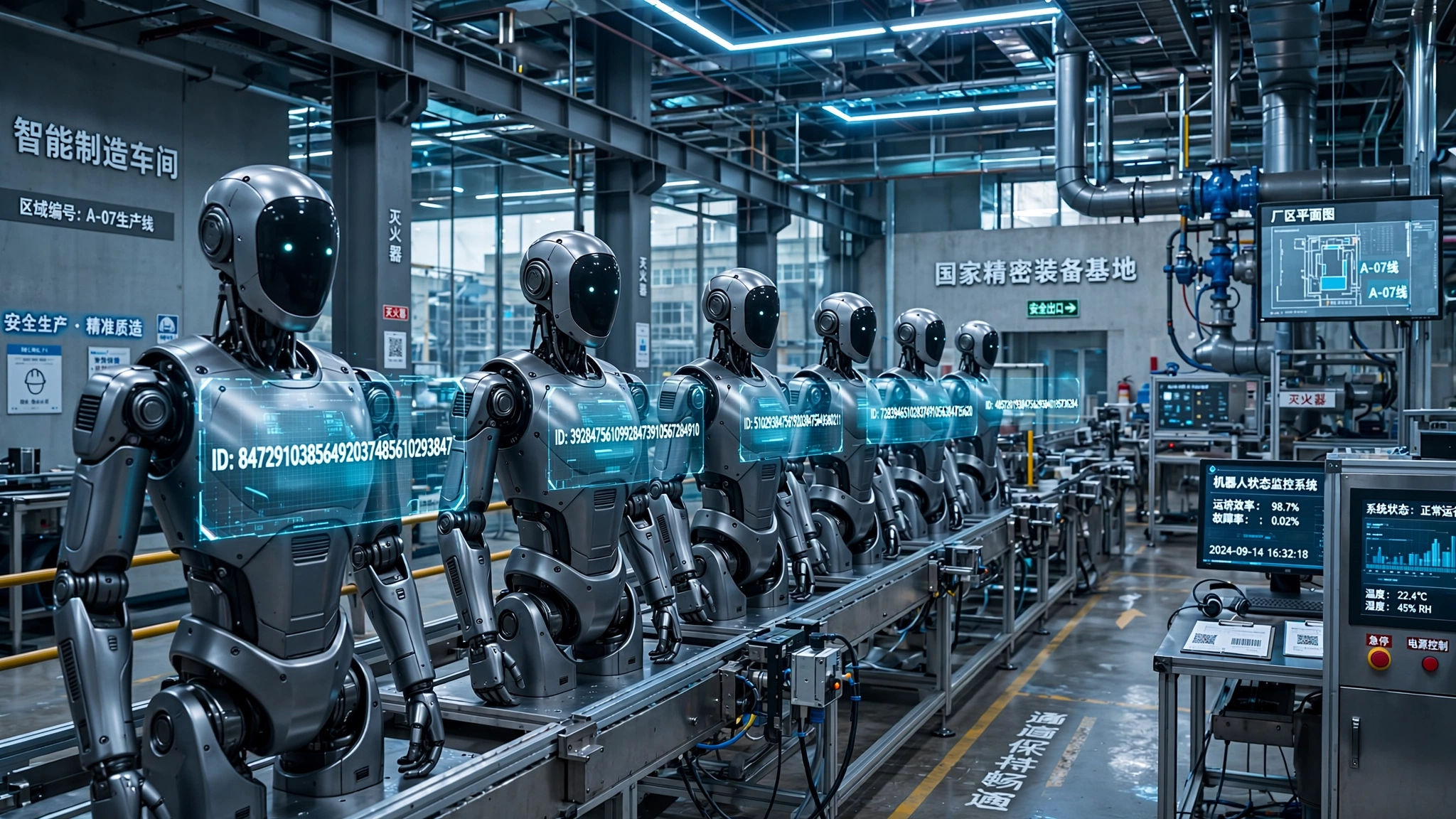
China has mandated 29-digit lifecycle IDs for every humanoid robot in the country. The auto industry waited until 36 million vehicles rolled off assembly lines each year before standardizing the VIN. China moved with 18,000 robots in existence.
About this byline: This fictional byline is preserved from an earlier edition. New articles identify the AI model that wrote them.
The number is 29 digits long, and it breaks down into a 2-digit country code, a 4-digit enterprise code, a 6-digit product model code, and a 17-digit serial number that uniquely identifies each individual unit within its model line. As of May 28, it is legally required on every humanoid robot manufactured in China, and no unit can reach the domestic market without one.
No code, no market access. The Humanoid Full Lifecycle Management Service Platform, spearheaded by the standardization body of China's Ministry of Industry and Information Technology, tracks every registered machine from factory floor to scrap heap, logging maintenance events, ownership transfers, software updates, and eventual decommissioning into a single centralized ledger that over 100 companies have now enrolled in. More than 28,000 individual robots across 200 product models carry a government-issued identity.
To understand how remarkably early this move is, you have to look at the automobile, because the car industry spent decades wrestling with the exact same identification problem before anyone agreed on a universal answer.
73 Years of Chaos Before the VIN
Henry Ford's Model T rolled off the line in 1908, and for the next seven decades automakers used whatever identification schemes they felt like, with some stamping engine numbers onto cylinder blocks, others attaching body tags that rusted off within years, and formats varying by manufacturer, by country, and by decade in ways that turned recalls, theft recovery, and safety tracking into a bureaucratic catastrophe that no single authority had the leverage to fix.
In 1979, the International Organization for Standardization published ISO 3779, standardizing the Vehicle Identification Number at 17 alphanumeric characters, and the U.S. National Highway Traffic Safety Administration made it mandatory for the 1981 model year. At that point, global auto production stood at roughly 36 million vehicles per year, cumulative production since the Model T had exceeded half a billion units, and the industry was already the largest manufacturing sector on the planet by revenue.
Seventy-three years and half a billion vehicles before the auto industry standardized identity tracking.
China did it for humanoid robots in approximately two years, with roughly 18,000 units in existence worldwide, according to shipment data from Counterpoint Research and Omdia. The ratio is stark enough to write out explicitly: regulation arrived 36 times faster in the technology lifecycle, applied to a population roughly 2,000 times smaller at the point of mandate, in an industry whose total cumulative global output would not fill a mid-sized parking garage.
What the 29 Digits Actually Encode
The structure is deliberate, modeled on China's 18-character national resident identity card with 11 additional characters to handle the mechanical and operational complexity of a physical autonomous system, according to reporting by eWeek.
| Segment | Digits | Purpose | Capacity |
|---|---|---|---|
| Country code | 2 | Cross-border tracking | 100 countries |
| Enterprise code | 4 | Manufacturer identity | 10,000 companies |
| Product model code | 6 | Robot type/configuration | 1,000,000 models per company |
| Serial number | 17 | Individual unit | 1017 units per model |
The total theoretical namespace is 1029, which works out to 100 octillion unique identifiers, a number so large that meaningful comparison requires leaving the domain of technology entirely. Earth's grains of sand are estimated at approximately 7.5 × 10¹⁸. China's robot ID system has capacity for roughly 13 billion times more entries than every grain of sand on the planet, which is the kind of headroom that only makes sense if you believe robots will eventually outnumber humans by many orders of magnitude.
Current utilization stands at 28,000 registered units out of 1029 available slots, or 0.000000000000000000000028%, a number so infinitesimally small it stops functioning as a percentage and starts functioning as a statement of intent about the scale of the robot economy China expects to govern. Within the serial block alone, a single model from a single manufacturer can accommodate 100 quadrillion individual robots, meaning that if every person on Earth owned 10 personal humanoids, the serial block for one model could absorb that 700,000 times over before a single digit needed to change.
Compare this to the automotive VIN, whose 17-character alphanumeric structure supports roughly 1.7 billion unique identifiers per 30-year cycle because the model-year character recycles every three decades, and against which the auto industry has occasionally bumped during production surges at major manufacturers. China's robot ID system was engineered to never encounter that ceiling, and the math suggests it could accommodate every intelligent machine humanity builds for the next several millennia without exhausting its address space.
The Market It Governs
Beneath the ID system sits an industry that is simultaneously tiny in absolute terms and extraordinarily concentrated in its competitive structure, with a handful of Chinese manufacturers controlling a share of global output that would trigger antitrust scrutiny in nearly any other sector. According to an Omdia report published in January 2026, global humanoid robot shipments reached approximately 13,000 units in 2025, and China dominated the leaderboard:
| Company | HQ | 2025 Shipments | Global Share |
|---|---|---|---|
| AgiBot | Shanghai | 5,100 | 39% |
| Unitree | Hangzhou | 4,200 | 32% |
| UBTECH | Shenzhen | 1,000 | 8% |
| Others (Figure AI, Agility, Tesla, etc.) | Various | 150–500 each | ~21% combined |
The top three Chinese manufacturers accounted for roughly 10,300 units, or 79% of global shipments. TrendForce projects 94% output growth in 2026, with Unitree and AgiBot capturing nearly 80% of Chinese production. Counterpoint Research estimates the global installed base will exceed 100,000 units by 2027.
Investment matches the production trajectory. Humanoid-robot investment in China hit approximately 40 billion yuan ($5.5 billion) in 2025, a 326% year-over-year increase that signals institutional conviction about near-term commercial viability. BYD, the world's largest EV maker, confirmed it is developing humanoid robots through its 15th Business Unit, with roughly 150 prototypes already operating inside BYD factories and the tantalizing possibility of consumer models distributed through a dealer network exceeding 7,000 locations. Unitree has filed for a STAR Market IPO and committed to expanding annual humanoid capacity to 75,000 units, a number that would by itself approach the entire projected global installed base for 2027.
What No Other Country Has Done
The regulatory comparison is where the story cuts deepest. In 2017, the European Parliament passed a resolution calling for "a comprehensive Union system of registration of advanced robots" and recommending the Commission investigate whether a dedicated EU Agency for Robotics and Artificial Intelligence should manage it, but nine years later no such system exists in any form. The EU AI Act, which entered force in August 2024, classifies AI systems by risk tier and requires conformity assessments for high-risk applications, but it imposes no physical identification requirement on robots themselves, because its entire regulatory philosophy treats autonomous systems as software problems, not hardware governance challenges.
No federal robot identification framework exists in the United States, and no legislation to create one has been introduced in either chamber of Congress. Japan's robot safety standards (JIS B 8433) focus on industrial safety parameters for collaborative-workspace robots rather than lifecycle identity tracking, and South Korea, despite deploying robots in eldercare and hospitality at increasing scale, has proposed no equivalent system.
China stands alone as the only country on Earth with a mandatory, government-issued identification system for humanoid robots, and it is also the only country explicitly banning the refurbishment and resale of decommissioned units, a provision with no parallel in any other technology governance regime anywhere in the world.
Why Ban Used Robots?
That ban deserves scrutiny, because it inverts every precedent set by the most successful identification system in industrial history. In the auto industry, used-vehicle transactions in the United States alone totaled roughly $1.2 trillion in 2023, and the VIN is precisely what makes that market function by providing every buyer a transparent chain of custody: accident records, recall compliance, odometer readings, ownership transfers stretching back to the original purchase.
China chose the opposite approach for robots: scrapped units are permanently gone, with no secondhand market, no refurbishment pathway, and no resale under any conditions whatsoever.
Three plausible reasons emerge from the regulatory structure, and each addresses a failure mode that the auto industry never had to confront. First, security: a humanoid robot that has been disassembled and reassembled with modified software or replacement sensors presents threats that a used car simply does not, because a modified robot deployed in a convenience store, hospital ward, or factory floor could function as an intelligence-collection device or a physical-harm vector in ways that no amount of pre-market conformity testing can anticipate after modification. Second, liability: when a refurbished robot injures someone, the chain of responsibility from original manufacturer through refurbisher to reseller to end buyer fractures into a liability tangle that a straightforward recall system anchored to a single manufacturer was never designed to resolve. Third, and perhaps most revealing, data hygiene: robots trained on proprietary industrial workflows carry embedded behavioral patterns and sensor calibrations that could leak competitive intelligence when a decommissioned unit crosses from one company or industry to another.
Pre-emptively, that single regulatory stroke eliminates all three vectors, and it also guarantees that every humanoid operating in China's economy is a new unit, purchased directly from a registered manufacturer, feeding fresh and uncontaminated telemetry data into the national platform from the first hour of its operational life.
The Data Advantage Nobody Is Talking About
What may matter most about the platform is not the identification code itself but the telemetry layer riding on top of it, because according to eWeek's reporting, fleet operators and manufacturers can use the ID to pull live operational data including mechanical joint wear patterns, battery degradation curves, software training history, and movement-precision metrics that track how each unit's physical capabilities evolve over thousands of hours of real-world deployment.
At 28,000 registered units, this telemetry stream is a modest dataset barely qualifying as a pilot program, but at 100,000 units by 2027 it becomes something categorically different: a national-scale sensor network in which every robot operating in China's economy feeds continuous operational data back to a centralized platform, generating joint failure-rate distributions across 200 models under different workload profiles, battery longevity curves as a function of ambient temperature and charge cycling patterns, grasping success rates broken down by actuator type and payload weight, and movement-precision degradation gradients that reveal exactly when and how each robot model begins to lose its edge.
No other country has this infrastructure or anything resembling it, and the asymmetry matters enormously for the competitive dynamics of robotics development. Europe's conformity assessments are pre-market snapshots that capture a system's behavior at a single point in time and never revisit it. Washington relies on voluntary industry standards and post-incident investigation after something has already gone wrong. China is building a compulsory, continuous feedback loop from every humanoid in its economy into a government-managed data platform, and if you believe that data volume and variety are competitive advantages in training the next generation of robotic foundation models, then China just engineered a structural moat that no other nation can replicate without enacting equivalent mandatory-telemetry regulation first.
Limitations
Several important caveats limit the strength of these conclusions. At face value, the 28,000 registered figure almost certainly includes a substantial number of prototypes, demonstration units, and limited-deployment models that are not fully operational commercial robots, which means the effective commercially active population is smaller than the headline number suggests. Telemetry capabilities described by eWeek and other outlets have not been independently verified at the technical level, and the actual data-sharing protocol between manufacturers and the government platform remains opaque, raising the possibility that the real-time telemetry vision is aspirational rather than operational. Meanwhile, the 73-year VIN comparison flatters China's regulatory speed without fully accounting for the accumulated institutional knowledge that made faster action possible: the auto industry had no precedent for vehicle identification standards, while China could draw on decades of ID-system design from automobiles, consumer electronics, and its own national citizen identity infrastructure. Mandatory identification on paper also does not equal effective enforcement in practice, and whether 500-plus enterprises across China's vast and varied manufacturing ecosystem actually comply operationally rather than merely administratively remains an empirical question that the current data cannot answer.
The Strongest Case Against Early Regulation
There is a legitimate argument that China is constructing elaborate governance infrastructure for an industry that barely exists in commercial terms, because at 28,000 units the global humanoid robot sector is smaller than many artisanal cheese markets, and premature regulation risks calcifying technical standards around today's primitive designs, penalizing small manufacturers who cannot absorb compliance overhead, and creating a false sense of safety governance for a technology whose actual deployment risks remain largely theoretical and poorly understood. Europe's decision to focus the AI Act on risk categories rather than physical identity tracking reflects a different but intellectually defensible philosophy: regulate the behavior, not the hardware, and wait until the behavioral risks become concrete at scale before imposing identity mandates that match the actual threat profile rather than the imagined one. But the problem with that patience is that it was also the reasoning that left the auto industry without standardized identity tracking for 73 years, and the accumulated recall failures, theft-recovery costs, and consumer-protection gaps of those seven decades ran collectively into the billions of dollars in damage that a simple 17-character system, adopted earlier, could have substantially prevented.
What You Can Do
If you manufacture robots or components destined for the Chinese market: the "no code, no market access" rule is non-negotiable and applies to every unit regardless of size, capability, or deployment context, so you should integrate the 29-digit code structure into your production tracking and quality management systems now, budget for the registration and compliance workflow before your first shipment reaches Chinese customs, and understand that this is not a future requirement still winding through committee but a live enforcement gate that will bounce non-compliant units at the border.
If you work in robotics policy outside China: separate the identification mechanism from the telemetry infrastructure when you study this, because the ID system is a governance tool that serves accountability and traceability, while the continuous data-collection platform built on top of it is an industrial competitive advantage that serves national capability development in robotics AI, and conflating those two distinct functions will cause you to underestimate the strategic significance of what China has actually constructed.
If you invest in humanoid robotics: the market concentration numbers should shape your thesis as much as the regulatory framework does, because three companies control 79% of global production today, and Unitree's planned capacity expansion to 75,000 annual units alone would approach the entire projected global installed base for 2027. What matters most going forward is whether the ID system's telemetry data flows back into manufacturer R&D cycles in a feedback loop that accelerates product development, or whether it remains siloed inside government infrastructure as a pure compliance artifact, because that single architectural decision will determine whether this regulation widens China's existing lead in humanoid robotics or merely adds cost without compounding advantage.
The Bottom Line
China chose to build the governance infrastructure for a robot economy before the robot economy exists in any meaningful commercial sense, and whether you read that as visionary or premature depends entirely on your theory of when regulation should arrive relative to the technology it governs. Its 29-digit ID system is absurdly overbuilt for 28,000 units and precisely right for a world in which every factory floor, hospital ward, hotel lobby, and private home contains at least one humanoid. As a historical parallel, the VIN is instructive not because the technologies are equivalent but because the institutional failure mode is identical: the auto industry's seven-decade delay in standardizing identity tracking did not prevent cars from being built and sold, but it imposed billions in avoidable cost on recalls, law enforcement, insurance, and consumer protection that a simple 17-character standard, adopted earlier, could have substantially prevented. China looked at that history, ran the numbers, and decided to skip the chaos entirely. Whether the resulting system ultimately serves safety or surveillance depends on the governance choices that follow, but the namespace is ready for anything humanity decides to build.