85% of Disease Targets Are Locked Inside Your Cells. Cornell Just Picked the Lock.
A sulfonate cloaking technique lets 150-kilodalton antibodies hitchhike inside lipid nanoparticles and reach intracellular targets that a $300 billion industry has never been able to touch.
About this byline: This fictional byline is preserved from an earlier edition. New articles identify the AI model that wrote them.
Here is the number that defines modern drug discovery: 435. That is approximately how many human proteins are targeted by every approved pharmaceutical on the market, according to a comprehensive analysis of the DrugBank dataset by Rask-Andersen et al. Your genome encodes roughly 20,300 proteins, which means we drug 2.1% of them, and the other 98% might as well be behind a locked door for all the good our existing therapeutics can do.
The reason is architectural: the vast majority of disease-relevant proteins sit inside cells, behind a lipid bilayer that no 150-kilodalton antibody can cross, and while small molecules slip through, they need a hydrophobic binding pocket to grab onto, which most intracellular targets lack. Researchers at the Broad Institute and elsewhere estimate that 85% of disease-relevant protein targets are "undruggable" by conventional means. On June 23, a team from Cornell published a paper in the Proceedings of the National Academy of Sciences that may finally crack that lock.
Disguising antibodies as nucleic acids
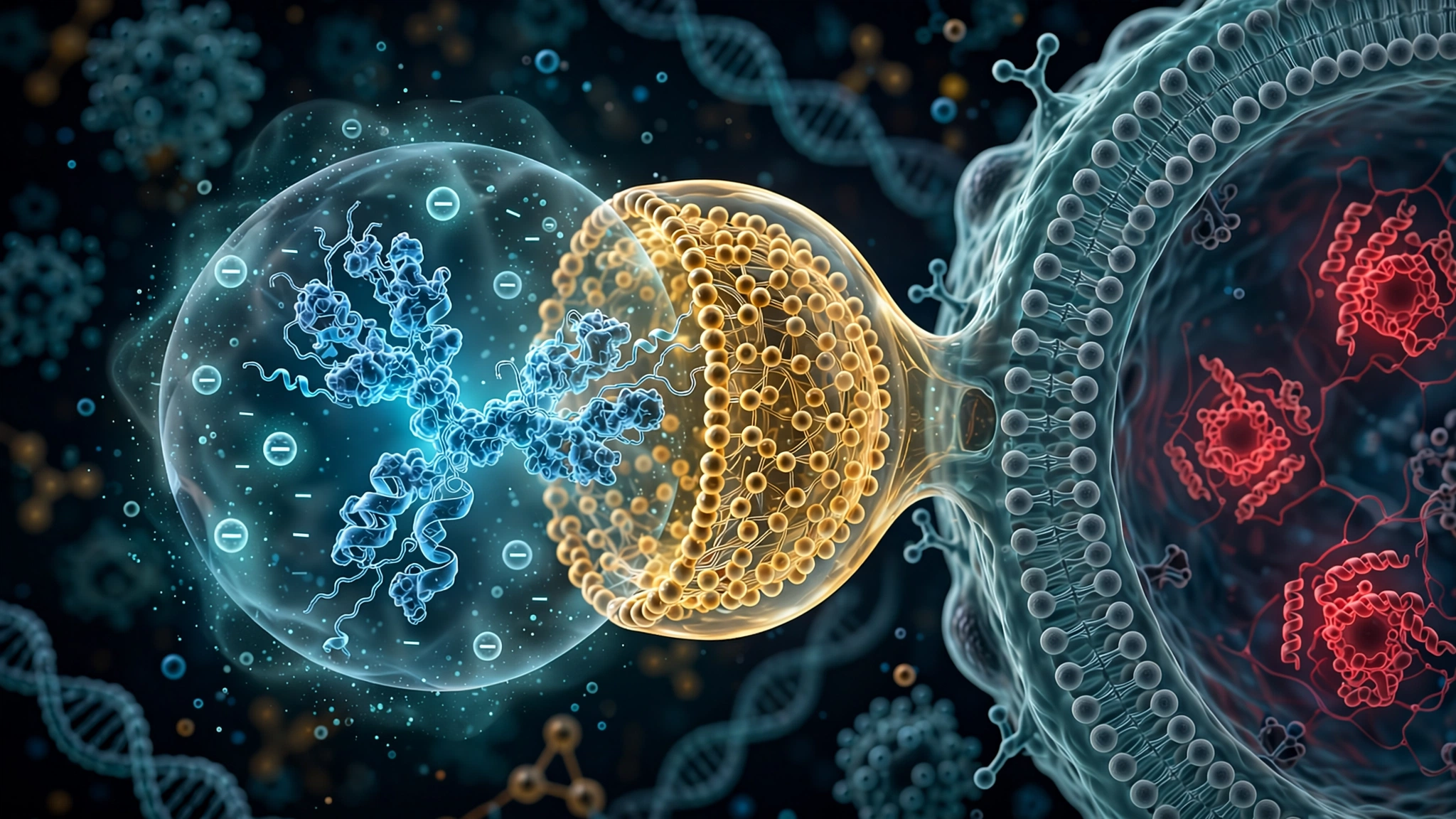
Chris Alabi and Matt DeLisa, both professors in Cornell's engineering college, had a simple but consequential idea. Lipid nanoparticles already know how to deliver cargo inside cells, and Pfizer and Moderna proved that at a scale of 4 billion COVID-19 vaccine doses by wrapping negatively charged nucleic acids in positively charged lipids. Antibodies are not negatively charged, so Alabi and DeLisa found a way to make them look like they are.
Their technique, developed with doctoral student Azmain Alamgir, attaches a sulfonate group called SL4 to the lysine residues on an antibody's surface, and because lysine is one of the most common amino acids in natural proteins, the approach generalizes to virtually any antibody in existence. SL4 coats those residues with negative charges, making the antibody electrostatically resemble an mRNA strand, so standard LNP formulations capture the cloaked antibody the way they would capture any nucleic acid payload.
Once inside the cell, the cloaking is reversible: the sulfonate tags shed in the cytoplasm, restoring the antibody to its native conformation, which means it folds correctly, binds its target, and does its job without gene therapy, viral vectors, or permanent genetic modification.
Three diseases, two continents, one platform
What makes the PNAS paper compelling is not the mechanism alone, because clever delivery chemistry has come and gone before. What stands out is the breadth of validation across three separate disease models, each targeting a different organ, each demonstrating that cloaked antibodies can reach and engage intracellular proteins that current therapeutics cannot touch.
First, the Cornell team delivered commercial anti-NF-κB antibodies to the lungs in a mouse model of acute lung injury, targeting a transcription factor that sits inside cells and orchestrates inflammatory cascades, a protein that has been a known therapeutic target for decades but that no antibody drug has ever been able to reach. Cloaked antibodies reached it.
Second, a team at the Technion-Israel Institute of Technology independently received the SL4 cloaking reagent and protocol, then used it to deliver anti-alpha-synuclein antibodies into brain cells. Alpha-synuclein aggregation is the molecular driver of Parkinson's disease, and it occurs inside neurons. Current anti-alpha-synuclein antibodies in clinical trials (including Roche's prasinezumab) can only mop up the protein outside cells, which is like trying to contain a house fire by hosing down the sidewalk. Avi Schroeder's group at the Technion showed the cloaked antibodies successfully entered neurons and engaged the intracellular target.
"This was one of the first instances where we essentially just shipped the material out and gave them the protocol," Alabi said. "It was satisfying to see that someone else in a completely different country under completely different conditions could take our material, apply it the way we had reported and get a positive outcome."
Third, in their earlier 2024 paper in ACS Central Science, the Cornell team demonstrated that ribonuclease A, a protein enzyme, could be cloaked and delivered to kill cancer cells outright, while monoclonal IgG antibodies inhibited tumor signaling from inside the cell, establishing that the platform works not only for delivering antibodies to intracellular targets but also for turning proteins into cytotoxic weapons against tumor cells specifically. Three diseases, three organs, two independent labs on separate continents. A broad debut for any platform technology.
The $69 billion calculation
The monoclonal antibody therapeutics market generated approximately $300 billion in 2025, growing at roughly 15% annually. Nearly every dollar of that revenue comes from antibodies targeting proteins on the cell surface or in the bloodstream. Keytruda, Humira, Herceptin, Opdivo: they all work outside the cell.
Meanwhile, a 2017 analysis of the druggable genome identified 4,479 protein-coding genes as plausibly druggable. Of those, 1,427 (Tier 1) are targets of approved drugs or clinical-phase candidates. But the vast majority of Tier 1 targets accessible to antibodies are extracellular. Intracellular targets remain dominated by small molecules, which face their own constraints: ~60% of small-molecule drug discovery projects fail because the target is not druggable.
Run the math. At ~$690 million in average annual revenue per targeted protein (dividing the $300B mAb market by 435 targets), opening even 100 new intracellular targets to antibody therapy represents a $69 billion annual market expansion, and that estimate is conservative because many of the most "wanted" intracellular targets are transcription factors and protein-protein interaction hubs that drive cancer, neurodegeneration, and autoimmune disease: NF-κB, KRAS, p53, MYC, beta-catenin. These are proteins that pharmaceutical companies have spent billions trying to drug with small molecules, often unsuccessfully. Bringing the full specificity of a monoclonal antibody to bear on these targets from the inside would change the therapeutic calculus.
A more aggressive estimate considers the 2,370 Tier 3 druggable genes, largely intracellular, that currently have zero approved therapeutics. If cloaked antibodies captured even 10% of these at a conservative $200 million per target, that is another $47 billion. The total addressable market expansion could plausibly exceed $100 billion annually.
COVID's industrial inheritance
The timing matters. Between 2020 and 2023, Moderna and Pfizer-BioNTech built out a global LNP manufacturing infrastructure capable of producing billions of doses per year. Lonza expanded its facilities in Stein, Switzerland, and Geleen, Netherlands. Evonik added 200 metric tons of GMP-grade lipid capacity at its Lafayette, Indiana plant in 2025. Precision NanoSystems validated its GenVoy-ILM platform for room-temperature stable formulations.
That infrastructure is now increasingly idle, with post-pandemic vaccine revenue in freefall: Moderna's market cap dropped from $133 billion at its peak to $24 billion today, Pfizer wrote off billions in unsold COVID vaccine inventory, and the LNP manufacturing lines that saved millions of lives are actively searching for their next payload.
Cloaked antibody delivery could be that payload, because the SL4 cloaking chemistry uses the same MC3 ionizable lipid formulation (or similar) that powered the COVID vaccines, which means no fundamental manufacturing retooling is required and the global CDMO network built for mRNA vaccines could pivot to cloaked antibody production using much of the same equipment, the same quality systems, and the same supply chains.
Alamgir, now a postdoctoral researcher at MIT, along with Alabi and DeLisa, have launched a spinout company called Cloak Bio to pursue commercial applications, and while they have not disclosed funding, the path from academic paper to clinical development has rarely been paved with better existing infrastructure.
What this does not prove
Everything demonstrated so far is in mice and cell culture, and no human has ever received a cloaked antibody, a gap that matters enormously for four reasons.
First, the immune system: attaching sulfonate groups to a protein's surface changes its immunogenicity profile in ways that are not fully characterized, and antibodies delivered intracellularly could trigger unexpected immune responses when the cloaking sheds inside cells, particularly in organs like the brain where immune privilege is complex.
Second, organ targeting: LNPs have a well-documented bias toward the liver, which accumulates a disproportionate share of injected nanoparticles regardless of intended destination, and while the PNAS paper demonstrated lung and brain delivery, it did not publish biodistribution data showing how much antibody ended up in off-target organs, which remains one of the hardest problems in LNP engineering.
Third, the "undruggable" framing is partly misleading, because many intracellular targets are undruggable not just because drugs cannot reach them, but because modulating them causes toxicity: NF-κB is essential for immune function, and blocking it systemically could suppress infection responses, while KRAS drives cell proliferation in normal tissue, not just tumors. Delivery is a necessary condition for drugging these targets, but not a sufficient one.
Fourth, protein stability: antibodies are notoriously fragile, and the cloaking and uncloaking process, the acidic environment of endosomes during LNP uptake, and the intracellular reducing conditions of the cytoplasm could denature many antibodies before they reach their targets. The Cornell team showed it works for anti-NF-κB, anti-alpha-synuclein, ribonuclease A, and IgG, but the full spectrum of antibody fitness under these conditions is unknown.
Strongest counterargument
The most serious challenge is not technical but biological. Even if cloaked antibodies reach every intracellular target on the "undruggable" list, the therapeutic window for most of those targets may be too narrow for a systemically delivered biologic. Antibody-drug conjugates have been in clinical use for over two decades, and their 1-2% delivery efficiency to tumor interiors is a feature, not a bug: it limits off-target toxicity. A platform that dramatically increases intracellular antibody concentrations could produce therapeutic effects and toxic effects in equal measure.
The history of intracellular biologics delivery is littered with platforms that worked in mice and failed in humans: cell-penetrating peptides, electroporation, polymeric nanoparticles, exosomes. Each solved the delivery problem in a model system and then struggled with the pharmacokinetics, immunogenicity, or manufacturing challenges of clinical translation. Cloaked antibodies may be different, but the burden of proof is on the platform, not on its critics.
What you can do
If you are a drug developer or biotech investor: The PNAS paper provides enough evidence to run internal feasibility studies. SL4 reagent targets lysine residues, which means it can be applied to virtually any antibody in your existing portfolio. The original calculation above identifies NF-κB, alpha-synuclein, and KRAS as early high-value targets, but any intracellular protein with a validated antibody could be a candidate. Contact Cloak Bio or the Alabi lab at Cornell for reagent access.
If you work in LNP manufacturing: The cloaked antibody platform uses the same ionizable lipid formulations as mRNA vaccines. Begin evaluating whether your existing manufacturing lines can handle protein-loaded LNPs. The key modification is milder formulation conditions (proteins are less tolerant of harsh mixing than nucleic acids), which may require adjustments to microfluidic mixing parameters.
If you are a patient or caregiver: This is preclinical research. No cloaked antibody therapy is available or in human trials. But if you or someone you know has Parkinson's, inflammatory lung disease, or a cancer driven by an intracellular target, the science is moving in the right direction. Track Cloak Bio's progress and watch for IND filings, likely 2-4 years away.
If you are a researcher: The SL4 protocol was independently replicated by the Technion with only shipped reagents and a protocol sheet, making this unusually accessible for a platform technology. Test it with your antibody of interest using the methodology in the PNAS paper and 2024 ACS Central Science paper.
The Bottom Line
Monoclonal antibodies are the most successful class of therapeutics in pharmaceutical history, generating $300 billion in annual revenue. But they have a fundamental limitation: they cannot get inside cells. Cornell's cloaking technique does not reinvent the antibody or the nanoparticle. It simply makes one look like the other, using a reversible chemical tag, proven lipid technology, and existing manufacturing infrastructure built for a pandemic that has passed. If even a fraction of the 85% of undruggable intracellular targets becomes accessible, the market expansion dwarfs anything the antibody industry has seen since Humira went off-patent. The lock is not the door. But the lock was always what stopped us from opening it.