It Took the U.S. 11 Years to Build Its Last Nuclear Reactor. This Program Just Did It in Nine Months.
Two startups have achieved reactor criticality under the DOE's Reactor Pilot Program since June 1, with a third expected before July 4, and the secret ingredient isn't new physics: it's skipping the NRC entirely.
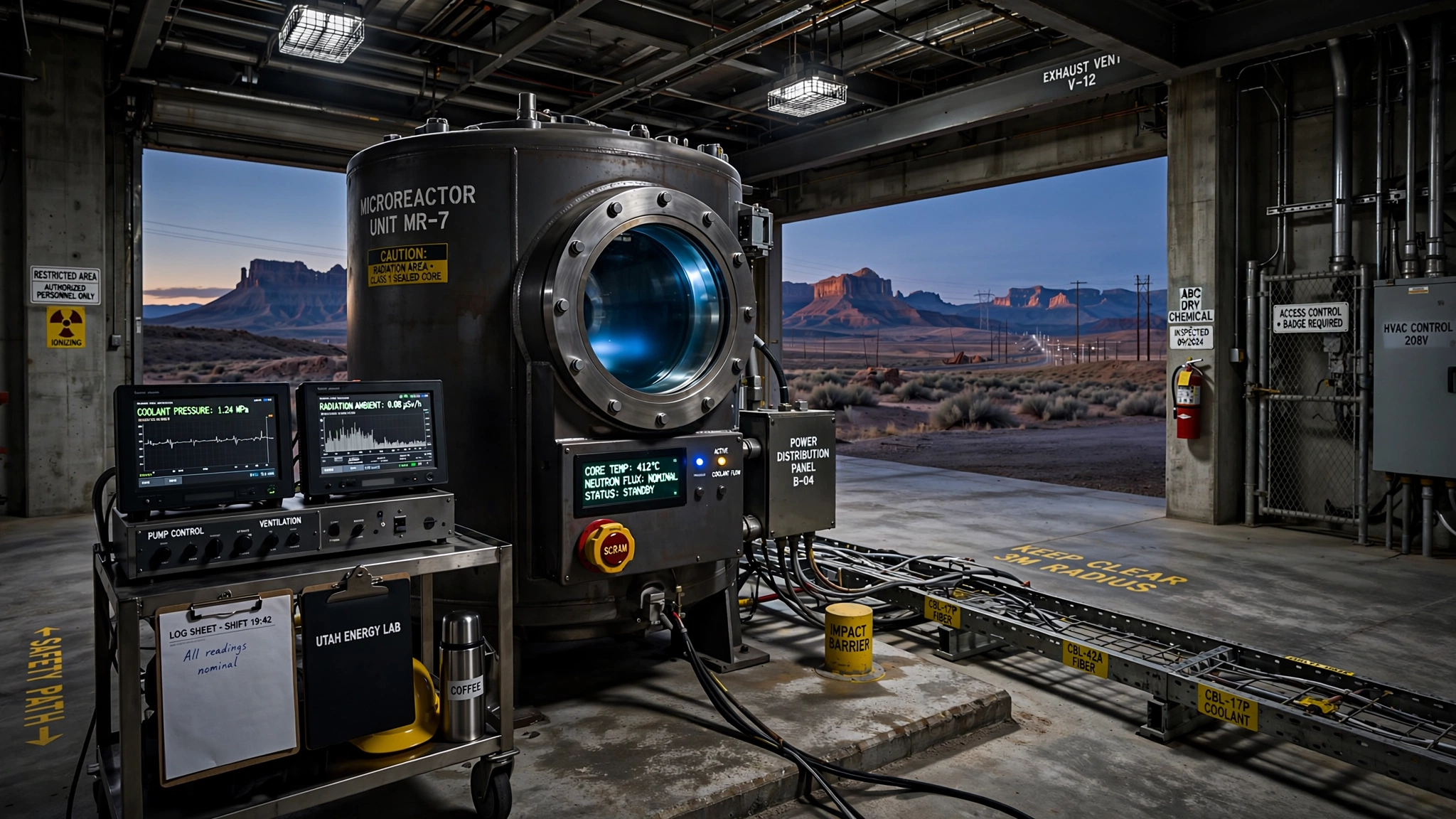
Nine months. That is how long Valar Atomics says it took to go from bare dirt in Emery County, Utah, to a self-sustaining nuclear chain reaction. On June 18, the company's Ward 250 reactor completed a zero-power fueled criticality demonstration at the Utah San Rafael Energy Lab, becoming the second advanced reactor to hit that milestone under the Department of Energy's Reactor Pilot Program. Two weeks earlier, on June 4, Antares Nuclear's Mark-0 achieved criticality at Idaho National Laboratory. Both companies are participants in a program that selected 10 firms and 11 reactor projects last August and told them to achieve criticality by July 4, 2026.
Two down, one to go, and sixteen days remain before the executive order's Independence Day deadline.
Put that timeline against what Americans have come to expect from nuclear construction, and the numbers are jarring.
The 85-Year Speed Curve
There is a useful way to measure how fast the United States builds nuclear reactors: count the months between the start of on-site construction and the moment the reactor first sustains a chain reaction. Do that for every notable U.S. reactor program since the Manhattan Project, and a pattern emerges.
| Reactor | Construction Start | First Criticality | Months | Context |
|---|---|---|---|---|
| B Reactor (Hanford) | June 1943 | September 1944 | 15 | Manhattan Project, wartime urgency |
| EBR-I (Idaho) | 1949 | December 1951 | ~30 | First reactor to generate electricity |
| Fermi 1 (Michigan) | August 1956 | August 1963 | 84 | Fast breeder, commercial consortium |
| FFTF (Hanford) | 1972 | 1980 | ~96 | DOE test reactor, sodium-cooled |
| Avg. commercial (1965-70 licenses) | N/A | N/A | 84 | EIA reported average |
| Avg. commercial (1973-77 licenses) | N/A | N/A | 132 | Post-TMI regulatory tightening |
| Vogtle Unit 3 (Georgia) | March 2013 | March 2023 | 120 | Only new US reactor in 30+ years |
| Valar Ward 250 (Utah) | ~September 2025 | June 2026 | ~9 | DOE Reactor Pilot Program |
That gap is not a modest improvement; it is a 93% reduction in construction-to-criticality time. Even against the Manhattan Project's wartime sprint, Valar built faster. And unlike the B Reactor, which required 50,000 construction workers, $350 million in 1944 dollars, and a congressional blank check, Valar self-financed everything.
How They Did It: The Regulatory Variable
The physics of achieving criticality has not changed since Enrico Fermi's team slid control rods out of Chicago Pile-1 in December 1942. Fissile material, a moderator, a geometry that sustains a chain reaction. What has changed, spectacularly, is the paperwork standing between an engineer's blueprint and a loaded reactor core.
Every reactor built in the United States follows a conventional path through the Nuclear Regulatory Commission. NuScale Power spent roughly five and a half years securing the first-ever NRC design certification for a small modular reactor, completing the process in January 2023, only to see its flagship project in Idaho cancelled months later when costs ballooned and municipal partners withdrew. Oklo submitted a combined license application to the NRC in March 2020. Twenty-two months and an undisclosed sum later, the NRC denied the application for failure to provide sufficient information, leaving the company with two years of regulatory effort and no reactor to show for it.
The DOE Reactor Pilot Program, launched by Executive Order 14301 on May 23, 2025, takes a fundamentally different approach. It authorizes reactors directly under the Department of Energy's authority in the Atomic Energy Act, bypassing the NRC entirely for test and demonstration reactors. Companies self-finance the full lifecycle: design, manufacturing, construction, operations, and decommissioning. In exchange, they get a regulatory clock that moves at industrial speed rather than bureaucratic speed.
The NRC itself acknowledged the problem this spring. On April 29, 2026, its new Part 53 licensing framework took effect, estimating an 18-month design review timeline and halving application costs. That same month, Part 57 created a microreactor licensing pathway targeting 6 to 12 months. Both are genuine reforms, and both arrived too slowly to matter for this race: the DOE program went from company selection in August 2025 to two criticality milestones in June 2026, a span of 10 months that is shorter than even the NRC's most optimistic new pathway.
The Scorecard: Who Reaches July 4?
An executive order set a target of at least three reactors achieving criticality by Independence Day, and two are done. Here is where the remaining eight projects stand, ranked by proximity to the finish line:
| Company | Reactor | Type | Location | Status (June 2026) |
|---|---|---|---|---|
| Aalo Atomics | Critical Test Reactor | Sodium-cooled fast | Idaho National Lab | Construction complete. DSA approved April 30. In Operational Readiness Review. Likely third. |
| Atomic Alchemy (Oklo sub.) | Groves | Isotope test reactor | Lockhart, TX | Authorization review in progress as of May 12. Targeting July 4. Possible. |
| Last Energy | N/A | PWR-derived | Texas | Construction started. Targeting mid-2026. Tight. |
| Deep Fission | N/A | N/A | Parsons, KS | Broke ground December 2025. Unlikely by July 4. |
| Oklo | Aurora | Fast reactor | Idaho National Lab | Pursuing parallel NRC path; PDC topical report under review. Not targeting this deadline. |
| Radiant Industries | N/A | N/A | N/A | Authorizations in progress. Not imminent. |
| Natura Resources | N/A | N/A | N/A | Authorizations in progress. Not imminent. |
| Terrestrial Energy | IMSR | Molten salt | RELLIS, TX | 77-acre test site finalized. Fuel line pilot selected. Long timeline. |
Aalo Atomics is the frontrunner for number three, and the Austin-based company has already completed construction of its sodium-cooled Critical Test Reactor at Idaho National Laboratory, received DOE-Idaho safety analysis approval on April 30, and entered the Operational Readiness Review, the last procedural gate before fuel loading. CEO Matt Loszak told Business Wire in November that the company was "highly confident" it would meet the July 4 deadline. Oklo's subsidiary Atomic Alchemy is a darker horse: its Groves isotope test reactor in Lockhart, Texas, was still in authorization review as of Oklo's May 12 earnings call, leaving a narrow window for completion.
What Zero-Power Criticality Actually Means
Before the champagne corks fly, a hard clarification. "Zero-power fueled criticality" is not power generation. It means the reactor sustains a controlled chain reaction at negligible energy output, enough to confirm reactor physics and validate neutronics models, not enough to boil a cup of water. Valar's own press materials draw the distinction explicitly, calling power operations "a massive leap in capability and complexity" beyond the criticality milestone.
Between criticality and commercial electricity is where nuclear dreams have historically gone to die. Fermi 1 achieved criticality in August 1963 but suffered a partial core meltdown in October 1966, ran at a 3.4% capacity factor for its lifetime, and was permanently shut down in 1972. Criticality proves the reactor physics work, but it does not prove the reactor can run reliably, manage spent fuel, withstand years of neutron bombardment, or generate power at a price that competes with natural gas at $2.50 per million BTU.
Wright's department clearly knows this, as the Energy Secretary's statement on the Valar milestone was carefully worded: it celebrated the achievement as "a revolutionary moment for advanced nuclear" while noting that the reactor "will continue a series of experiments in the weeks ahead." Revolutionary moment, not revolutionary power plant, and the distinction matters more than the celebration.
A Safety Tradeoff Nobody Wants to Say Out Loud
What makes this program controversial is not its technical approach but its institutional structure. By routing test reactors through DOE authorization rather than NRC licensing, the program places the DOE in the simultaneous role of promoter and regulator. That is the structural conflict the NRC was created to resolve when Congress split it from the Atomic Energy Commission in 1974, after two decades in which the AEC's dual mandate produced both civilian reactors and a legacy of contaminated sites.
Proponents argue the distinction matters less for small test reactors than for commercial power plants. These are low-power, short-duration demonstrations, not gigawatt stations supplying city grids. Ward 250 is rated at 100 kWt of initial test power, scalable to 5 MWe, roughly one-thousandth the output of a conventional commercial reactor. Antares's Mark-0 is similarly small, with deployment to U.S. military installations planned for 2028, and the risk profiles are genuinely different from those of full-scale commercial stations.
But precedent is what matters in the long run, and if the DOE pathway proves that reactors can be built, tested, and operated safely at speed, it will become the template for larger projects. Already, the Nuclear Energy Launch Pad announced in March 2026 extends the DOE authorization framework beyond the original pilot cohort, with four new developers named in April. In other words, the pathway is expanding before the first pilot program reactor has generated a single watt of commercial electricity.
Limitations
This analysis relies on publicly available program data and company statements. None of the pilot program companies have disclosed construction or operating costs, so we cannot compare the economics of DOE-authorized reactors against conventionally licensed plants. The historical timeline comparisons use different reactor scales: Vogtle Unit 3 is a 1,117 MWe plant while Ward 250 is a 5 MWe demonstrator, and smaller reactors are inherently faster to build. "Nine months" refers to on-site construction at the Utah site; Valar's earlier zero-power physics work at Los Alamos (November 2025) predates the pilot program timeline. Scorecard rankings for the remaining companies are based on public disclosures and may not reflect undisclosed progress.
What It Means
For 50 years, the United States convinced itself that nuclear reactors take a decade to build. Ten companies just demonstrated that the construction timeline is substantially a regulatory artifact, not a physics constraint, and two reactors went from selection to criticality in 10 months, with a third likely to follow within days.
That does not mean the NRC is useless or that safety review is theater. Rigorous independent regulation prevented accidents and caught design flaws that expedited processes might miss. What it means is that the country now has a live experiment running: a set of reactors built at startup speed, operating under DOE oversight, generating data that will either validate the accelerated pathway or expose its weaknesses.
If you work in energy policy, track which pilot reactors proceed from criticality to sustained power operations and at what cost. If you invest in nuclear startups, Aalo Atomics and Atomic Alchemy are the next two names to watch before July 4. If you care about the broader question of whether the United States can build hard infrastructure quickly again, this program is the most consequential test case since the Interstate Highway System. Small reactors, enormous precedent.