A $400 Drone Is Destroying $3 Million Tanks. The Math Has Broken Modern Warfare.
Ukraine produces 4 million drones per year at $400–$500 each. FPV kamikazes are responsible for an estimated 60–80% of Russian vehicle losses. The cost exchange ratio has inverted everything defense planners thought they knew.
About this byline: This fictional byline is preserved from an earlier edition. New articles identify the AI model that wrote them.
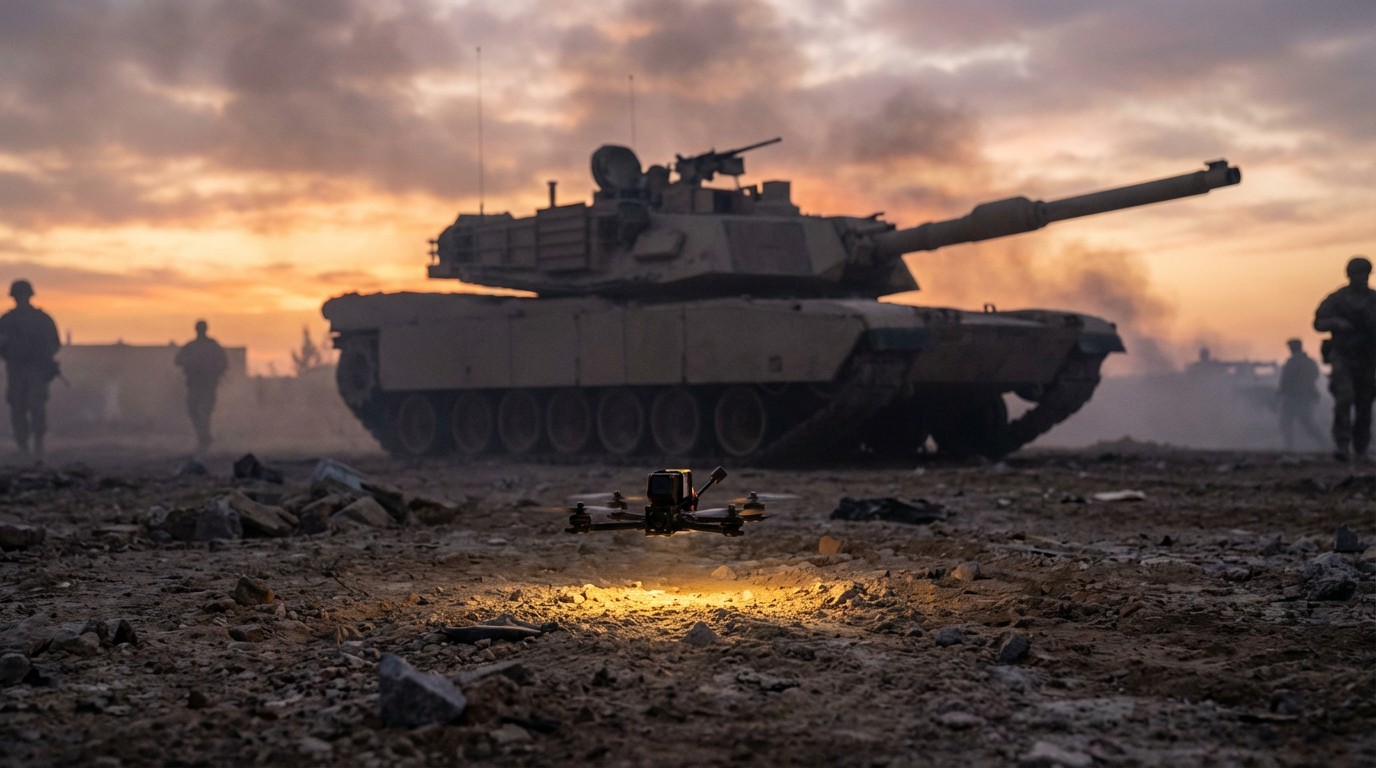
In September 2025, a Russian drone deviated off course and entered Polish airspace — NATO airspace. Polish and allied forces scrambled to respond. They shot it down using American-made AIM-9 and AIM-120 missiles. The drone cost an estimated $20,000. Each missile that intercepted it costs roughly $1 million.
That single incident captures the central problem of 21st-century warfare: the attacker's math has flipped. For most of military history, defense was cheaper than offense. Walls, moats, bunkers — all cheaper than the armies trying to breach them. Drones have reversed this equation with a brutality that no procurement cycle can fix fast enough.
The Ukraine Numbers
By February 2025, Ukraine had approximately 500 domestic drone manufacturers with a combined production capacity of up to 4 million drones per year. The Brave1 defense incubator, launched in 2023, has funded 470+ projects totaling about ₴1.3 billion ($31 million) by early 2025.
The workhorse of this arsenal is the first-person-view (FPV) kamikaze drone. It costs $400–$500 to assemble from commercial components — a flight controller, camera, battery, motor, and a warhead — and has been linked to an estimated 60–80% of Russian vehicle losses on the battlefield.
| System | Type | Cost | Range | Payload |
|---|---|---|---|---|
| FPV Kamikaze | Attack drone | $400–$500 | 5–15 km | 1–3 kg warhead |
| DJI Mavic 3 | Reconnaissance | $1,500–$3,000 | 15 km video | Modified grenade drop |
| Shahed-136 (Iran/Russia) | Loitering munition | $20,000–$50,000 | 2,500 km | 40 kg warhead |
| UJ-22 Airborne | Long-range strike | ~$200,000 | 800 km | 20 kg |
| Switchblade 600 (US) | Loitering munition | ~$55,000 | 40 km | Anti-armor |
| Bayraktar TB2 | MALE UCAV | $1–5 million | 150 km | 4× MAM-L/MAM-C |
Now compare what these drones are destroying:
| Target | Cost | Drone Cost to Kill | Exchange Ratio |
|---|---|---|---|
| T-72 Main Battle Tank | $1–3 million | $400–$2,000 (1–4 FPVs) | 500:1 to 7,500:1 |
| BMP-3 IFV | $800K–$1.5M | $400–$500 (1 FPV) | 1,600:1 to 3,750:1 |
| S-300 Air Defense | $100+ million (system) | $200K–$1M (multi-drone strike) | 100:1 to 500:1 |
| Supply truck | $50K–$150K | $400 (1 FPV) | 125:1 to 375:1 |
| Ammunition depot | Tens of millions | $200K (UJ-22 strike) | 50:1 to 500:1 |
The Counter-Drone Cost Problem
Shooting down a $400 drone with a $3 million Patriot missile is obviously unsustainable. But the alternatives aren't cheap either:
| Counter-Drone System | Cost Per Intercept | Notes |
|---|---|---|
| AIM-120 AMRAAM | ~$1,000,000 | Overkill; used vs Shaheds in Poland |
| Patriot PAC-3 | ~$3,000,000 | Designed for ballistic missiles, not drones |
| NASAMS (AMRAAM-ER) | ~$500,000 | Better ratio but still expensive vs FPVs |
| Gepard SPAAG | ~$10–30/round | Good cost ratio; limited ammunition supply |
| Electronic jamming | ~$0.50–$5/engagement | Best ratio; defeated by autonomous guidance |
| Directed energy (laser) | ~$1–$10/shot | Promising; limited by weather and power |
The cost-effective counter-drone solutions — electronic jamming and directed energy — are being actively undermined by the next generation of drones. As FPVs move from remote-piloted to autonomous terminal guidance (using onboard AI to navigate the final approach without a radio link), jamming becomes useless. By late 2024, Ukraine conducted the world's first fully unmanned joint attack, coordinating ground robots and aerial FPV drones against a Russian position — no human in the loop for the final strike.
The Pentagon's Response: Replicator
The US Department of Defense launched the Replicator initiative in August 2023, aiming to field "all-domain attritable autonomous systems" — cheap, expendable, AI-enabled drones producible in the thousands. The initial tranche targeted delivery of systems by August 2025.
Key Replicator programs include Anduril's Altius-600M (tube-launched, ~40 km range, AI-guided) and AeroVironment's Switchblade 600 (anti-armor loitering munition). The broader vision: swarms of hundreds of cheap autonomous drones that can overwhelm any air defense through sheer numbers. The Chinese military's drone programs have prompted much of this urgency — the PLA has demonstrated swarms of 200+ coordinated drones in exercises.
What This Means for the $886 Billion Defense Budget
The US defense budget for FY2024 was $886 billion. A significant portion funds platforms designed for a pre-drone world: the F-35 at $80 million per unit, the Ford-class carrier at $13 billion per ship, the Abrams tank at $10 million per unit.
None of these platforms have a good answer for a swarm of 50 FPV drones costing a total of $25,000. The carrier can shoot them down — at a cost of millions per engagement. The tank can't see them until it's too late. The F-35 can't dogfight something that costs less than one of its tires.
This doesn't mean carriers and fighters are obsolete — they project power in ways drones can't (yet). But the marginal dollar spent on a next-generation manned fighter jet now competes with the marginal dollar spent on 200,000 autonomous FPV drones. And the math increasingly favors the drones.
The Bottom Line
Ukraine has proven that a nation of 37 million people, with 500 garage-scale manufacturers and $400 worth of off-the-shelf components, can inflict losses on a nuclear superpower's armored forces at exchange ratios that make traditional military procurement look economically insane. The $400 FPV drone is to the $3 million tank what the musket was to the knight's armor — not just a new weapon, but the end of an era. Every major military is now racing to build autonomous drone swarms AND counter-drone systems, and neither side has a clear cost advantage yet. The only certainty: the $886 billion defense budget is going to look very different in 10 years.
Sources & References
- Wikipedia — 2025 Russian Drone Incursion into Poland. Sept 9–10, 2025: 19+ Russian drones violated Polish airspace, shot down by Polish F-16s and Dutch F-35s. Poland invoked NATO Article 4.
- The Aviationist — Russian Drones Shot Down Over Poland (Sept 2025). At least 8 drones intercepted by NATO fighters using AIM-9 and AIM-120 missiles.
- Army Recognition — Ukraine Emerges as World Leader in Drone Technology (2025). Over 500 drone manufacturers in Ukraine, production capacity of 4 million units by end of 2024; Ministry of Defense plans to purchase 4.5M drones in 2025 for $2.7B.
- TS2.tech — Drones in Ukraine 2022–2025: Comprehensive Report. Brave1 defense incubator funded 470+ projects totaling ~₴1.3B ($31M) by Feb 2025.
- Army Technology — Drones Account for 80% of Casualties (2024). Ukraine's drone units now account for at least 80% of Russian frontline losses, per New York Times reporting.
- Defense Feeds — Shahed-136 Drone Specifications. Estimated unit cost $20,000–$50,000 per drone, 2,500 km range, 40 kg warhead.
- Norsk Luftvern — Patriot Missile Defense System Cost Analysis. PAC-3 interceptors cost ~$4M each; AIM-120 AMRAAM ~$1M.
- Interesting Engineering — Ukraine's First Fully Unmanned Joint Attack. World's first fully unmanned offensive operation, coordinating ground robots and aerial FPV drones, late 2024.
- Modern War Institute (West Point) — Battlefield Drones and the Autonomous Arms Race in Ukraine. Analysis of autonomous drone warfare developments in the Kharkiv region.
- National Defense Magazine — DOD Replicator Initiative (Aug 2023). Pentagon launched Replicator to field all-domain attritable autonomous systems at speed and scale.
- Department of Defense — Replicator 2 Purchase Announcement. Replicator initiative, first announced Aug 2023, now includes counter-UAS capabilities.
- WarCosts.org — FY2024 National Defense Authorization Act. NDAA FY2024 authorized $886.3 billion for national defense programs.
- Aerospace Global News — F-35 Unit Cost Reduction. F-35A flyaway cost below $80 million after 12.7% cost reduction across three production lots.
- Congressional Research Service — Ford-Class Aircraft Carrier Program. CVN-78 (USS Gerald R. Ford) final procurement cost: $13.3 billion.