Grid Storage Just Split Into Three Chemistries. Only One Cost Metric Tells You Which Wins.
In a single week, CATL launched the first field-validated sodium-ion grid battery, Ore Energy signed Europe's largest iron-air contract, and Form Energy announced dozens of UK facilities. A three-way cost-per-cycle comparison using June 2026 pricing reveals sodium-ion undercuts LFP by 50 percent and iron-air undercuts sodium by 63 percent, but the conventional $/kWh headline metric hides the fact that each chemistry dominates a different duration band.
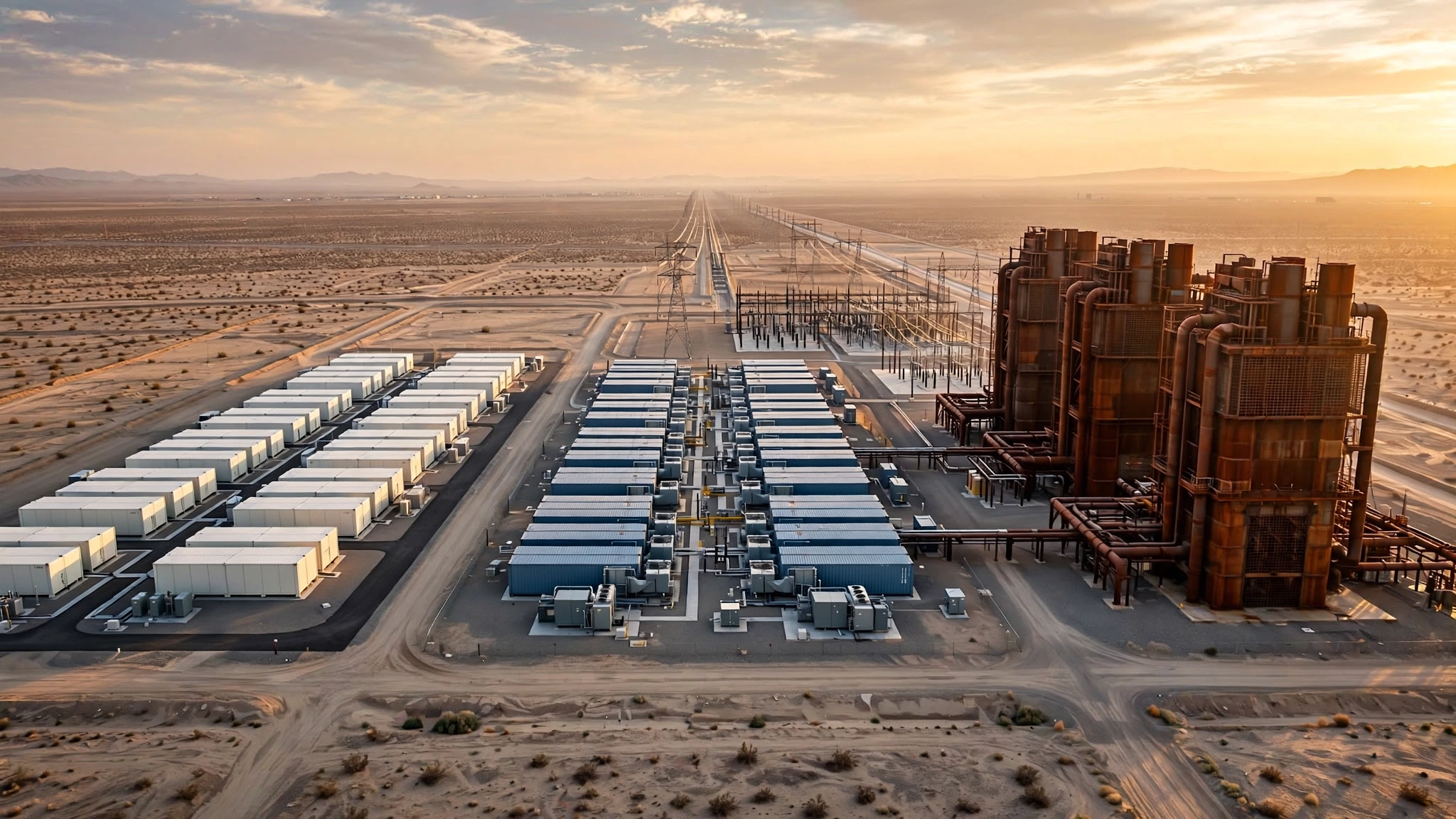
Zero point zero zero seven three eight dollars. That is what one kilowatt-hour of grid storage costs per charge-discharge cycle if you fill a sodium-ion battery at today's prices, a number nobody published before this week because the inputs did not exist until June 22, when CATL unveiled TENER, the world's first field-validated sodium-ion battery energy storage system. Three days earlier, Form Energy told the Times of London it would build "dozens" of iron-air battery facilities in the United Kingdom. And in between, on June 22, Ore Energy signed a 1 GWh iron-air deal in the Netherlands, the largest such contract in European history.
Three chemistry milestones landed in a single week, and nobody has run the three-way comparison that reveals which one actually delivers the cheapest stored energy, because the metric everyone reaches for first, the cell cost in dollars per kilowatt-hour, is the wrong number. A battery that costs $20/kWh but lasts 7,300 cycles delivers fundamentally different economics than one that costs $52/kWh and lasts 3,500 cycles, and understanding which is actually cheaper requires a metric that the industry has stubbornly refused to adopt as its standard benchmark despite two decades of grid storage deployment experience. You need to divide cost by cycle life to see what matters, and when you do, the grid storage market cleaves into three bands so cleanly it looks designed.
The Comparison Nobody Ran
Every source covering these announcements reported them as isolated stories. CATL's sodium play got its own headlines, iron-air got its own headlines, and LFP's continued dominance was background furniture that nobody questioned. What none of them did was put the three chemistries side by side with current June 2026 pricing and run the cost-per-cycle arithmetic that determines which chemistry wins at which duration, and that comparison follows.
| Metric | Sodium-Ion | LFP | Iron-Air |
|---|---|---|---|
| Cell cost ($/kWh) | $59 | $52 | $20 |
| Cycle life | 8,000 | 3,500 | 7,300 |
| Cost per cycle ($/kWh-cycle) | $0.00738 | $0.01486 | $0.00274 |
| Round-trip efficiency | ~90% | ~90% | ~52% |
| Efficiency-adjusted $/kWh-cycle | $0.0082 | $0.0165 | $0.0053 |
Sodium-ion's cell cost is 13 percent more expensive than LFP, yet its cost per cycle is 50 percent cheaper. What inverts the relationship is that sodium-ion delivers 8,000 cycles versus LFP's realistic 3,500 in grid-storage applications, based on MDPI lifecycle studies of CALB LFP cells that show lab-condition cycle counts of 8,000 degrade to 2,000-4,000 under real-world depth-of-discharge and temperature profiles. Zhongke Haina's sodium-ion cells have demonstrated 8,000-plus cycles under fast-charging conditions, and BYD claims 10,000 for their own formulation.
Iron-air is cheaper than both. Radically so. Even after you adjust for its brutal round-trip efficiency penalty, where you lose 48 cents of every dollar of electricity you store, its efficiency-adjusted cost per cycle of $0.0053 still undercuts sodium-ion by 36 percent and LFP by 68 percent. But iron-air batteries breathe, inhaling oxygen during discharge and exhaling it during charge in a process that takes 24 to 100 hours per cycle, which means they cannot respond to the minute-by-minute demands of frequency regulation or four-hour peak shaving. They are not competing with sodium-ion and LFP at all; they are solving a problem those chemistries cannot touch.
Three Duration Bands, Three Winners
The grid storage market is not one market. It is three.
Zero to four hours: sodium-ion. Daily arbitrage, buying cheap overnight solar and selling into the evening peak, demands high cycle counts, fast response, and tolerance for temperature extremes that would cripple a lithium battery without expensive thermal management systems adding cost and complexity to every installation. CATL's TENER system operates at minus 40 degrees Celsius while retaining over 90 percent of its capacity, a specification that opens deployment sites in Nordic countries and northern China where LFP batteries require heated enclosures that add 15-20 percent to system cost. At $0.0082 per kWh-cycle efficiency-adjusted, sodium-ion undercuts LFP by half for applications that cycle daily.
Four to eight hours: LFP, dominant but vulnerable. Peak shaving and solar time-shifting require medium duration and benefit from LFP's established supply chain, proven 15-year track records, and the largest manufacturing base in battery history. This is where the fight gets interesting, because sodium-ion's energy density has reached 175 Wh/kg, overlapping with LFP's 160-180 Wh/kg range for the first time. The density gap that kept sodium out of medium-duration applications is closing while lithium carbonate trades at $24,840 to $25,200 per ton, up 14.2 percent year-over-year, with UBS and Morgan Stanley warning of a potential 80,000-tonne deficit if African and Australian mining projects slip.
Twenty-four to one hundred hours: iron-air, unopposed. Multi-day storage, bridging the gap when wind stops blowing for three days or a winter storm blocks solar for a week, is where iron-air has no competition at any price point anyone can name. At $20/kWh versus $125/kWh for grid-scale lithium systems, the raw material equation is almost absurd: iron, water, and air, sourced from everywhere on Earth with zero supply chain concentration risk. Ore Energy's 1 GWh Netherlands deal includes a 400 MWh Phase 1 with 2028 delivery, and Form Energy's UK announcement alongside the Prince of Wales signals that this chemistry has crossed from pilot project to policy-endorsed infrastructure that governments are willing to bet public credibility on.
CATL's Efficiency Trick Is Worth $438,000 a Year
Buried in CATL's TENER press release is a detail that most coverage missed entirely. The system uses bi-directional DC voltage regulation that improves round-trip efficiency by two percentage points compared to industry-standard sodium-ion configurations, a gain that sounds trivial until you apply it to a 1 GWh installation cycling daily.
A 1 GWh system cycling once per day at 90 percent round-trip efficiency stores and releases 900 MWh of usable energy, and at 92 percent it releases 920 MWh. The difference, 20 MWh per day and 7,300 MWh per year, translates at European wholesale electricity prices of approximately €60/MWh into €438,000 per year of recovered energy. Over a 20-year system lifetime, the cumulative value of that two-point efficiency gain exceeds €8.7 million for a single 1 GWh site, assuming constant wholesale pricing, which is conservative given the secular upward pressure from data center load growth across Europe.
CATL also halved auxiliary power consumption from the industry average of 2 percent to 1 percent and cut system noise to 65 dB, ten decibels quieter than conventional installations. Noise matters. It determines setback distance from residential areas, and setback distance determines how close a battery can sit to the load it serves, which determines how much energy is lost in transmission. Every kilometer of high-voltage line between a battery and its grid injection point consumes 0.5-1 percent of delivered energy, so siting a quieter system 500 meters closer to a substation is an advantage that compounds across 7,300 annual cycles for 20 years in ways that never appear on a spec sheet but show up relentlessly in operating margins.
The Lithium Price Trap
LFP's dominance in the four-to-eight-hour band rests on an assumption that lithium carbonate will remain cheap enough to maintain the cell-cost advantage over sodium-ion, and recent history complicates that assumption considerably.
Between December 2025 and January 2026, lithium carbonate surged 95 percent in under two months, from $13,433 per ton to $26,278 per ton. The 2025 market had a surplus of 141,000 tonnes of lithium carbonate equivalent, but by the end of 2026, analysts project that surplus shrinking to approximately 109,000 tonnes, and a single major mine delay in the Democratic Republic of Congo or Western Australia could erase the buffer entirely, sending prices back to the peaks that briefly paralyzed procurement departments at utilities across three continents. Sodium does not share this vulnerability. It is roughly 1,000 times more abundant than lithium in the Earth's crust. It can be extracted from seawater, rock salt, or industrial brine at prices that are functionally decoupled from the geopolitical supply chain shocks that move lithium markets by 95 percent in eight weeks.
For a grid operator signing a 20-year storage contract, price stability is not a feature but a foundational requirement that governs every assumption in the financial model. And the arithmetic above shows that sodium-ion already delivers lower cost per cycle and superior supply-chain resilience, which means LFP's remaining advantage is manufacturing scale and track record, both of which erode on a predictable timeline once sodium-ion volume begins to compound.
Limitations
This analysis compares cell-level costs. System-level costs, including battery management systems, thermal management, housing, inverters, and grid interconnection, add 30 to 60 percent to cell costs and vary by chemistry in ways that could shift the per-cycle rankings. Iron-air's lower energy density means larger physical footprints and higher land costs per kWh, a factor invisible in cell-level comparisons. Sodium-ion's 8,000-cycle claim comes from manufacturer-reported testing by Zhongke Haina, not from independent verification in multi-year grid-storage deployments; no sodium-ion system has been operating at grid scale long enough to confirm that figure. Iron-air's $20/kWh is Form Energy's target projection, not a demonstrated commercial price at scale. LFP cycle counts vary enormously by manufacturer, C-rate, temperature, and depth of discharge; our midpoint of 3,500 is defensible for typical grid applications but is not universal. Iron-air's round-trip efficiency of 52 percent is the midpoint of a 45-60 percent range, and actual field performance across seasons and climates may diverge from this estimate.
The Strongest Case Against Three Chemistries
LFP manufacturers are not standing still. Not remotely. CATL, BYD, and EVE Energy are all pushing LFP cycle life toward 10,000-plus cycles with reformulated cathode chemistries, and cell costs continue falling as manufacturing scale compounds year after year. If LFP reaches $40/kWh at 6,000 cycles, its cost per cycle drops to $0.0067 per kWh-cycle, undercutting current sodium-ion pricing. LFP has the most manufacturing capacity on Earth, the deepest supply chain, the longest operational track record, and the largest installed base of any grid battery chemistry by a factor of twenty or more. History consistently shows that the chemistry with the most scale iterates past its challengers, not because it is fundamentally better, but because the feedback loops between volume, cost reduction, and reliability improvement are nearly impossible to replicate from a smaller base. It is entirely plausible that LFP absorbs both the short-duration and medium-duration bands by 2030 through sheer industrial momentum, relegating sodium-ion to niche cold-climate applications and iron-air to pilot-stage curiosity. That three-chemistry model may describe June 2026 perfectly and be obsolete by 2028.
What You Can Do
If you work for a utility or grid operator evaluating storage procurement, stop comparing bids on dollars-per-kWh alone. Require vendors to quote efficiency-adjusted cost per cycle for your specific use case: duration, cycling frequency, and site temperature profile. The chemistry that wins a four-hour daily-cycling contract in the Sonoran Desert, where temperatures routinely exceed 45 degrees Celsius and every heated LFP enclosure adds $15,000 in parasitic cooling costs, is not the chemistry that wins a 72-hour weather-gap contract in the Scottish Highlands, where the problem is not heat but the three consecutive days of zero wind that shut down 4 GW of offshore capacity twice last winter.
If you invest in energy storage, the signal from this week is that the market is segmenting, not consolidating. Pure-play sodium-ion companies like HiNa Battery and Zhongke Haina, and iron-air developers like Form Energy and Ore Energy, are not competing with LFP incumbents. They are opening duration bands that LFP economics cannot serve profitably, and the first utility to realize this is already signing contracts the rest of the industry does not yet understand. Watch for the first independent audit of sodium-ion cycle life in a grid deployment exceeding two years, because that data point, when it arrives, will determine whether the 8,000-cycle advantage holds outside the lab or joins the long list of manufacturer claims that dissolve under field conditions.
If you are a policymaker setting energy storage mandates, recognize that mandating "battery storage" without specifying duration requirements is like mandating "vehicles" without distinguishing between ambulances and freight trucks. California's storage mandates, the most aggressive in the world, already differentiate by duration. States and countries that follow California's lead on volume but not on duration specificity will overpay for the wrong chemistry in the wrong application.
The Bottom Line
The grid storage market did not gradually evolve toward three chemistries. It snapped into a three-band structure in one week in June 2026, when the last missing pieces, validated sodium-ion grid systems and commercial-scale iron-air contracts, arrived simultaneously. The metric that reveals this structure is not the one the industry has used for a decade, and switching from buy-cost to use-cost changes every procurement decision on the table. Cost per kilowatt-hour describes how much a battery costs to buy; cost per kilowatt-hour-cycle describes how much it costs to use, and the gap between those two numbers is where fortunes will be made and lost over the next decade. Buy a sodium-ion system for $59/kWh, use it 8,000 times over 20 years, and each use costs seven-tenths of a cent. Buy an LFP system for $52/kWh, use it 3,500 times, and each use costs one and a half cents. Cheaper to buy, more expensive to own. The era of one chemistry fitting all durations ended the same week it became possible to prove it with numbers.