A U.S. Factory Worker Costs $48.27 an Hour. A Humanoid Robot Costs $5.11. The Gap Is Widening by 35% Every Year.
Cross-referencing BLS employer compensation data against three independent robot cost analyses reveals the displacement constraint was never economics. It was always capability. That constraint is now dissolving.
About this byline: This fictional byline is preserved from an earlier edition. New articles identify the AI model that wrote them.
June 21, 2026
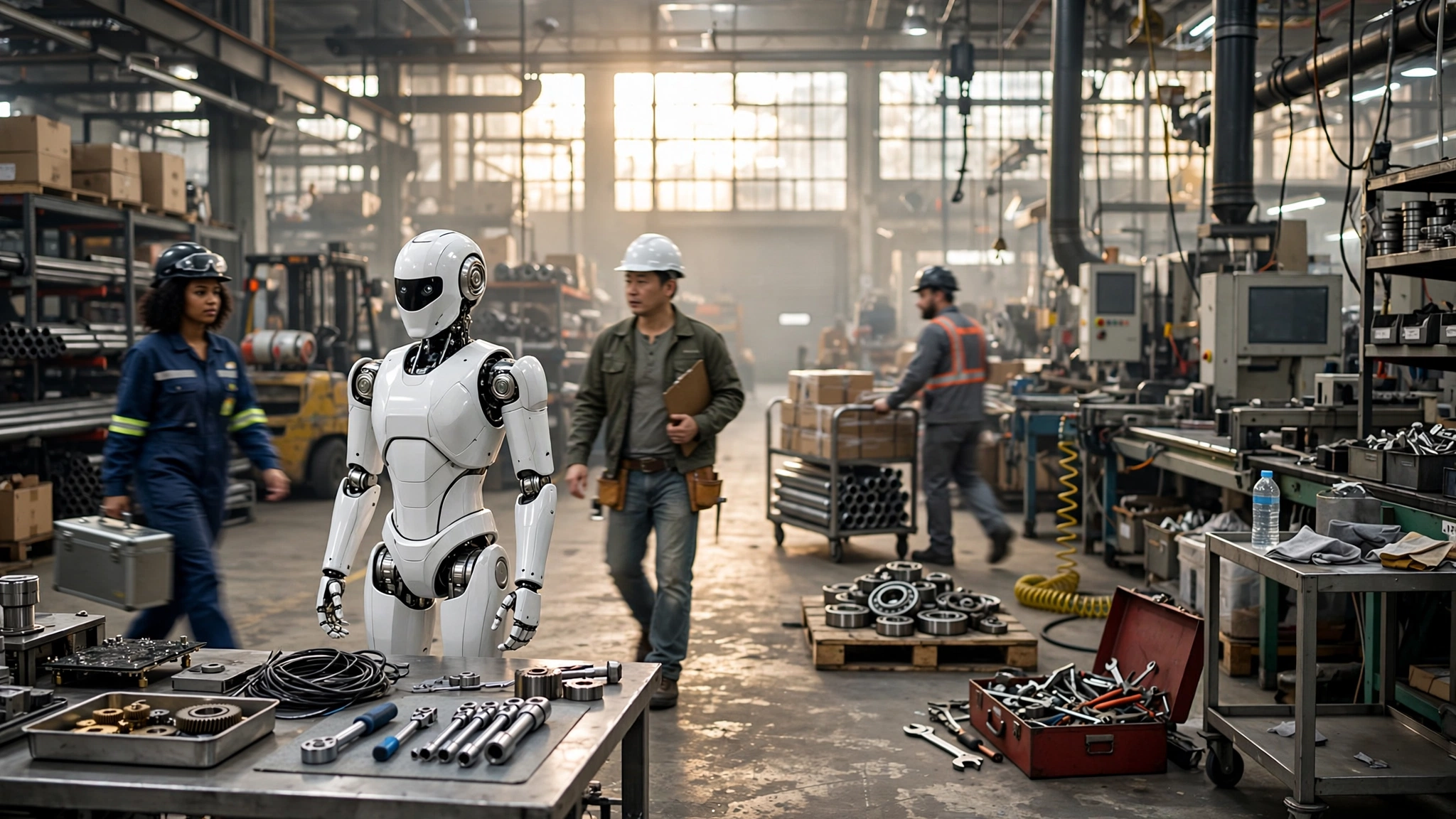
The Bureau of Labor Statistics published its Q1 2026 Employer Costs for Employee Compensation data this spring with the kind of quiet precision that makes government statistics easy to ignore, the sort of spreadsheet that arrives on a Wednesday afternoon and reshapes entire industries if anyone bothers to read it alongside the robotics cost data published the same month. Total employer cost for a private-industry worker: $48.27 per hour, composed of $32.20 in wages and $16.07 in benefits. For a unionized manufacturing worker, the total reaches $57.47, and for transportation and warehousing, $75.98. These numbers have been ticking upward at 3.4% annually, steady as a clock, for three consecutive quarters.
Meanwhile, three separate analyses published since April 2026 independently converged on a number that nobody in the labor economics community has seriously cross-referenced against those BLS figures. Roland Berger projected $2 per hour, Samsung Securities calculated $3.40 at current unit prices, and IDTechEx modeled below $5 under high-utilization conditions. I ran my own build-up using conservative assumptions and landed at $5.11. Four independent estimates converging within a $3 band isn't coincidence; it's the kind of signal that emerges when a technology crosses from theoretical modeling into measurable commercial reality.
The Math Nobody Published
Let me show the calculation because nobody else has. Take a humanoid robot at today's commercial price point of $100,000, which is where the market sits according to Samsung Securities' baseline modeling. Assume 22 hours of daily operation (two hours reserved for charging), 350 productive days per year (15 days for scheduled maintenance), and a five-year operational lifespan, which gives you 38,500 productive hours.
| Component | Annual Cost | Per-Hour Cost |
|---|---|---|
| Hardware amortization ($100K / 5 years) | $20,000 | $2.60 |
| Maintenance (15% of unit price/year) | $15,000 | $1.95 |
| Energy (500W × 22h × $0.12/kWh) | $482 | $0.06 |
| Software and cloud services | $3,850 | $0.50 |
| Total | $39,332 | $5.11 |
At $37,000, the price IDTechEx projects for 2030 based on a 68% decline from 2024's average selling price of $114,700, the same calculation yields $2.04 per hour. That almost perfectly validates Roland Berger's $2 projection, arrived at through entirely different methodology. At Tesla's stated target price of $20,000 for Optimus, it drops to $1.17.
Sector-by-Sector Parity Ratios
Now put those numbers against BLS Q1 2026 employer costs, because this is the comparison that matters and the one that neither the robotics industry nor the labor economics field has published in a single table.
| Sector | Human Cost/Hr | Robot Cost/Hr | Ratio |
|---|---|---|---|
| Transport & warehousing (union) | $75.98 | $5.11 | 14.9× |
| Healthcare & social assistance | $63.93 | $5.11 | 12.5× |
| Manufacturing (union) | $57.47 | $5.11 | 11.2× |
| Private industry average | $48.27 | $5.11 | 9.4× |
| Retail trade | $30.22 | $5.11 | 5.9× |
Every single sector is already above parity, not in 2030, not in 2035, but right now in Q1 2026. Retail at $30.22, the cheapest human labor in the BLS dataset, is still nearly six times more expensive than a robot operating at current hardware prices, and transportation and warehousing workers cost their employers almost fifteen times what a robot does. Economically, the argument for humanoid robot adoption ended sometime around 2024, when nobody was tracking it closely enough to notice, and what remains is a capability gap that is closing faster than most labor economists appreciate.
The Divergence Accelerator
The numbers above describe a snapshot, but the trajectory is considerably worse for anyone counting on the status quo. BLS data shows total employer compensation rising at 3.4% per year across private industry, a rate that has been stable for three consecutive quarters, which means it's structural rather than cyclical. Robot costs, by contrast, are collapsing at a pace that even the analysts covering the space failed to predict: Goldman Sachs reported in late 2025 that lower-end humanoid robot prices dropped 40% in a single year, from $50,000 to $30,000, far surpassing the firm's own initial forecast of 15-20% annual decline. IDTechEx tracks a broader average selling price decline from $114,700 in 2024 to a projected $37,000 by 2030, an annualized reduction of roughly 17%.
Run both rates forward five years and the picture crystallizes into something that should alarm labor planners and energize procurement teams in roughly equal measure. A private-industry worker costing $48.27 today will cost $57.10 by 2031 at the BLS trend rate, while a $5.11 robot costing 17% less each year reaches $2.05 by 2031, pushing the ratio from 9.4× to 27.9×. For union transportation workers, the gap expands from 14.9× to a staggering 43.9×. These curves are not converging; they passed each other years ago and are now accelerating apart at roughly 20 percentage points per year.
16,000 Units and Counting
Counterpoint Research counted approximately 16,000 humanoid robot installations worldwide in 2025 and projects that figure will exceed 100,000 by 2027, a sixfold increase in two years that, if realized, would represent one of the fastest industrial scaling events since the smartphone supply chain consolidated in the early 2010s. Omdia's assessment, published in January 2026, tracked roughly 13,000 units shipped, and the discrepancy between "shipped" and "installed" hints at something important: the gap between robots leaving factories and robots doing useful work on someone's production floor is still substantial.
China dominates by volume, and the scale advantage is not subtle. AGIBOT, a Shanghai-based startup founded in February 2023, shipped 5,100 humanoid robots in 2025, capturing 39% of global market share according to Omdia, then doubled its cumulative shipments to 10,000 units by March 2026 and is now pursuing a Hong Kong IPO at a $5.1-6.4 billion valuation. Unitree, the quadruped robot manufacturer turned humanoid maker, claimed 27% share, and the top five vendors together controlled 73% of the market.
Roland Berger's April 2026 study identified a stark regional split that complicates the obvious narrative. China has shipped 30 times more humanoid units than the United States, but the economics in China are significantly worse: Chinese manufacturing labor costs $4-6 per hour, making the robot-to-human ratio closer to 1:1 at current prices, which means the cost justification for deployment is almost nonexistent there. With a US ratio of 9-15×, American factories have far more economic incentive to automate but far fewer deployed units. China is scaling through volume and government coordination; the US is scaling through venture capital and the brute economic logic of a $48.27 human hour.
Proof of Deployment, Not Proof of Concept
The deployed base is small, but the data from early commercial installations is concrete enough to model against. Figure AI's Figure 02 robot worked daily 10-hour shifts at BMW's Spartanburg, South Carolina plant for 10 months, accumulating 1,250 operating hours and moving more than 90,000 sheet metal parts while supporting production of over 30,000 BMW X3 vehicles. BMW subsequently launched a second pilot at its Leipzig, Germany plant using AEON robots from Hexagon Robotics, marking the first deployment of humanoid robots in European automotive manufacturing.
In logistics, Agility Robotics' Digit humanoid moved more than 100,000 totes at GXO Logistics' facility in Flowery Branch, Georgia, in what the industry recognizes as the first formal commercial deployment. GXO operates under a multi-year Robots-as-a-Service agreement, the first of its kind for humanoid systems, under which the operator pays for utilization rather than outright ownership. Hyundai Motor Group has announced plans to deploy 25,000 Atlas robots across its factories starting in 2028, and Tesla has placed Optimus units on its Fremont assembly line with plans to scale to roughly 1,000 units by year-end.
Capital is following. NEURA Robotics closed a $1.4 billion Series C in June 2026, the largest funding round ever raised by a full-stack robotics company, with backers including Qualcomm, Amazon, NVIDIA, Bosch, and Schaeffler. NEURA's existing order book already exceeds $1 billion. Samsung Securities projects that integrating humanoid robots could enable automotive plants to shift from 10-hour daily operation to 24/7 production, raising annual output from 300,000 to 500,000 vehicles while cutting total manufacturing cost as a share of sales price from roughly 80% to as low as 44%.
The Strongest Case Against
The comparison in the table above is misleading in one critical respect, and acknowledging it honestly requires saying something the robotics industry's press releases never do: a $5.11-per-hour robot is not interchangeable with a $48.27-per-hour human, not remotely, and the gap between those two capabilities in 2026 is enormous. The most capable commercial humanoid robots today can perform perhaps 5-10% of the tasks a manufacturing floor worker handles in a shift. The BMW deployment moved sheet metal parts; the GXO deployment moved totes; these are narrow, repetitive, structured tasks that occupy a fraction of what a warehouse associate or assembly technician does in a single day, let alone across the range of edge cases and judgment calls that make up real industrial work.
IDTechEx is precise about this constraint, and the specificity matters because the headline payback number obscures the most important variable in the entire analysis. The six-month payback requires "high-utilization conditions" that most facilities cannot achieve, and the spread between high and medium utilization, which amounts to nine additional months of payback time, is explained entirely by how effectively the operator deploys the machine rather than by equipment cost. Humanoid robot utilization varies considerably by task type, workflow structure, environmental complexity, and software capability, which means a tightly structured automotive assembly cell delivers dramatically higher utilization than a mixed warehouse with variable package types and unpredictable layouts.
Honest framing requires splitting the question in two: the economics have been solved, but the engineering hasn't, and conflating the two leads to projections that are simultaneously correct on cost and wildly optimistic on impact. Cost is answered. Capability is what will determine whether 100,000 units in 2027 becomes 1.8 million by 2036, which is IDTechEx's projection, or stalls at something far smaller.
The Safety Signal Nobody Can Ignore
Rushing toward deployment is not without its warnings. In November 2025, Robert Gruendel, Figure AI's former head of product safety, filed a wrongful-termination lawsuit in California federal court alleging he was fired after warning CEO Brett Adcock that the company's Figure 02 robots generated forces more than double those required to fracture a human skull during internal impact testing. Figure AI disputes the allegations and says Gruendel was dismissed for performance reasons; the lawsuit is pending.
The case matters well beyond Figure AI because it's potentially among the first whistleblower cases focused specifically on humanoid robot safety, and the regulatory vacuum it exposes is one the industry's deployment pace is actively outrunning. OSHA currently has no regulations specific to humanoid robots operating alongside humans. ISO 25785-1, a dedicated standard for dynamically stable walking robots, remains under development. Existing safety frameworks were designed for traditional fenced-off automation, not for 180-pound machines navigating the same aisles as people. Senators Tom Cotton and Chuck Schumer have jointly introduced the American Security Robotics Act to bar federal agencies from purchasing robots from adversary-linked manufacturers, but the bill addresses supply chain security, not physical safety standards.
Limitations
This analysis has specific blind spots that should shape how seriously you take its conclusions. BLS compensation data aggregates across all establishment sizes; small manufacturers face lower employer costs, which narrows the ratio. Robot maintenance at 15% of unit price per year is an assumption borrowed from industrial robotics benchmarks, not from multi-year humanoid deployment data, which barely exists. Software and cloud services costs ($0.50/hour) are estimated from comparable industrial automation platforms rather than humanoid-specific contracts, and real-world downtime and failure rates from pilot deployments have not been publicly disclosed with enough consistency to validate utilization models. Chinese labor cost comparisons rely on industry analyst estimates rather than government statistical data. And critically, none of the robot cost projections include the cost of regulatory compliance, insurance premiums, or safety testing, all of which could materially increase the effective hourly rate as the regulatory landscape matures.
The Bottom Line
For years, the labor cost displacement debate has been framed as a question of when robot economics would become competitive with human workers. That question was answered sometime in 2024 and nobody published the math. BLS data shows that even at today's $100,000 unit prices, a humanoid robot's all-in operating cost of $5.11 per hour undercuts every sector of the US private economy by a factor of 6 to 15. Both curves are diverging at 20+ percentage points per year. By 2031, the ratio in manufacturing will be roughly 28:1.
What you can do depends on where you sit. If you manage a manufacturing floor or warehouse, the honest answer is that pilot programs with RaaS (Robots-as-a-Service) providers like GXO's Agility Digit arrangement are now the lowest-risk way to test whether your specific workflows can achieve the utilization rates that justify deployment, without capital commitment. If you're a union negotiator, the threat model isn't a humanoid robot that replaces your members tomorrow. It's a 17% annual price decline that makes the same conversations drastically harder to have in three years. Start the retraining and transition planning now, when leverage exists. If you're a policymaker, the gap between 16,000 units deployed worldwide and the regulatory infrastructure governing them is already uncomfortable. OSHA's silence on humanoid robot safety standards in mixed environments will look untenable after the first serious injury. Any window for getting ahead of this is measured in months, not years.