$700 Billion in AI Spending Depends on a Metal 70% Sourced From Chinese Zinc Smelters. Almost Nobody Is Tracking It.
The G7 just launched a Critical Minerals Alliance to reduce dependence on China. Indium, the element that makes every AI optical interconnect work, isn't even on the pilot list.
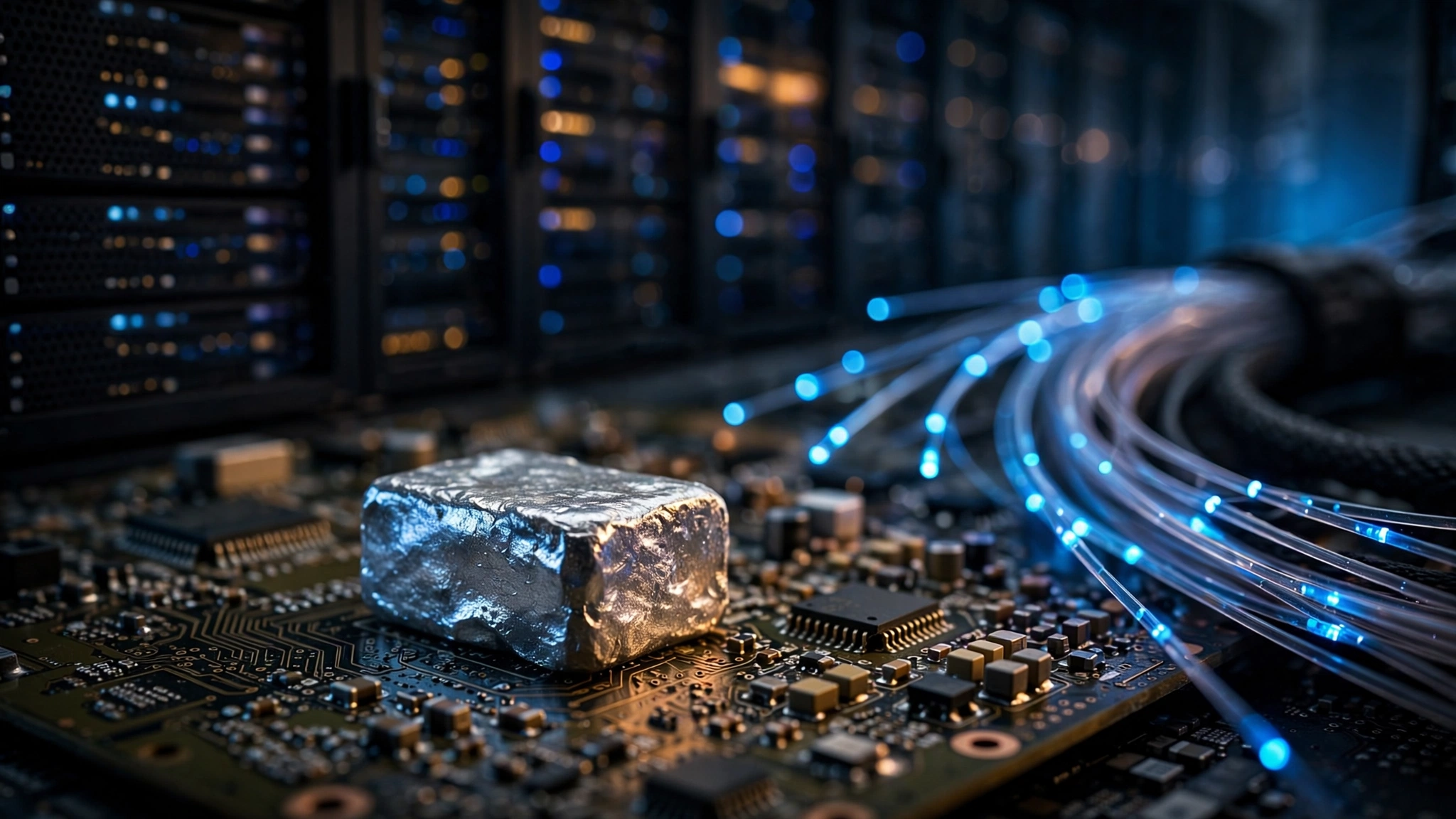
The number is $26 billion. That is the projected size of the global AI optical transceiver market in 2026, according to TrendForce, up 57% from $16.5 billion last year. Shipments of 800-gigabit and faster modules will hit 63 million units, a 2.6-fold increase over 2025. Every one of those modules exists to solve the same problem: moving data between GPU clusters fast enough that artificial intelligence can actually learn.
Without optical transceivers, a data center full of Nvidia H200s is a warehouse full of expensive space heaters. The top four U.S. hyperscalers (Alphabet, Amazon, Meta, and Microsoft) have collectively guided to $700 to $725 billion in capital expenditure for 2026, according to J.P. Morgan, roughly 75% more than the $410 billion they spent last year. By 2027, the top five (adding Oracle) are expected to exceed $1.1 trillion. Almost all of it flows into AI data center infrastructure.
Here is what virtually none of the analyst reports, earnings calls, or capital allocation debates mention: every medium- and long-reach optical transceiver in those data centers relies on lasers built from indium phosphide, a compound semiconductor whose primary raw material is indium. And 70% of the world's refined indium comes from one country.
The Metal at the Bottom of Everything
Indium is a soft, silvery-white metal with atomic number 49. You cannot mine it. It does not occur in deposits of its own. It is recovered as a byproduct of zinc smelting, scraped from the residues left after primary metal processing. Global refinery production in 2024 totaled roughly 1,090 metric tons, according to USGS Mineral Commodity Summaries 2026. China produced an estimated 760 tons of that, or 69.7%. South Korea contributed 180 tons (16.5%). Canada, the third-largest producer, managed 40 tons. It is declining.
Those numbers matter because indium is the precursor to indium phosphide (InP), the compound semiconductor substrate on which virtually all medium- and long-range optical laser chips are fabricated, and without which the photonic links connecting AI server clusters at distances beyond a hundred meters would simply not exist. An electro-absorption modulated laser (EML) operating at 1,310 or 1,550 nanometers, the workhorse wavelength for data center interconnects beyond 100 meters, is built on an InP wafer. So is the continuous-wave laser diode used in silicon photonics co-packaging, and so is the photodetector on the receiving end.
Short-reach transceivers use vertical-cavity surface-emitting lasers (VCSELs) built on gallium arsenide, which does not require indium. But VCSELs work only for distances under roughly 100 meters. For everything beyond that distance, from rack-to-rack fabric and data center interconnect to the long-haul links connecting distributed AI training clusters, the industry runs on InP. By market value, InP-based transceivers account for an estimated 80% of the $26 billion AI optical module market, or roughly $20.8 billion.
Four Layers of Chokepoint
China's leverage over this supply chain operates at multiple levels, and Beijing has been tightening each one in sequence. Deliberately.
Layer 1: Raw indium. China produces 70% of global supply, and because indium is a byproduct of zinc refining, production cannot be ramped independently. You do not build an indium mine; you build a zinc smelter and hope the ore contains enough indium to justify extraction. Supply, in the language of commodity economists, is highly inelastic. "The tight supply of crude indium is a long-standing structural issue, exacerbated by China's increasingly stringent environmental protection policies," Cristina Belda, a senior analyst at Argus, told Reuters earlier this year. Rotterdam spot prices hit $500–600 per kilogram in February 2026, up more than 55% since September 2025 and the highest level in over a decade.
Layer 2: Indium phosphide compound. Beijing placed indium phosphide on its export control list in February 2025, a restriction significant enough that Coherent Corp CEO Chuck Mattera traveled to Beijing with President Trump in May 2026 to raise the issue directly, according to Reuters.
Layer 3: InP wafer fabrication. Only a handful of companies globally can grow the single-crystal InP ingots and slice them into the atomically precise wafers that optical chip fabrication requires, a process that demands years of capital investment and proprietary crystal growth expertise that cannot simply be purchased off a shelf. Coherent operates fabs in Sherman, Texas and Järfälla, Sweden, where it established the world's first 6-inch InP wafer capability in March 2024, while AXT Inc. (now part of MACOM) also grows InP substrates. But even these non-Chinese producers source some fraction of their raw indium from the global market where China sets the marginal price.
Layer 4: Laser chip manufacturing. EML chips fabricated on InP wafers are produced by a similarly small group of companies, including Lumentum, Coherent, Mitsubishi, Sumitomo, and Broadcom, and Nvidia, anticipating the bottleneck well before most of its customers did, has pre-allocated a substantial share of global EML capacity to secure supply for its GPU cluster interconnects. TrendForce reported that this strategic lockup has pushed lead times beyond 2027 and created a worldwide shortage that is forcing other module makers and cloud service providers to scramble for secondary suppliers and alternative laser designs.
We Have Seen This Playbook Before
On August 1, 2023, China imposed export licensing controls on gallium and germanium products, citing national security. China produced 94% of the world's gallium at the time, and the market response was immediate and brutal: gallium prices climbed from roughly $300 per kilogram to $595, the highest in 13 years, while germanium more than doubled from $1,200 to $2,600 per kilogram. In the first quarter of 2024, China's gallium exports fell 74.1% year over year and germanium exports dropped 62.8%.
A USGS study modeled the GDP impact of a complete Chinese export ban on both minerals and arrived at $3.4 billion in losses to the U.S. economy, concentrated overwhelmingly in semiconductor manufacturing, a finding that understates the downstream disruption because it predates the current AI infrastructure buildout and does not account for the ripple effects through GPU cluster deployment timelines. Actual restrictions fell short of a total ban, but the price and volume effects were severe enough to reshape procurement strategies across the defense and electronics industries overnight.
China's indium market share (70%) is lower than its gallium dominance (94%), but the structural dynamics are nearly identical: a byproduct metal with inelastic supply, concentrated production, no meaningful strategic reserve outside China, and rising demand from a sector that cannot substitute away.
The Math Nobody Is Running
Here is the calculation that does not appear in any hyperscaler earnings call, G7 communiqué, or semiconductor industry forecast we reviewed. Nobody runs it because the numbers are inconvenient.
Start with the $26 billion AI optical transceiver market and subtract the roughly 20% of market value served by VCSEL-based short-reach modules that use gallium arsenide, not InP. That leaves approximately $20.8 billion in InP-dependent transceivers.
Now trace the raw material back to its origin. China produces 70% of global refined indium, and while non-Chinese InP wafer producers (primarily Coherent and AXT/MACOM in the U.S. and Sweden) can source from South Korea, Canada, and recycled indium tin oxide from LCD panels, they operate in a global market where Chinese output determines the marginal price and availability. Conservatively, 60–70% of the InP supply chain's raw material traces back to Chinese zinc smelters, which implies roughly $12.5 to $14.6 billion of the AI optical transceiver market has direct Chinese supply chain exposure at the material level.
But the transceivers are just the capillaries of a much larger body. A single GPU server rack in a modern AI cluster requires 32 to 64 optical transceivers for its network fabric, and a 100,000-GPU training cluster, the kind Meta, Microsoft, and xAI are now building, needs more than 200,000 optical modules. Without them, the GPUs cannot communicate, the training run cannot proceed, and the $700 billion in capital expenditure produces nothing.
No transceiver, no training. No indium, no transceiver. That is the dependency chain, and right now it runs through Beijing.
The G7 Blind Spot
On June 17, 2026, G7 leaders meeting in Évian-les-Bains announced the G7 Critical Minerals Resilience and Production Alliance, a framework to reduce dependence on single-source suppliers. Its target: below 60% reliance on any non-G7 country for rare earths and permanent magnets by 2030, with an ultimate goal of 50%.
The alliance will begin traceability mechanisms with two pilot minerals, lithium and nickel, adding five additional minerals each year. At that pace, indium might not receive formal G7 attention until 2028 or 2029.
By then, according to J.P. Morgan, the hyperscalers will have spent a cumulative $5.5 trillion on AI infrastructure, and the optical interconnect buildout will be substantially complete, constructed on whatever supply chain was available during the spending sprint. The window for diversification is now. Not in three years.
China's foreign ministry responded to the G7 announcement by urging the group to "respect market economy principles and international trading rules" rather than forming what it characterized as "small cliques." Meanwhile, Chinese customs officials have begun requiring first-time end-user disclosures from indium buyers, Reuters reported on June 19. A European buyer was asked to disclose where their end users were based. A North American buyer said approval timelines had stretched from same-day to several days, and while the scrutiny is not uniform (two other buyers told Reuters they had not experienced it), the pattern is unmistakable. End-user tracking preceded formal export controls on gallium and germanium by approximately six months.
The Strongest Case Against Alarm
Coherent's 6-inch InP wafer fabs represent a genuine step toward supply chain resilience. Larger wafers yield more laser dies per run, reducing per-unit cost and increasing output from existing infrastructure. Moving from the industry-standard 2-inch and 3-inch wafers to 6-inch is comparable to the transition that silicon went through decades ago, and it is happening in U.S. and Swedish facilities outside Chinese jurisdiction.
Additionally, the absolute mass of indium consumed by the InP photonics industry is modest relative to total global production: a 2-inch InP wafer weighs roughly 3.8 grams, of which about 3 grams is indium, and even at 63 million transceivers annually the photonics industry's direct indium consumption is measured in hundreds of kilograms, not hundreds of tons. ITO recycling from decommissioned LCD panels offers a growing secondary source, and silicon photonics, where the optical modulation happens on a silicon chip with only an external InP laser source, reduces (though does not eliminate) the InP footprint per transceiver.
The counterargument is real but incomplete, because processing capacity, not raw tonnage, is the binding constraint. Growing single-crystal InP ingots with the defect density low enough for telecom-grade laser fabrication requires years of process development and capital investment that cannot be accelerated by throwing money at zinc smelters, which is why Coherent's 6-inch breakthrough is notable: it took years to achieve, and nobody else has replicated it, even with the commercial incentive now plainly visible.
Limitations
This analysis relies on estimates where proprietary data is unavailable: the InP wafer market is opaque, and exact indium consumption by the photonics industry is not publicly reported by any major producer. The 80/20 split between InP-based and VCSEL-based transceivers by market value is derived from industry pricing differentials and TrendForce shipment mix data, not from a single definitive source. Some emerging architectures, including co-packaged optics with integrated silicon photonics and linear-drive pluggable modules using distributed feedback (DFB) lasers, may shift this ratio over time, and China's customs scrutiny may reflect routine enforcement tightening rather than a prelude to formal export controls, given that some buyers told Reuters they had not experienced increased scrutiny at all. The pattern matches the gallium/germanium precedent, but precedent is not prediction.
The Bottom Line
Seven hundred billion dollars in AI capital expenditure, routed through 63 million optical transceivers, ultimately depends on a metal that most technology investors have never thought about. China controls 70% of global indium production, has already restricted the processed compound, and is now probing the raw material supply chain with the same end-user scrutiny that preceded formal controls on gallium and germanium.
The G7's new Critical Minerals Alliance is the right instinct, but it is starting with the wrong minerals. Lithium and nickel matter for batteries, but indium matters for the infrastructure that is supposed to justify the largest capital expenditure cycle in the history of technology.
What you can do: If you manage infrastructure procurement at a cloud provider, transceiver supplier, or data center operator, run the indium audit now: map your optical supply chain back to raw material origin and identify your tier-2 and tier-3 exposure to Chinese zinc smelters. If you invest in AI infrastructure, ask the companies you hold whether they have done the same. If you work in trade policy, note that indium is absent from both the G7 traceability pilots and the U.S. critical minerals reserve (Project Vault). The gap between the scale of AI spending and the fragility of its optical supply chain is not a theoretical risk. It is an open line item that nobody has priced in.