Microsoft Promised Carbon-Free AI by 2030. Then It Built 4.75 Gigawatts of Gas Plants.
Microsoft is internally debating whether to abandon its hourly clean energy matching pledge while simultaneously building three new natural gas facilities that would increase its data center carbon footprint by 160%. Behind-the-meter gas demand surged from 5% to 39% of all new US methane capacity in a single year. Our calculation: the gap between annual and hourly matching costs $3–5 billion per year for Microsoft’s growing fleet.
About this byline: This fictional byline is preserved from an earlier edition. New articles identify the AI model that wrote them.
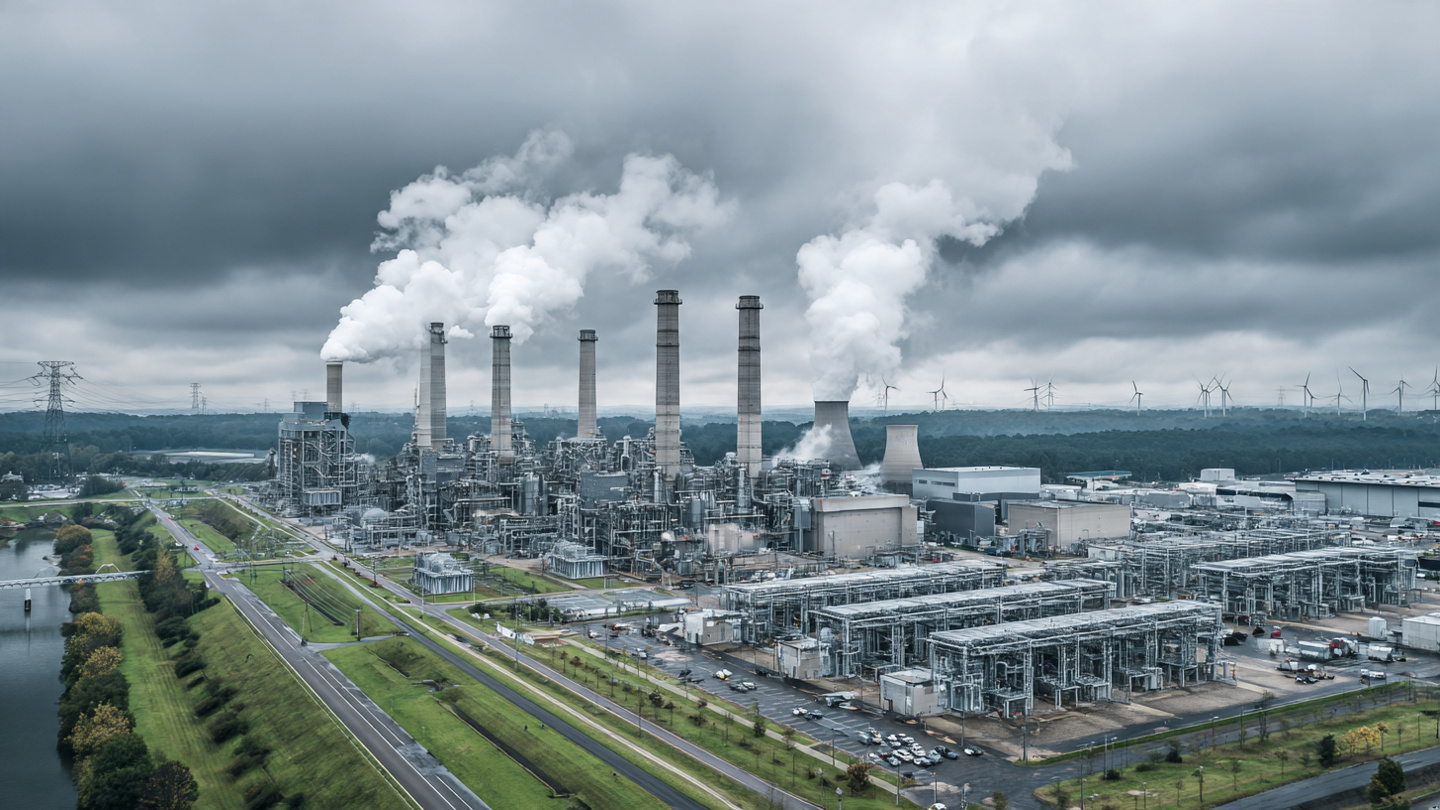
Four point seven five gigawatts of new natural gas capacity, announced in a single month, by a company that promised to be carbon negative by 2030.
In 2020, Satya Nadella committed Microsoft to becoming carbon negative by 2030, and that commitment included the most aggressive clean energy target in corporate history: 100/100/0, meaning 100% of electricity matched with zero-carbon sources, 100% of the time, every hour of every day, not as an annual accounting exercise but as actual, continuous, hour-by-hour clean power flowing into every data center on the planet. Six years later the company is adding roughly 1 GW of AI data center capacity every three months, and according to Bloomberg reporting from May 6, internal teams are now debating whether to delay or outright abandon that hourly matching pledge while the gas plants go up around them.
Three Projects, 15.52 Million Tonnes
Stand.earth documented three new methane gas projects announced in a single month this spring: a 2.5 GW facility in Pecos, Texas, built with Chevron and Engine No. 1 and expandable to 5 GW; a 1.35 GW campus in Mason County, West Virginia, operated by Nscale; and a 900 MW facility in Abilene, Texas, run by Crusoe, with combined projected emissions of 15.52 million tonnes of CO₂ equivalent per year.
Microsoft’s total reported emissions had already increased 30% in the three years after Nadella’s 2020 pledge, and these three projects alone would add another 160% on top of that already-swollen baseline, which means this is not a company on a path to carbon negativity but a company building fossil fuel infrastructure at a pace that would embarrass a mid-tier oil producer.
Our Calculation: The Clean Energy Honesty Gap
Nobody has published the hour-by-hour math on what “annual matching” actually conceals, so we ran the numbers ourselves, starting with a typical 1 GW data center operating 24/7 with annual electricity demand of 8,760 GWh. Solar capacity factor in the US averages around 25%, wind around 35%, blended approximately 30%, which means you need about 3.3 GW of solar and wind nameplate capacity to produce 8,760 GWh annually, and Microsoft can buy renewable energy certificates covering that output and claim “100% renewable.”
But at 2 a.m. solar produces nothing, wind is intermittent, and most US grid regions run 40-60% on fossil fuels overnight, so a data center operating under annual matching draws coal and gas power for roughly half the day, then offsets it with daytime solar certificates. A company claiming 100% renewable energy is actually fossil-fueled 40-60% of the time during off-peak hours.
Hourly matching changes everything because you need clean power at 2 a.m. in January, which means batteries with 4-8 hour duration at $150-300/MWh, geothermal, nuclear, or hydro to fill every gap, and adding roughly 500 MW of battery storage per GW of data center capacity approximately doubles energy procurement cost.
| Metric | Annual Matching | Hourly (24/7 CFE) |
|---|---|---|
| Energy cost | $15-25/MWh | $50-80/MWh |
| Multiplier vs annual | 1x | 3-4x |
| For 10 GW fleet (annual) | $1.3-2.2B | $4.4-7.0B |
| Incremental cost | Baseline | $3-5B/yr extra |
| Actual fossil hours/day | ~10-14 hours | ~0 hours |
Read that last row carefully: a company running annual matching burns fossil fuels for 10-14 hours every day while calling itself “100% renewable,” and the gap is not a technicality but 15.52 million tonnes of CO₂.
Behind the Meter: The Fastest Fossil Expansion You Have Never Heard Of
When Microsoft builds a gas plant directly connected to a data center, not plugged into the public grid, that capacity sits “behind the meter,” and because traditional Scope 2 emissions reporting only covers grid electricity, behind-the-meter generation occupies a gray zone where corporate sustainability reports can sidestep the worst numbers entirely.
How fast is this growing? At the end of 2024, on-site data center gas capacity represented 5% of all new methane demand in the United States, and one year later it had ballooned to 39%, meaning that behind-the-meter data center gas demand in 2025 exceeded all methane gas capacity demand from every sector in the prior year combined.
This is the fastest-growing category of fossil fuel demand in America, and almost nobody talks about it because the data centers generate their power off-grid, off-books, and off the sustainability report.
The Counterargument, at Full Strength
Microsoft has done more for corporate clean energy than any company in history, and that claim holds up under scrutiny: its portfolio includes 40+ GW of renewable power purchase agreements across 26 countries, over 400 individual deals, representing more clean energy procurement than most entire nations manage. Annual matching, even when accomplished with unbundled renewable energy certificates, directs real capital toward real wind and solar projects that would not exist otherwise, and Wilson Ricks of the Clean Air Task Force told Heatmap News that hourly matching “was always going to be difficult,” noting that only two companies globally (Microsoft and Iron Mountain) even attempted it, which suggests the target was aspirational rather than operational from the start.
There is a stronger version of this argument, and it goes like this: if Microsoft refuses to build gas-backed data centers in the United States, the AI workloads do not disappear but migrate to regions with dirtier grids, weaker environmental regulation, and zero accountability, which means that running AI on US natural gas at 0.4 tonnes CO₂/MWh is measurably better than running it on Indonesian coal at 1.0+ tonnes CO₂/MWh, and building gas capacity in Texas with carbon capture plans, even speculative ones, is preferable to building unconstrained capacity in jurisdictions where no one is watching.
This argument deserves serious engagement because it is largely correct on the near-term emissions math, but the question it leaves unanswered is whether “better than the worst alternative” is the right standard for the company with the second-largest market capitalization on Earth.
Limitations
Bloomberg’s May 6 report cites unnamed internal sources, and Microsoft has neither confirmed nor denied reconsidering the hourly pledge. Our honesty gap calculation uses industry-average capacity factors (25% solar, 35% wind) and national-average grid mix data, but Microsoft’s actual data center locations, power purchase agreement terms, and hourly consumption profiles are proprietary, so our estimates could differ from their internal figures by 20% or more in either direction. Stand.earth is an advocacy organization whose projected 160% emission increase relies on full-capacity operation of all three gas projects, which may not materialize immediately, and corporate PPA costs vary significantly by region and contract structure. We also do not know the carbon capture provisions, if any, in Microsoft’s gas plant contracts.
What You Can Do
If you are a data center customer: Ask your cloud provider for hourly carbon intensity data, not annual averages. Google publishes regional carbon data by hour. Azure publishes annual numbers. Request the same granularity and choose regions with verified 24/7 clean supply. US-West (Washington state hydro) and Nordics (hydro plus wind) consistently outperform Texas and Virginia.
If you are a policymaker: Behind-the-meter gas exploits a reporting loophole in EPA Scope 2 methodology. Require data centers above 100 MW to disclose all on-site generation emissions regardless of grid connection status. Virginia’s Loudoun County and Georgia’s Newton County have already restricted data center builds on local grid capacity grounds, but no US jurisdiction currently addresses behind-the-meter gas at all.
If you are an investor: Watch corporate PPA disclosures for the shift from hourly to annual language. BloombergNEF reports that corporate clean power contracting fell 10% to 55.9 GW in 2025, the first significant slowdown in a decade. If Microsoft publicly abandons hourly matching, expect the entire 24/7 CFE movement to stall. Only two companies attempted it. Soon it may be zero.
If you are a Microsoft shareholder: At the annual meeting, ask one question: “What percentage of Azure compute-hours are powered by fossil fuels right now, measured hourly, not annually?” If the answer is classified, that tells you everything.
The Bottom Line
Microsoft’s 100/100/0 pledge was the gold standard for corporate clean energy because it was the only target that closed the gap between accounting and physics. Annual matching lets you burn gas all night and buy solar certificates in the morning. Hourly matching forces you to actually solve the storage, transmission, and generation problems that decarbonization requires.
Abandoning hourly matching while building 4.75 GW of gas plants is not a pivot. It is an admission that AI growth and climate commitments are, at current technology and current prices, mutually exclusive at Microsoft’s scale. The honest version of that admission would be worth something. Instead, the company is building gas plants behind the meter where the emissions do not show up on the sustainability report, buying annual renewable certificates for the electricity that does hit the grid, and hoping nobody does the hour-by-hour math.
We did the math. The honesty gap is $3-5 billion per year and 10-14 hours of fossil-fueled operation every single day. At some point a climate pledge that excludes half the clock stops being a pledge and starts being a press release.