⚡ Energy
A $10-Per-Square-Meter Membrane Just Cut Oil Refinery Energy Use by 37.6%. It Was Hiding in Water Filters.
KAIST researchers published in Nature showing that polyacrylonitrile, a commodity polymer used for decades as a throwaway support layer in water purification membranes, can pre-fractionate crude oil at room temperature. Applied globally, the energy savings would exceed France's entire annual electricity consumption.
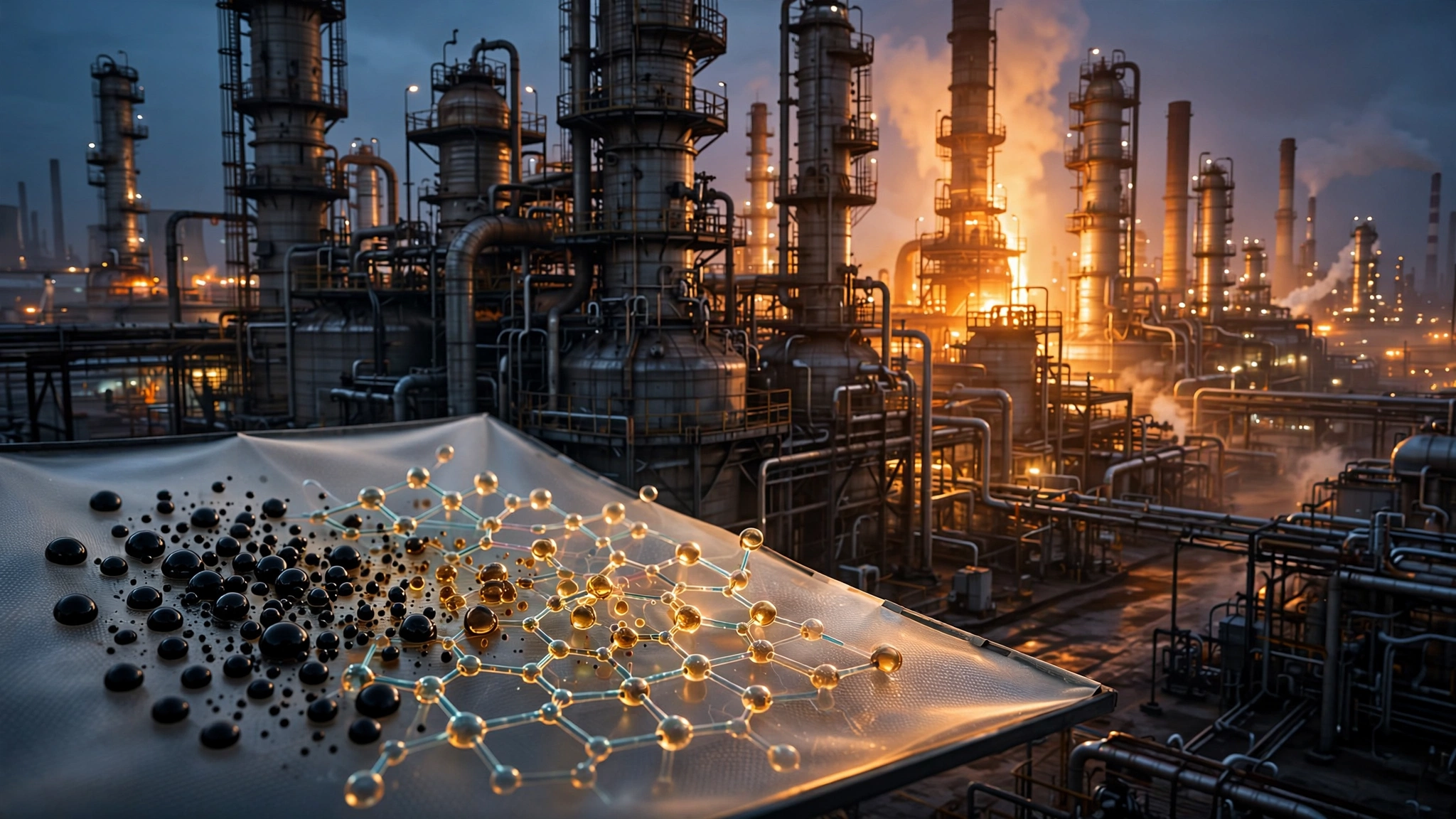
1,100 terawatt-hours. That is how much energy the world's refineries burn each year just to boil crude oil into its constituent parts: gasoline, diesel, kerosene, and the heavy residua that become asphalt and lubricants. Equivalent to the total annual energy consumption of New York State, that number represents roughly 1% of all energy used on Earth. Humanity has been performing this separation by heating crude oil in towering distillation columns since the 1860s, and the fundamental approach has barely changed in 160 years. Dead simple. You heat the mixture. Lighter molecules rise. Heavier ones stay low. Collect them at different heights, and you have gasoline, diesel, jet fuel, asphalt.
A team at the Korea Advanced Institute of Science and Technology just demonstrated that a cheap plastic sheet can do a substantial portion of the same job at room temperature, with no furnace, no steam, no cooling towers, and no combustion of any kind.
Their paper, published today in Nature, shows that mesoporous polyacrylonitrile (PAN) membranes with pores measuring 8 to 10 nanometers can selectively fractionate crude oil, separating light hydrocarbons from heavy ones based on molecular confinement effects rather than boiling points. When the researchers modeled a hybrid process, combining membrane pre-fractionation with conventional distillation, the results were striking: 37.6% less furnace energy, 20.7% less cooling water, 37.6% less CO2, and a 36% reduction in total annualized refinery cost, from $140.3 million to $89.8 million per year.
That membrane material costs $10 per square meter. You have probably already used products filtered through it; PAN membranes are mass-manufactured globally as support layers for reverse osmosis water purification.
Why Nobody Tried the Obvious Material
Membrane-based crude oil separation is not a new idea. Researchers have been chasing it for over a decade, publishing landmark papers in Science at a remarkable pace. A Georgia Tech and ExxonMobil team demonstrated spirocyclic polymers in 2020. A Queen Mary University group showed hydrophobic polyamide nanofilms in 2022. MIT and ExxonMobil published microporous polyimine membranes in 2025. Each was a genuine advance, representing thousands of hours of synthetic chemistry and careful characterization. Each required custom-synthesized polymers that existed only in research laboratories, produced in gram-scale batches by doctoral students using multi-step synthesis routes, with no clear path to manufacturing at the thousands-of-square-meters scale that a single refinery would demand, let alone the global fleet of 700.
PAN was sitting right there the whole time. Manufacturers already produce it in enormous rolls for water treatment plants on every continent. But membrane researchers considered it "non-selective," meaning it did not discriminate between molecules of different sizes in liquid filtration. For water applications, PAN served purely as a structural scaffold, a cheap substrate supporting a thin active layer of fancier material on top, invisible to the chemists who published paper after paper on the exotic polymers deposited onto it and utterly ignored by the process engineers who might have thought to run crude oil through it rather than water. Nobody tried.
What Jihoon Choi, Hyeokjun Seo, and senior author Dong-Yeun Koh at KAIST discovered was that PAN's supposedly non-selective pores become highly selective when filled with crude oil instead of water. At 8 to 10 nanometers, the pores are small enough to trigger nanoconfinement effects: heavier hydrocarbon molecules experience changes in viscosity and even freezing-point depression inside the pore channels, while lighter molecules flow through relatively freely. Around C24 the carbon number cut-off falls, meaning the membrane lets gasoline and diesel-range molecules pass while rejecting heavier fractions. In the paper's most vivid demonstration, jet-black Arabian Light crude enters one side of the membrane; what emerges on the other side is a yellow-to-colorless liquid enriched in light naphtha. Black in, clear out.
Running the Global Numbers
The question nobody has answered yet is what these results would mean if membrane pre-fractionation were deployed across the refining industry. We ran the calculation using the paper's per-refinery figures, public IEA throughput data, and the carbon intensity estimates from Jing et al. (2020).
| Metric | Conventional Distillation | With PAN Pre-Fractionation | Savings |
|---|---|---|---|
| Furnace energy (per refinery/yr) | $140.3M (TAC baseline) | $89.8M (TAC) | $50.5M / 36% |
| Global distillation energy | ~1,100 TWh/yr | ~686 TWh/yr | ~414 TWh/yr (37.6%) |
| Human-scale anchor | 414 TWh = ~92% of France's entire annual electricity consumption (450 TWh) | ||
| Cooling water reduction | Baseline | -20.7% | Significant in water-stressed regions |
| Economic (700 refineries, 100% adoption) | ~$35.4B/yr | ||
414 terawatt-hours per year is a number so vast that it defeats intuition entirely, requiring comparison against the annual energy output of whole nation-states before the mind can assign it any weight. For comparison, the entire global solar PV industry added approximately 600 TWh of new generation in 2025. A single process change in oil refining could recover two-thirds of that, not by building anything new, but by wasting less heat in the oldest industrial separation process on Earth. And the CO2 implications follow directly: at a conservative estimate of 0.5 kg CO2 per kWh of refinery thermal energy, 414 TWh in saved furnace fuel translates to roughly 200 million tonnes of avoided annual emissions. For context, the United Kingdom's total industrial CO2 output is around 140 million tonnes per year.
The Cost Paradox
Here is where the economics become genuinely strange. Previous membrane approaches were exciting science but terrible business propositions. Custom-synthesized spirocyclic polymers or polyimine films might cost hundreds or even thousands of dollars per square meter at lab scale, with no existing manufacturing infrastructure to produce them at refinery volumes. KAIST's result inverts this problem entirely. PAN costs $10 per square meter. Toray, INGE (a BASF subsidiary), and numerous Chinese producers already manufacture it in industrial quantities, with roll-to-roll fabrication lines, established quality control processes, and mature supply chains already in place serving the water treatment sector.
Process simulation pegs total annualized cost savings at $50.5 million per refinery per year. A large refinery processing 100,000 barrels per day would need, at the membrane fluxes reported in the study, a membrane area on the order of several thousand square meters. At $10 per square meter, the membrane material cost is negligible, a rounding error against a $50 million annual saving, the kind of cost asymmetry that makes procurement departments wonder whether they are reading the decimal point correctly. Even accounting for membrane housing, pumps, and cross-flow filtration infrastructure, the capital expenditure is modest compared to a distillation column that can cost $100 million to build. A full 36% reduction in total annualized cost, as reported in the paper, accounts for the membrane system's full capital and operating expense.
Where This Breaks Down
The gap between a Nature paper and a working refinery is enormous. It always is. Intellectual honesty demands stating exactly where this research stops and where conjecture begins.
First, there is scale. Ryan P. Lively, a chemical engineer at Georgia Tech who is both a co-author on this paper and the researcher who published the first crude oil membrane separation in Science, has himself acknowledged the fundamental challenge: "The main challenge facing membranes is the enormous scale of crude oil processing." A single large refinery processes 100,000-plus barrels per day. All KAIST experiments used laboratory-scale membrane cells. No one has built a membrane system that handles even 1% of a commercial refinery's throughput. Not even close.
Second, fouling remains a concern. Crude oil contains asphaltenes, resins, and metalloporphyrins that adhere to membrane surfaces and degrade performance over time. Steady-state operation under cross-flow conditions is reported in the paper, but the timescales tested remain far shorter than the continuous multi-year operation that refineries require. PAN's chemical stability is well characterized for aqueous environments, but how the polymer behaves over months and years of continuous contact with the thousands of distinct molecular species present in crude oil, from light paraffins to heavy asphaltenes to trace metals, remains genuinely unknown.
Third, crude oil variability presents an open question. Only two crude oil types were tested: Arabian Extra Light (AXL) and Arabian Light (AL), both relatively low-viscosity, low-asphaltene crudes. Heavier crudes like Canadian oil sands bitumen or Venezuelan Orinoco crude, which constitute a significant and growing share of global throughput, present fundamentally harder separation challenges. No claim is made that results generalize to all feedstocks.
Fourth, the energy savings figures come from process simulation using Aspen HYSYS, not from a running industrial pilot. Process models are essential engineering tools, but they carry assumptions about heat integration, pressure drops, and membrane replacement cycles that can diverge meaningfully from operational reality.
The Strongest Case Against
The most serious objection to membrane refining has nothing to do with chemistry or physics. It is about incumbent infrastructure and incentive structures, the same forces that kept coal plants running two decades after natural gas became cheaper, and that kept incandescent bulbs in hardware stores a decade after LEDs became superior. The global refining industry has approximately $1.5 trillion invested in distillation-based infrastructure, with equipment lifetimes measured in decades. Refiners that have already depreciated their distillation columns face a marginal cost of continued operation that is far lower than the total cost of installing a new membrane system, even if the membrane system is cheaper on a greenfield basis. This is the same lock-in dynamic that has slowed every industrial transition in modern history: a new technology can be demonstrably superior on every metric and still lose to the installed base for an entire generation, because the marginal cost of running existing equipment is always lower than the full cost of replacing it.
Moreover, refineries operate at razor-thin margins, typically 3 to 8% of revenue, and their operators are among the most risk-averse industrial decision-makers on Earth. Proposing a novel membrane pre-treatment step in front of a distillation column means persuading operators to insert an unproven technology into the most critical process in a facility where an unplanned shutdown costs $1 million or more per day. Risk tolerance at these facilities is near zero, which explains why even obviously beneficial process improvements can take a decade to propagate across the industry. Rational caution.
What You Can Do
If you work in refinery operations or process engineering, the most immediate takeaway is to track the KAIST group's next publications, because the critical milestone will be a pilot-scale demonstration at HD Hyundai Oilbank, which supplied the crude oil for this study and whose involvement signals commercial interest well beyond the laboratory. A membrane retrofit that reduces furnace load by even half the paper's claimed 37.6% would justify pilot investment at most mid-complexity refineries.
If you invest in energy infrastructure, the indicator to watch is whether a major refiner, ExxonMobil, Shell, Saudi Aramco, or Reliance Industries, announces a licensing agreement or pilot partnership. ExxonMobil has already funded three previous membrane crude oil separation studies. Saudi Aramco co-sponsors the research center where Koh holds a secondary appointment. The commercial interest is real, even if the timeline is measured in years, not quarters.
If you care about industrial decarbonization as a citizen or policymaker, the lesson here is counterintuitive but important: the single largest source of avoided emissions in the refining sector may not come from shutting refineries down, at least not in the medium term. Global crude oil demand is projected to remain above 90 million barrels per day through at least 2035 under every major forecasting scenario. A technology that makes existing refining 37.6% less carbon-intensive would eliminate more emissions, faster, than any plausible near-term reduction in oil demand.
The Bottom Line
For 160 years, the only way to sort crude oil into useful products was to boil it. Brute force. A team in Daejeon, South Korea, just showed that a polymer sheet you can buy for the price of a coffee can do a substantial fraction of the same work at room temperature. The material was never exotic; it was simply never asked the right question. Whether this translates from a laboratory bench to the 700 refineries that process the world's crude supply is an engineering challenge, not a science problem. The science, published today in Nature, is settled: PAN membranes selectively fractionate crude oil. Now the question is whether an industry that perfected its current process over a century and a half will adopt one that could save it $35 billion a year.