The Pentagon Just Separated the Brain from the Body of a Fighter Jet
Two companies build the airframe. Six compete to build the AI. The Air Force calls it “software sold separately.” For 1,000 drone wingmen, that creates a $4.5–$7.5 billion market for fighter jet autonomy that no single contractor controls.
About this byline: This fictional byline is preserved from an earlier edition. New articles identify the AI model that wrote them.
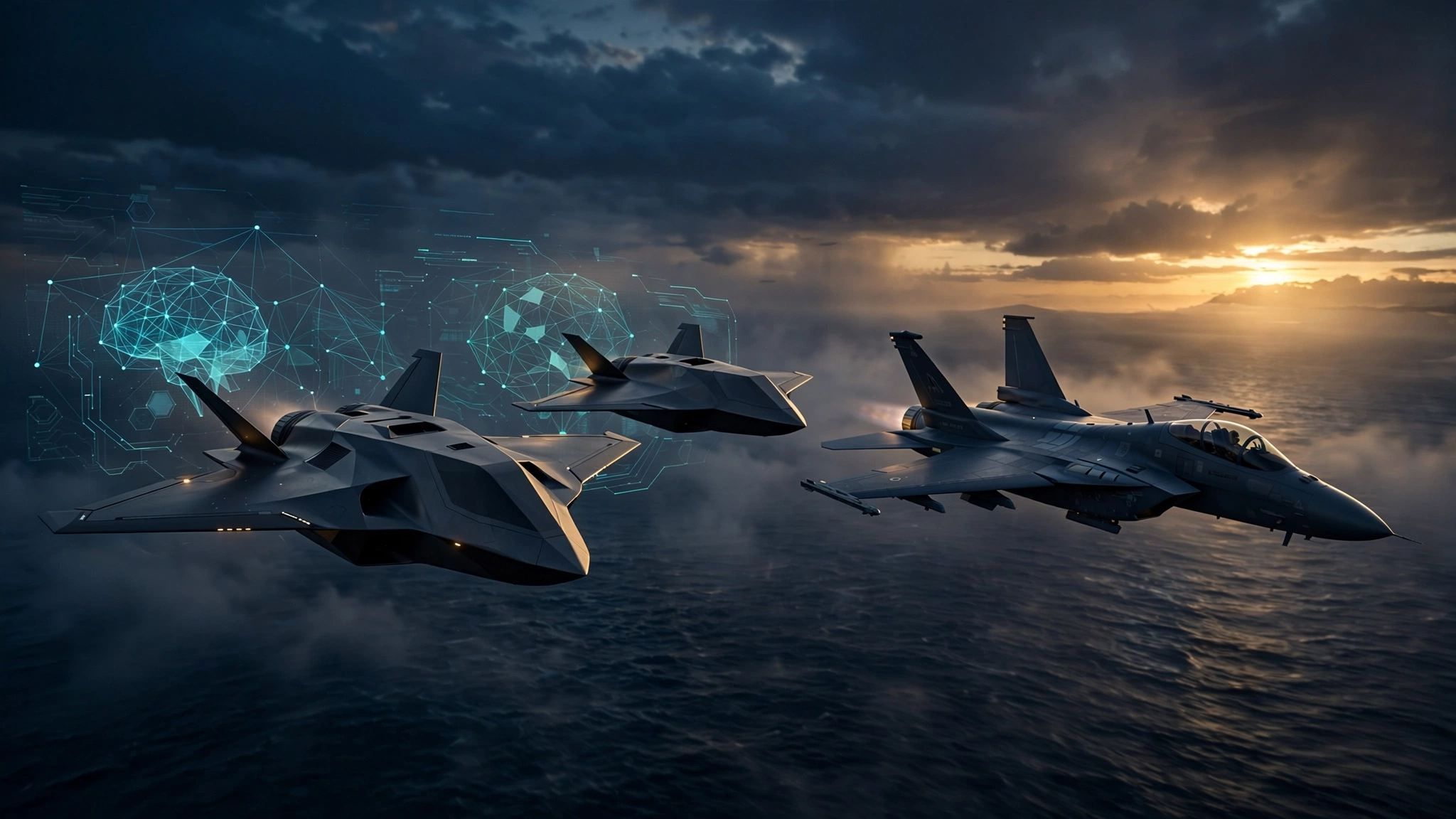
Six. That is the number of companies now competing to write the artificial intelligence that will fly America's next generation of fighter aircraft. On June 17, the U.S. Air Force awarded production contracts for its Collaborative Combat Aircraft program to General Atomics (the FQ-42) and Anduril Industries (the FQ-44), the semi-autonomous drone wingmen designed to fly alongside crewed fighters in contested airspace. Contracts arrived months ahead of schedule, which is good news by Pentagon standards. But the announcement that matters sits one paragraph deeper in the press release, and most coverage buried it entirely: the Air Force simultaneously awarded mission autonomy software contracts to six separate vendors, deliberately decoupling the purchase of the aircraft's brain from its body.
"Software sold separately." That is what the Air Force calls this approach. It is, without exaggeration, the most consequential change in American fighter procurement since the Great Engine War of 1984.
Why Decoupling Is the Story
For decades, the Pentagon bought fighters the same way, following a procurement logic so deeply embedded in the defense industrial base that questioning it felt roughly as productive as questioning gravity: one prime contractor owned the airframe, the avionics, the software, and the integration. Lockheed Martin builds the F-35 and writes the code that flies it. Boeing builds the F/A-18 and writes its code too, and when something breaks or needs upgrading, you go back to the same company that sold you the jet because nobody else understands the proprietary systems well enough to touch them. That arrangement gives the contractor enormous leverage over pricing, timelines, and technical direction while leaving the Department of Defense, the only customer, with almost none of the negotiating power that any rational buyer would demand before committing trillions of dollars to a single program.
Consider where that model leads. The Government Accountability Office now projects lifetime costs exceeding $2 trillion for approximately 2,500 F-35 aircraft, with sustainment alone reaching $1.58 trillion, a 44 percent increase from the $1.1 trillion estimate just five years earlier. Operating an individual F-35 costs $6.6 million per year, 61 percent above its original affordability target of $4.1 million. Block 4 software modernization, the upgrade that was supposed to transform the F-35 into a software-defined electronic warfare platform, is at least five years behind schedule and $6 billion over budget. When a single vendor controls both the hardware and the software, the customer pays whatever the vendor charges, because switching means starting over from zero.
CCA's "software sold separately" model breaks that dependency completely, and the implications ripple through every line of the defense budget.
How It Works
Two airframe vendors build the physical aircraft: General Atomics produces the FQ-42 and Anduril produces the FQ-44. Both go into production simultaneously, a move that is itself unusual for defense procurement, where down-selects typically leave one winner and one disappointed lobbyist, not two parallel manufacturing lines funded against each other.
Six software vendors compete to build the mission autonomy that makes each aircraft useful: Anduril, General Atomics, Lockheed Martin, Northrop Grumman, RTX's Collins Aerospace, and Shield AI. Their software handles navigation, sensor fusion, target identification, electronic warfare, and weapons employment, everything that turns a jet-powered airframe into a combat system. A human pilot in a crewed fighter serves as mission commander. But the CCA makes second-to-second decisions on its own, processing sensor data, evaluating threats, and executing maneuvers at machine speed while the human focuses on strategy and authorization rather than stick-and-throttle flying.
Mix and match. Run Lockheed software on a General Atomics airframe, or Shield AI autonomy on an Anduril jet, or swap vendors between missions as requirements shift. Software vendors compete not once at contract award but continuously, because the next software buy is always up for grabs regardless of which airframe it runs on.
A Calculation the Air Force Has Not Published
Nobody in the defense press has run the full cost comparison between a traditional fighter squadron and a CCA-augmented one. So here it is.
A conventional fighter squadron fields 24 F-35As. At $110.3 million per jet (flyaway plus mandatory ground support and initial spares, per current procurement data), that is $2.65 billion in acquisition costs. Training 24 pilots to fly them costs another $314 million, at $13.1 million per F-35A pilot adjusted to 2026 dollars using the RAND Corporation's 2019 study and Bureau of Labor Statistics CPI data. Annual operating and sustainment runs $6.6 million per aircraft per year according to the GAO, a figure that itself represents a 61 percent overrun from the program's original affordability target and that the department's own officials acknowledge is unlikely to decrease despite years of cost-reduction initiatives, performance-based logistics contracts, and supply chain restructuring efforts that have collectively saved an estimated $84 billion off what would have been an even more staggering sustainment bill. Over five years, a 24-ship F-35 squadron costs approximately $3.75 billion to buy, train, and operate. It puts 24 pilots at risk. Every one of them irreplaceable.
Now consider a CCA-augmented force with equivalent firepower. Twelve F-35As serve as mission commanders, each controlling four CCAs, a ratio supported by simulation data showing that a single pilot, aided by the CCA's onboard autonomy for low-level navigation and threat avoidance, can effectively manage four or even five semi-autonomous wingmen simultaneously under current testing conditions. Acquisition: 12 F-35s at $110.3 million ($1.32 billion) plus 48 CCAs at $30 million apiece ($1.44 billion). CCA unit cost is the target set by former Air Force Secretary Frank Kendall at one-third the price of an F-35, and Col. Timothy Helfrich, the program's acquisition executive, told a Defense One panel in March that the program is currently tracking below that figure. Pilot training drops to 12 aviators at $13.1 million each, saving $157 million, while F-35 operating costs fall to $79 million per year; CCA sustainment, absent pilot life support systems, pressurization, ejection seats, and the elaborate maintainer infrastructure that crewed aircraft require, is estimated by defense analysts at roughly $2 million per unit per year, or $96 million for the 48-ship fleet. Five-year total: approximately $3.80 billion.
Nearly identical cost. But instead of 24 platforms with 24 humans aboard, you field 60 platforms with 12 humans aboard, which means two and a half times the combat mass at half the aircrew exposure for roughly the same five-year investment. If the Air Force hits the "much better than" $30 million target that Helfrich described, the CCA-augmented squadron becomes cheaper outright.
The $4.5 Billion Software Market Nobody Is Pricing
Mission autonomy software typically accounts for 15 to 25 percent of the unit cost of an autonomous military platform, a range consistent across programs from the MQ-9 Reaper ground control station to the Navy's MQ-25 Stingray aerial refueling drone. At a CCA unit cost of $30 million, that puts the software component between $4.5 million and $7.5 million per airframe.
Multiply by the Air Force's stated goal of 1,000 CCAs. Result: a $4.5 billion to $7.5 billion market for fighter jet AI, and under the traditional procurement model, one prime contractor would capture that entire sum without a competitive bid in sight. Under "software sold separately," six companies compete for it, and the Air Force retains the ability to shift market share toward whichever vendor delivers the best autonomy at the lowest price.
There is a direct historical precedent. In 1984, the Pentagon broke Pratt & Whitney's monopoly on the F-16 engine by qualifying General Electric's F110 as a second source, an acquisition strategy known as the Great Engine War. Over the following decade, engine unit costs dropped approximately 20 percent as the two manufacturers competed for annual buys. Quality improved, schedules tightened, and reliability went up across both manufacturers in a pattern that defense acquisition scholars still cite as the clearest demonstration that competition works even in markets with only two suppliers. Clear enough that the GAO cited it repeatedly in F-35 sustainment reviews as a model the Pentagon had abandoned. "Software sold separately" applies that lesson to the most valuable component of a 21st-century weapon system: its artificial intelligence.
$2.37 Billion Buys the Transition
The Air Force's fiscal year 2027 budget request allocates $996.5 million for CCA procurement, the first procurement funding the program has ever received, plus $150 million in advance procurement for FY28 and $1.37 billion in continued research and development. Total FY27 request: roughly $2.37 billion, making CCA the single largest new line item in the Air Force's $30.64 billion aircraft procurement account.
For context, cumulative CCA development spending since fiscal 2024 totals approximately $1.91 billion. Congress also provided $678 million in mandatory funding through the FY2025 reconciliation act, and nine vendors are already under contract for Increment 2 prototypes, which include runway-independent designs, extended-range variants, and concepts optimized specifically for a Pacific theater fight where distance and logistics favor autonomous platforms that do not need runways, hangars, or life support. Northrop Grumman's YFQ-48A is in testing for later phases, and analysts estimate the FY27 production lot covers roughly 30 airframes depending on final negotiated unit costs.
International interest is materializing. In April, the Netherlands became the first allied nation to commit funding for two Increment 1 CCAs in April, embedding Dutch personnel with the Air Force's Experimental Operations Unit at Nellis Air Force Base to develop shared concepts of operations.
What This Analysis Cannot Tell You
CCA operating costs are estimated, not established. No semi-autonomous combat aircraft has ever been sustained in squadron-level service, so the $2 million per unit per year figure is extrapolated from MQ-9 Reaper sustainment data adjusted downward for the absence of pilot-rated systems, ground control stations, and satellite communication links. Actual CCA operating costs could be higher if autonomy software requires frequent updates, classified network infrastructure adds overhead, or combat attrition rates exceed planning assumptions. Helfrich's statement that unit costs are tracking below $30 million is not accompanied by a published figure, and defense programs have a well-documented history of costs rising between development and full-rate production. A 1:4 pilot-to-CCA ratio used in the squadron comparison reflects the upper bound of what testing suggests a single pilot can manage; operational experience may prove that lower ratios are more effective in high-threat environments where cognitive load on the human commander spikes.
Strongest Counterargument
Interoperability is the strongest case against "software sold separately," and it is not a hypothetical concern but an engineering problem that has broken previous integration efforts across far simpler systems. Running autonomy software from six different vendors on two different airframes in the same battlespace creates an integration challenge that defense procurement has never attempted at this scale. Each software stack will interpret sensor data differently, prioritize targets differently, and make split-second maneuvering decisions using different algorithms. A pilot commanding a mixed flight of General Atomics airframes running Lockheed software and Anduril airframes running Shield AI autonomy will depend on those two software stacks coordinating flawlessly with each other and with the crewed jet's own systems, in real time, under electronic warfare conditions designed to disrupt exactly that coordination. Lockheed's Joint Simulation Environment for the F-35 took years to integrate a single vendor's software across three variants of one aircraft. Integrating six vendors' autonomy across two airframes is an order-of-magnitude harder problem, and the consequences of integration failure in combat are not a cost overrun but a midair collision or a fratricide event. Air Force leadership is betting that continuous competition will drive down costs and drive up quality. Maybe. But the counterbet is that continuous competition produces six slightly incompatible versions of the same mission, none of which talk to each other as well as a single vendor's integrated stack.
What You Can Do
Defense investors should watch which of the six software vendors wins the first operational autonomy contract for a live CCA deployment. That award, expected within the next 18 months, will signal which company's AI stack the Air Force trusts most in contested airspace, and it will almost certainly move share prices. Shield AI, the only pure-play autonomy company in the pool, is the most leveraged bet; the traditional primes (Lockheed, Northrop, RTX) treat CCA software as one program among hundreds. Aerospace engineers should note that every CCA software vendor is hiring autonomy engineers at rates that reflect a $4.5-$7.5 billion market opening in real time. If you work in autonomous systems, robotics, or computer vision and have considered defense work, this is the widest the door has been in a generation. Allied defense ministries watching from Europe and the Indo-Pacific should study the Dutch model: early buy-in gets you embedded in the concept-of-operations development, not just the hardware purchase.
The Bottom Line
The Air Force did not just buy 1,000 drone wingmen. It built a marketplace. Two airframe vendors compete on hardware. Six software vendors compete on the AI that makes each airframe lethal. No single contractor controls both the body and the brain, which means no single contractor controls the upgrade cycle, the sustainment cost curve, or the pace of innovation. Forty-two years ago, the Pentagon last introduced genuine competition into a fighter component market was the Great Engine War, 42 years ago. That contest cut engine costs by a fifth, improved reliability across both manufacturers, and proved that even in a market with exactly two qualified suppliers, the threat of losing next year's production order is enough to discipline pricing and delivery in ways that decades of sole-source negotiations never achieved. "Software sold separately" applies the same logic to the most consequential technology in modern warfare. For a department that spent $2 trillion learning what happens when one company owns everything, the lesson arrived expensive. Whether it arrived in time depends on how quickly six companies can teach a robot to fight.