84% of Your Rocket Costs Go to the Company That Just Became Your Competitor. SpaceX’s Starfall Capsules Launch Monday.
SpaceX's Starfall reentry capsules launch June 23, entering the in-space manufacturing market as the only vertically integrated player. An original cost-per-kilogram analysis shows SpaceX holds a potential 100x advantage over Varda Space Industries, because 84% of Varda's per-mission budget goes to a single line item: paying SpaceX for the ride up.
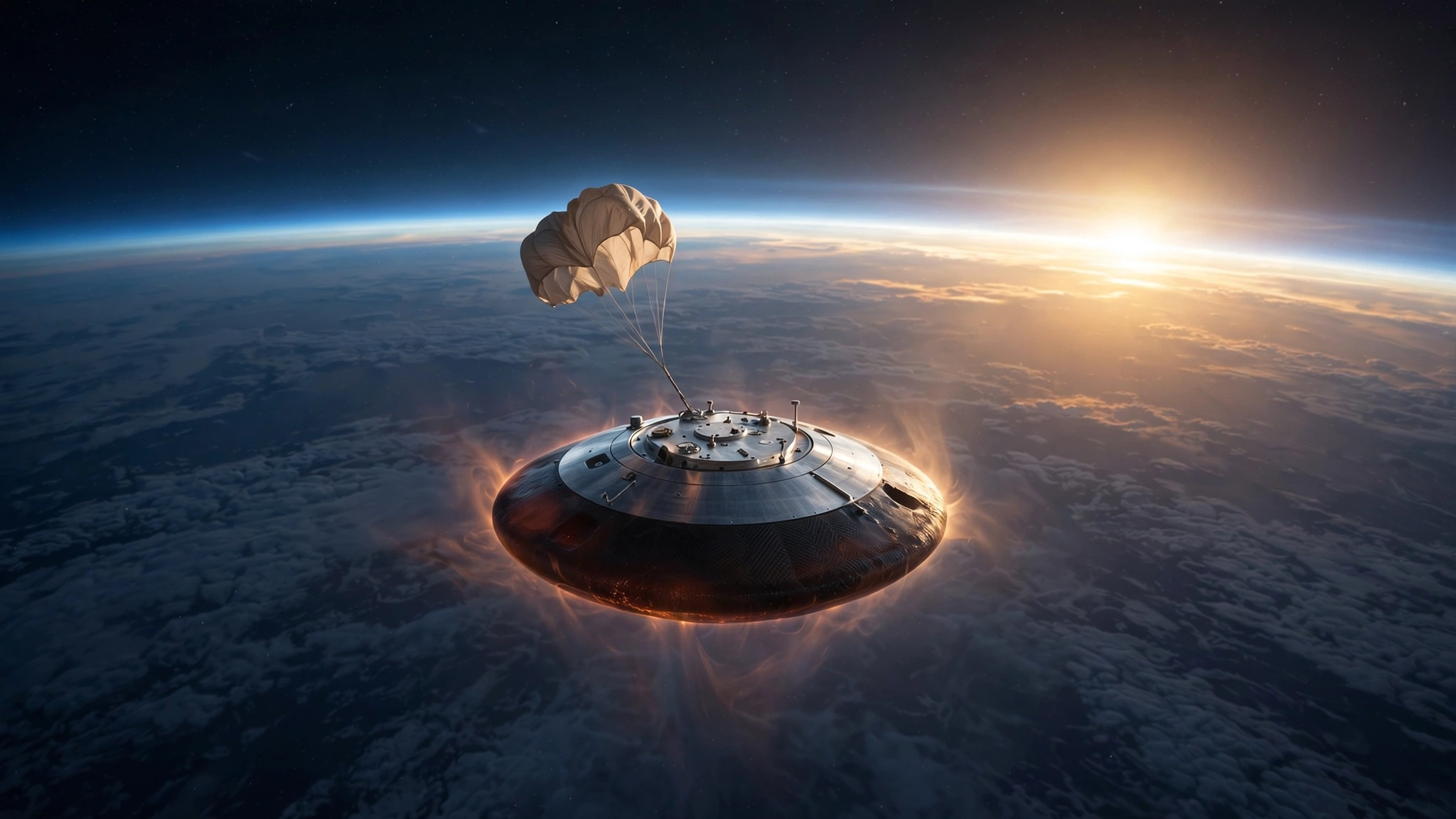
Two thousand one hundred kilograms. That is the mass of a single Starfall capsule: 1,400 kg of aluminum top plate, 700 kg of carbon-fiber heat shield, small enough to fit inside a Starship payload bay 47 times over, cheap enough to mass-produce like shipping containers, and capable of carrying one metric ton of material back from orbit without a parachute, a guidance computer, or a human being. According to SpaceX's FAA Environmental Assessment filed May 15, 2026, two of them will splash down in the Pacific Ocean on Monday, 1,300 kilometers off the California and Mexico coasts, in what will be the company's first test of a vehicle designed to do something SpaceX has never done before: come back down with cargo that was manufactured in space.
This matters because every company currently in the in-space manufacturing business pays SpaceX for launch. Varda Space Industries, the market leader with six missions flown, pays SpaceX for rideshare slots on Falcon 9. Atmos Space Cargo, the European competitor, plans to launch on SpaceX. Inversion Space, still pre-revenue, has booked SpaceX rides. On Monday, the company that sells everyone their tickets enters the arena itself, and the economics of that entrance are more lopsided than anything the space industry has seen since SpaceX undercut United Launch Alliance on military contracts a decade ago.
Nobody has run the numbers on what this structural advantage actually looks like in dollars per kilogram of returned material. So we did.
The Platform Tax
Varda's economics are unusually transparent for a space startup because its CEO, Delian Asparouhov, has discussed them publicly. In a 2024 podcast appearance covered by TechCrunch, Asparouhov laid out the cost trajectory: roughly $12 million for Varda's first mission, dropping to $5-6 million by mission four, and a target of $2.5 million per mission by mission ten and beyond, after the company has moved to fully in-house spacecraft with its W-4 design.
Where does that $2.5 million go, and who gets it? SpaceX's published rideshare pricing, updated February 2026, starts at $350,000 for 50 kg to sun-synchronous orbit and $7,000 per kilogram above that. Varda's W-series spacecraft weigh approximately 300 kg total, according to SpaceNews reporting from June 2025. At published rates, a W-series rideshare slot costs approximately $2.1 million.
$2.1 million of a $2.5 million mission. That is 84% of the total cost going to launch services provided by the company that is now building a competing product.
| Cost Component | Varda (at scale) | % of Mission | SpaceX Starfall | % of Mission |
|---|---|---|---|---|
| Launch to orbit | ~$2.1M | 84% | Internal cost | Near $0 marginal |
| Spacecraft + capsule | ~$250K | 10% | ~$200K (est.) | ~67% |
| Operations + recovery | ~$150K | 6% | ~$100K (est.) | ~33% |
| Total per mission | ~$2.5M | 100% | ~$300K (est.) | 100% |
| Payload capacity | 10 kg processed | 1,000 kg raw | ||
| Cost per kg of downmass | $250,000/kg | $300/kg |
That bottom line deserves a pause: $250,000 per kilogram versus $300 per kilogram, an 833x gap that exists because one company pays for launch and the other does not.
Starfall's cost estimate requires several assumptions because SpaceX does not publish internal marginal launch costs, but multiple analyst estimates and Gwynne Shotwell's 2023 remarks place Falcon 9's marginal cost per flight at $15-28 million after booster recovery. At Starship scale, Musk has targeted $2 million per launch, though the realistic near-term estimate is probably $20-90 million. Even at the pessimistic end, one Starship carrying 47 Starfall capsules at $90 million per launch means roughly $1.9 million per capsule in launch costs, or $1,900/kg of downmass, still 130 times cheaper than Varda's cost structure. At the optimistic end, at $2 million per Starship launch, you reach $43,000 per capsule and $43/kg.
The Apples-to-Orangutans Problem
Before anyone emails: yes, this comparison conflates two fundamentally different things, and doing so honestly is the point.
Varda's 10 kg of downmass is not raw material. It is processed pharmaceutical product, crystallized in microgravity under carefully controlled conditions using equipment that took years and $329 million in venture funding to develop. A single kilogram of ritonavir crystallized in the correct polymorph, the focus of Varda's first commercial missions, can be worth millions at pharmaceutical pricing. Varda is not selling kilograms. It is selling crystallography that cannot be replicated on Earth.
SpaceX's 1,000 kg of downmass is an empty bus. The Starfall capsule, as described in the FAA Record of Decision, has no internal processing equipment, no pharmaceutical expertise, no FDA relationships, and no crystallization chambers. Its stated purpose is "offering access to microgravity and vacuum, loiter on orbit, and safe return from orbit as a service at scale." SpaceX is not entering the pharmaceutical business but the delivery business.
That distinction matters enormously today, though it may not matter in five years.
The AWS Pattern
Amazon Web Services launched in 2006 by selling raw computing infrastructure: storage, servers, bandwidth. Netflix built its entire streaming platform on AWS. Dropbox built its entire file sync business on the same platform. Dozens of startups built products on top of Amazon's infrastructure, and Amazon watched the traffic data, identified which products generated the most demand, and launched competing services in 13 of the top 20 categories within four years.
SpaceX does not need to learn pharmaceutical crystallization. It needs to sell cheap rides down from orbit to any company that does, collect data on which payloads generate the most demand, and let competition among its customers drive the manufacturing innovation. The FAA filing says exactly this: Starfall is a "proliferated successor" to the International Space Station, designed not as a single laboratory but as a swarm of cheap, disposable capsules that make orbital access routine enough to support an entire ecosystem.
Varda clearly sees this threat, which is why its W-4 spacecraft, launched in early 2026, was the company's first in-house design, replacing the Rocket Lab-built buses used for its first three missions. Varda is vertically integrating away from its second-largest supplier, Rocket Lab, for the spacecraft. It cannot vertically integrate away from its largest cost: SpaceX's launch.
Unless it launches on someone else's rocket, and the options are bleak. Rocket Lab's Neutron is years from regular service. ULA's Vulcan costs roughly three times as much as Falcon 9 for comparable payloads, Blue Origin's New Glenn has flown exactly once, and the European launch market is mid-transition with no clear alternative emerging before 2030. Varda's realistic options for the next five years are SpaceX or SpaceX, which is precisely the position SpaceX has engineered across the entire commercial launch industry.
The Swarm Math
Starfall's real innovation is not the capsule but the production model.
Building the ISS cost $150 billion to build and services one set of experiments at a time. Axiom Space's commercial station modules, still under construction, will cost several billion dollars. Varda's W-series capsules are cheaper at approximately $250,000 each, but their processing capacity is 10 kg per mission, and each mission takes months of preparation.
A Starfall capsule is 3.1 meters long, 0.75 meters in diameter, and built from two components: a machined aluminum plate and a carbon-fiber heat shield. No avionics beyond cold-gas thrusters for attitude control, no parachutes, no guidance computer, no thermal protection tiles. The FAA assessment describes them as "mass-producible reentry vehicles," and the dimensions and construction suggest SpaceX intends to build them in batches of dozens or hundreds, the way it builds Starlink satellites, in a factory, on a line, one after another.
One Starship launch can carry 100,000 kg to low Earth orbit. At 2,100 kg per Starfall capsule, that is 47 capsules per launch. If each capsule carries 1,000 kg of payload capacity, a single Starship mission could deploy 47,000 kg of in-space manufacturing capacity in one flight. Varda's entire manifest of six missions has processed perhaps 60 kg of material total.
| Metric | Varda (6 missions) | 1 Starship + 47 Starfall | Ratio |
|---|---|---|---|
| Total downmass capacity | ~60 kg | 47,000 kg | 783x |
| Total cost (est.) | ~$42M | $90M (Starship) + $14.1M (capsules) | 2.5x |
| Cost per kg capacity | $700,000/kg | $2,215/kg | 316x cheaper |
| Development time | 4 years, $329M raised | Incremental (Starship already funded) | — |
The Varda cost-per-kg figure here uses actual cumulative mission costs ($42M across six missions at declining per-mission rates) divided by cumulative processing capacity (~60 kg), reflecting the reality that early missions were expensive development flights. Even at Varda's target $2.5M/mission and 10 kg/mission scale, the cost per kg of processed material remains $250,000 against SpaceX's $2,215 for raw capacity.
What SpaceX Cannot Do
Owning the cheapest reentry vehicle does not make you a pharmaceutical company, and the gap between "delivery capacity" and "manufacturing capability" is measured in years of regulatory relationships, not dollars of infrastructure.
Varda has spent four years building the only microgravity pharmaceutical processing platform that has actually returned product from orbit and demonstrated controlled crystallization of an active pharmaceutical ingredient. Its W-1 mission in 2024 produced ritonavir crystals in the correct polymorph, a result that required custom-designed crystallization chambers, proprietary process control software, and collaboration with pharmaceutical partners who will not share their formulations with a launch provider. The FDA pathway for space-manufactured drugs requires not just the physical product but the validated manufacturing environment, quality management system, and chain-of-custody documentation that Varda is building mission by mission.
SpaceX has none of this. Starfall is a heat shield with a hole in the top. Whatever manufacturing happens inside it will be done by SpaceX's customers, using their own equipment, their own processes, and their own regulatory relationships. This is a strength if SpaceX wants to be a platform (many customers, diverse payloads, no domain expertise required) and a weakness if it wants to capture the highest-value segment of the market (pharmaceuticals, where margins are measured in thousands of percent and the barrier to entry is regulatory, not physical).
Varda's strongest defense is that its moat is not the capsule but the crystallization science, and no amount of cheap reentry changes the fact that growing pharmaceutical crystals in microgravity requires knowledge that lives in Varda's team, not in SpaceX's factory. If Varda can secure its pharmaceutical supply chain before SpaceX's platform attracts competitors with similar expertise, Varda wins the highest-value niche regardless of Starfall's cost advantage on the transport layer.
The Market Nobody Agrees On
In-space manufacturing has a forecasting problem. Research and Markets values it at $2.6 billion in 2026, growing to $5.23 billion by 2030 at 19.1% CAGR. MarketsandMarkets projects $4.6 billion by 2030 rising to $62.8 billion by 2040 at 29.7% CAGR. That is a 12x disagreement on the 2040 number, which tells you that nobody knows whether in-space manufacturing will be a niche pharmaceutical play or a broad industrial platform, and the answer depends almost entirely on whether transport costs drop enough to make non-pharmaceutical applications viable.
At Varda's current economics ($250,000/kg of processed material), only pharmaceuticals justify the cost. At SpaceX's potential Starfall economics ($1,200-$2,400/kg of raw downmass on Starship), the addressable market expands to semiconductor substrates, specialty alloys, fiber-optic preforms manufactured in microgravity, and research payloads that universities and national labs currently price out of ISS access. That expansion, if it materializes, is the difference between the two forecasts.
Atmos Space Cargo, the Paris-based competitor with a €25.7 million Series A and an inflatable heat shield design, is betting on the broader market with its Phoenix 2 capsule targeting 100 kg of payload capacity across three missions planned for H2 2026. Inversion Space, with roughly $44 million raised, is pursuing both manufacturing return and point-to-point cargo delivery. Both companies pay for launch.
Limitations
Our cost estimates for SpaceX Starfall are built on assumptions that may not hold. SpaceX does not disclose internal marginal launch costs. Our $300/kg figure for Starfall downmass uses an aggressive estimate of near-zero marginal launch cost; at published rideshare pricing, even SpaceX would pay $7,000/kg for payload mass, which would raise the per-capsule cost substantially and narrow the gap with Varda to approximately 35x rather than 833x. Our 47-capsules-per-Starship calculation assumes maximum payload utilization, which first flights will not achieve. Starfall has never flown; Monday's test may fail, and the capsule's ability to protect delicate pharmaceutical payloads during an uncontrolled oceanic splashdown is unproven. Varda's per-mission cost projections are management targets, not audited figures, and the $2.5M target at mission ten may be optimistic. Finally, comparing cost-per-kg of raw reentry capacity against cost-per-kg of processed pharmaceutical product overstates SpaceX's advantage in the specific market segment Varda serves, because the value creation happens in the processing, not the delivery.
The Bottom Line
On Monday, two small capsules will fall into the Pacific Ocean, and the in-space manufacturing industry will split into two eras: before SpaceX entered, and after. The company that sells launch to every player in the market is now building its own reentry vehicle at a structural cost advantage that ranges from 35x to 833x depending on assumptions. This is the AWS playbook applied to orbit: build the cheapest infrastructure, let customers figure out the applications, watch what works, and then decide whether to stay a platform or compete.
Varda's best defense is speed. Every pharmaceutical partnership it signs before Starfall reaches operational scale is a customer SpaceX cannot easily poach, because the value is in the crystallization protocol and the FDA relationship, not the capsule. Every mission Varda flies builds regulatory precedent that SpaceX would need years to replicate. The pharmaceutical moat is real. Whether it is wide enough to survive a competitor that can deliver 47,000 kg to orbit for less than Varda spends on six missions is the question the entire industry will spend the next three years answering.
What You Can Do
If you invest in space startups, audit their launch dependency: any company whose cost structure is more than 50% launch services is exposed to platform risk the moment SpaceX enters their vertical. Ask management what their plan is when their launch provider becomes their competitor. If you work in pharmaceutical R&D, watch Varda's upcoming missions closely because the crystallization results will determine whether microgravity manufacturing is a real production pathway or an expensive proof of concept, and the answer has implications for drug formulation timelines in your pipeline. If you follow space policy, read the FAA's Starfall Environmental Assessment in full; the "mass-producible reentry vehicle" language signals a regulatory framework for orbital manufacturing at scale that does not yet exist, and the rulemaking that follows these tests will shape whether in-space manufacturing becomes an open or closed market. The June 23 test splashdowns are the starting gun.