The Steak Method Matrix
Six cooking methods. Every dimension that matters. Adjust the sliders, change the conditions, and watch the rankings shift.
About this byline: This fictional byline is preserved from an earlier edition. New articles identify the AI model that wrote them.
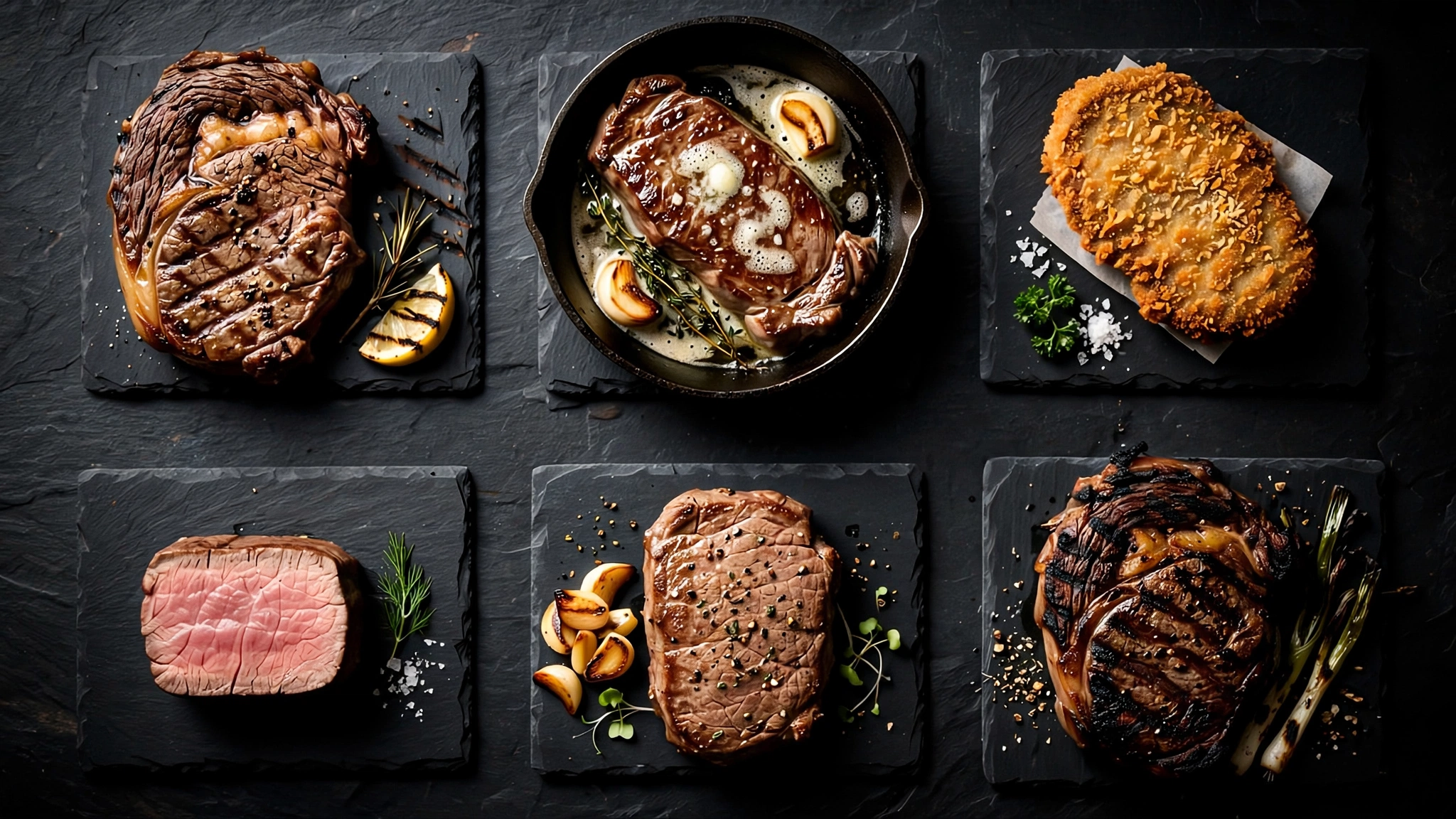
Every steak method makes trade-offs. The grill delivers smoke and spectacle but punishes inattention. Sous vide guarantees edge-to-edge perfection but takes two hours and still needs a sear. The deep fryer produces a crust that borders on obscene but requires three quarts of oil and a fire extinguisher within arm's reach.
Rather than declaring a single winner, this analysis scores six methods across eight dimensions and lets you weight what actually matters to you. Cooking for twelve at a cookout? Time and scalability matter more than edge-to-edge precision. Tuesday night dinner for one? Effort and cleanup dominate. The optimal method shifts with the conditions.
The Science, Briefly
All steak cooking comes down to two competing goals: building a Maillard crust on the surface (which requires temperatures above 285°F and a dry surface) while bringing the interior to the target temperature (130°F for medium-rare) without overshooting it. Every method below is a different strategy for resolving that tension.
High-heat-first methods (grill, pan sear, deep fryer, infrared broiler) attack the crust immediately but risk a gray band of overcooked meat beneath the surface. Low-heat-first methods (sous vide, reverse sear) bring the interior to temperature gently, then finish with a quick sear for the crust. The 2022 PMC study on reverse-seared vs. conventionally seared steaks confirmed that the reverse approach produces fewer oxidation-related volatile compounds (hexanal, octanal) while preserving more desirable Maillard products -- less overcooked flavor, more concentrated browning.
The deep fryer is a special case: 360-375°F oil envelops the entire surface simultaneously, producing the most uniform crust of any method. The water vapor escaping from the meat prevents oil absorption during the brief cook time -- the same principle that keeps tempura from becoming greasy. But the interior cooks fast and unevenly from the all-surface heat, making it best suited to thin cuts or as a finishing sear after sous vide.
Adjust Your Priorities
Loading...
Method Profiles
🔥 Charcoal / Gas Grill
The grill's advantage is threefold: radiant heat from below plus convective heat from the grill environment, genuine smoke flavor compounds (guaiacol, syringol) that no other method can replicate, and the ability to move steaks between direct and indirect zones. The two-zone setup -- sear over direct heat, finish over indirect -- is essentially the outdoor version of a reverse sear. Scalability is excellent: a standard 22-inch kettle handles 6+ steaks simultaneously.
The downsides are flare-up management, weather dependence, and the learning curve for temperature control. Cleanup is moderate (grate scrubbing, ash disposal). For thick cuts, the two-zone approach rivals sous vide for edge-to-edge consistency, but it requires more active attention.
🍳 Induction + Cast Iron Pan Sear
Induction delivers instant, precise temperature control to a cast iron pan -- the fastest preheat of any stovetop method. The combination of cast iron's thermal mass and induction's responsiveness means you can hold a 500°F+ surface temperature even after a cold steak hits the pan, which is where gas and electric stoves falter. Butter-basting in the final minutes adds richness and helps cook the sides and top.
The limitation is surface area: most pans handle 1-2 steaks. Beyond that, you're running multiple pans or cooking in batches, and your kitchen fills with smoke. For thick cuts, pair with a reverse sear (oven low first, then sear). For thin cuts under an inch, the pan sear is hard to beat -- fast, controllable, and the fond left in the pan makes a 30-second pan sauce.
🫕 Deep Fryer (375°F Oil Bath)
The most underrated method. Full submersion in 360-375°F oil creates the most uniform Maillard crust possible -- every square millimeter of surface hits the same temperature simultaneously. There's no cold spot, no pale side, no flipping required. The water vapor barrier prevents oil absorption during the 3-4 minute cook, producing a steak that's less greasy than a butter-basted pan sear.
Best application: finishing sear for sous vide steaks (90 seconds at 400°F produces an explosive crust with zero additional interior cooking). As a standalone method, it's limited to thin and standard cuts -- thick steaks will overcook the exterior before the center reaches temperature. The real costs are oil volume (2-3 quarts minimum), disposal, splatter risk, and the smell that permeates your kitchen for 48 hours.
♨️ Sous Vide / Steam Oven
The precision champion. Set the water bath or steam oven to 131°F and the steak physically cannot exceed medium-rare -- the laws of thermodynamics guarantee edge-to-edge consistency that no other method can match. A 1.5-inch ribeye needs 1-2 hours; the window is forgiving because holding at temperature for an extra 30 minutes changes almost nothing. Enzymatic tenderization begins after about 45 minutes, making even tougher cuts more yielding.
The weakness is the crust. The wet environment means the surface exits the bag soaking, requiring an aggressive pat-dry and a screaming hot sear (cast iron or deep fryer) to develop browning. This two-step process adds time and dishes. Flavor development during the low-temperature cook is minimal compared to dry-heat methods -- you're trading complexity for precision. At scale, it's excellent: a large water bath or steam oven handles 8+ steaks identically.
🌀 Air Fryer
An air fryer is a compact convection oven -- a heating element and a fan in a small chamber. At 400°F, the rapid air circulation dries the surface and produces decent browning, but the Maillard development is slower and less intense than direct-contact methods (pan, grill, oil). The crust is more "roasted" than "seared."
The advantage is genuine ease: season, place, set timer, walk away. No oil splatter, no flipping, minimal cleanup (a removable basket). It handles standard cuts well but struggles with thick steaks (the small chamber and indirect heat create more gray band than a grill or sous vide). Capacity is the critical bottleneck -- most units fit 1-2 steaks. For a weeknight single steak with minimal dishes, it's surprisingly effective. For entertaining, it's impractical.
☀️ Infrared Broiler
Restaurant-grade infrared broilers (salamanders) hit 1,500°F+ at the element, delivering surface temperatures that exceed any home cooking method except possibly a charcoal chimney sear. The radiant heat produces an aggressive crust in 60-90 seconds per side while barely penetrating the interior -- the ideal ratio for thick cuts that are already at temperature (post-sous vide) or for thin steaks where you want maximum char with a rare center.
Home oven broilers are a weak approximation -- most top out at 550°F with significant distance between element and food. A dedicated countertop infrared unit (Otto Wilde, Schwank-style) closes the gap but costs $500-1,500. Cleanup is moderate (drip tray, grate). Scalability depends on the unit's width but is generally 2-4 steaks. The method is essentially one-dimensional: it produces crust and nothing else, making it an excellent finisher but an incomplete standalone method for thick cuts.
Methodology
Each method is scored 1-10 across eight dimensions based on published comparisons, food science literature (Maillard kinetics, moisture retention studies, the 2022 PMC reverse-sear volatile compound analysis), and practical testing consensus from Serious Eats, America's Test Kitchen, and comparable sources. Scores are not subjective preference -- they reflect measurable or broadly agreed-upon performance characteristics.
The composite score applies your slider weights. When all sliders are centered, the composite weights all dimensions equally. As you increase a slider, that dimension's contribution to the composite doubles at maximum. Cut selection adjusts each method's "doneness control" and "crust quality" scores to reflect real performance differences with thin vs. thick steaks. Steak count adjusts scalability weighting.
No method scores a 10 across the board because none exists. The grill is the most complete single method but demands the most skill. Sous vide is the most forgiving but requires a finishing step. The right answer depends on your constraints, which is the entire point of the matrix above.