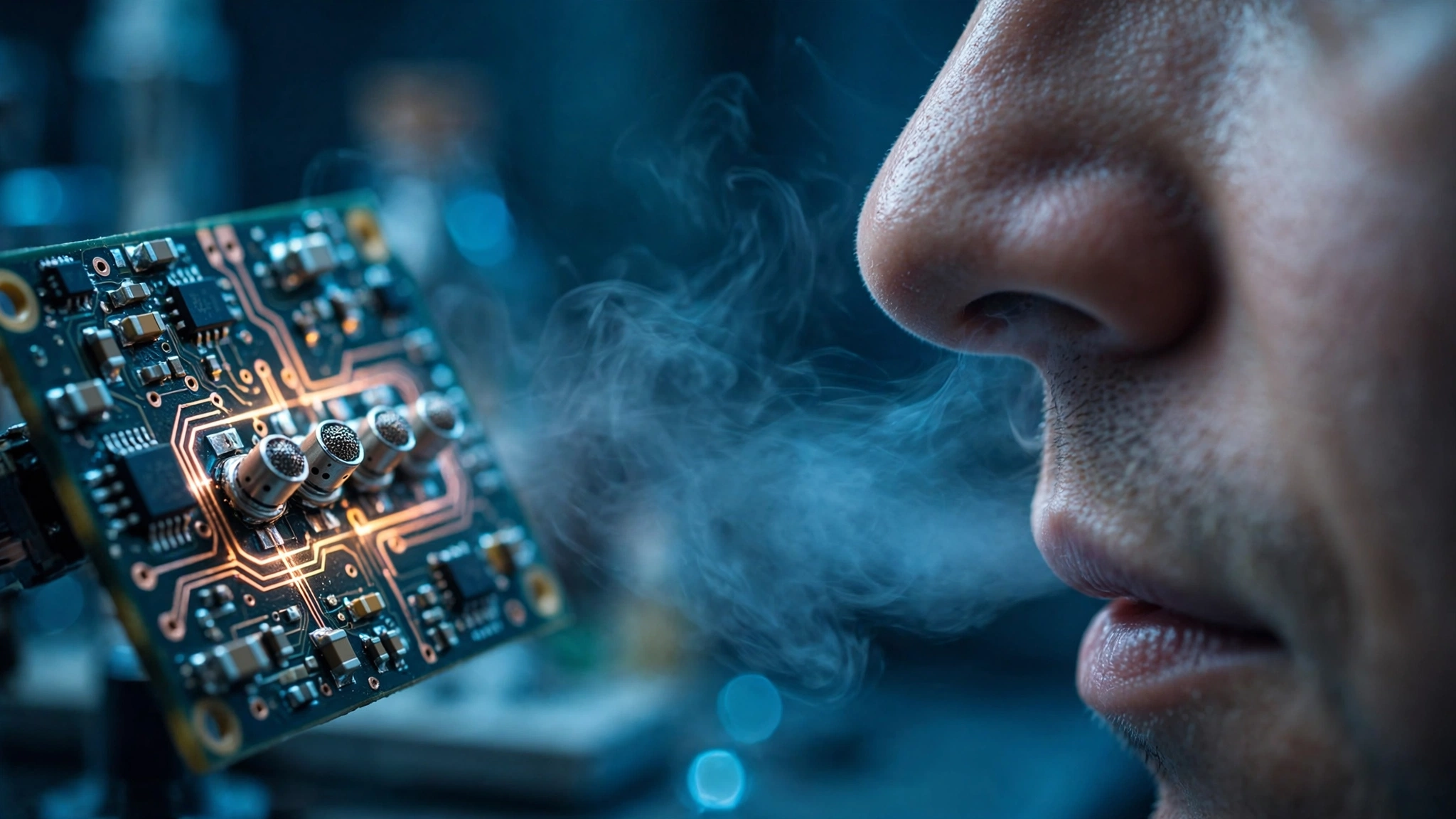
Twelve years. Joy Milne noticed her husband Les smelled different a full twelve years before neurologists confirmed his Parkinson's disease. She described a musky, yeasty odor that intensified as the condition progressed. When researchers at the University of Edinburgh handed her twelve T-shirts—six worn by PD patients, six by controls—she identified eleven correctly. Her single "miss" was a control subject who received a Parkinson's diagnosis eight months later. She had outperformed the test itself.
Perdita Barran's team at the University of Manchester spent five years turning Milne's olfactory feat into chemistry. Using gas chromatography-mass spectrometry on sebum swabs from 64 participants, they identified volatile organic compounds that differed systematically between Parkinson's patients and controls—hippuric acid, eicosane, octadecanal, and perillic aldehyde among them (ACS Central Science, 2019), and a 2021 validation study with a larger cohort confirmed the differential VOC profile (ACS Central Science, 2021). In 2024, a study published in the Journal of Parkinson's Disease found that trained detection dogs could identify Parkinson's from skin swabs with similar accuracy, and that people with isolated REM Sleep Behavior Disorder—a prodromal marker—showed VOC levels intermediate between patients and controls across 55 significant features. The biological signal is real, and the question has never been whether disease changes what you smell like—it has always been whether a machine can learn to smell it too.
The Machine That Learned to Smell
It can, and multiple machines built by independent groups on three continents have demonstrated it, each approaching the problem with different sensor architectures and different diseases. Here is what exists right now, not in proposals or grant applications, but in peer-reviewed publications with reported accuracy metrics.
A team at Zhejiang University built a gas chromatography-surface acoustic wave (GC-SAW) sensor paired with a convolutional neural network that detects Parkinson's disease from ear canal secretions. They identified four VOC biomarkers—ethylbenzene, 4-ethyltoluene, pentanal, and 2-pentadecyl-1,3-dioxolane—with statistically significant differences between PD and non-PD patients, achieving 94.4% classification accuracy. A separate group used a similar SAW-based system on sebum samples from 250 participants across multiple clinical centers, classifying PD versus healthy controls with an artificial intelligence olfactory system (Brain Sci. 2022).
Hossam Haick's group at Technion—Israel Institute of Technology went broader. Much broader. Their "artificially intelligent nanoarray" uses gold nanoparticles and single-walled carbon nanotubes coated with organic ligands that change electrical resistance when exposed to different VOC mixtures. In a study published in ACS Nano (2017), they collected 2,808 breath samples from 1,404 subjects across 9 clinical centers in 5 countries and classified 17 different diseases—including lung cancer, gastric cancer, Parkinson's, Crohn's disease, ulcerative colitis, irritable bowel syndrome, multiple sclerosis, pre-eclampsia, pulmonary arterial hypertension, and chronic kidney disease. Average classification accuracy across all diseases: 86%. A heat map of 13 discriminating VOCs showed that each disease produced a distinct "breathprint," with specific compounds elevated or suppressed in patterns unique enough for algorithmic separation.
For cancer specifically, the field has moved furthest. A comprehensive ACS Sensors review (April 2026) cataloging the state of metal-oxide e-nose arrays with ML pipelines for breath-based cancer detection found that integrated multisensor array chip architectures paired with machine learning consistently achieve 85-95% sensitivity for lung, colorectal, and gastric cancers. Owlstone Medical, the Cambridge-based company that builds the ReCIVA Breath Biopsy platform, has been running the LuCID clinical trial for lung cancer detection with their field asymmetric ion mobility spectrometry (FAIMS) sensor across 21 UK and European sites.
The Patent Landscape: 42 Filings and Counting
Anyone wanting to build a diagnostic breath sensor should first understand who has already claimed what. The intellectual property thicket is dense. Haick alone holds US 11,181,519 B2 ("System and method for differential diagnosis of diseases," granted November 2021, assigned to Technion Research & Development Foundation) plus at least nine related patents: US 8,366,630; US 8,481,324; US 8,597,953; US 8,945,935; US 8,999,244; US 9,359,197; and several pending applications. These cover the core concept of cross-reactive nanoparticle sensor arrays with pattern recognition for multi-disease breath diagnosis. The Technion patents were licensed to Breathtec Biomedical in 2016 and later to NanoVation and Nanose Medical.
Owlstone Medical holds EP 3,448,254 A1 covering their method for collecting selective breath portions and the ReCIVA collection apparatus, plus the FAIMS chemical detection platform patents. Their core innovation is combining breath fraction selection (dead space rejection, alveolar targeting) with miniaturized FAIMS.
Other significant filings include: US 11,045,111 ("Real time breath analyzer for detecting volatile organic compounds and identifying diseases," granted 2021)—covers the integrated sensor-plus-diagnostic-module architecture; US 2021/0186367 A1 (pending, filed 2018)—covers a modular VOC detection system with replaceable disease-specific sensor cartridges and molecularly imprinted polymer sensors; and WO 2020/005874 A1—covers breath analysis methodology for medical diagnostics with solid-state metal-oxide sensors.
The strategic gap is notable. The Haick patents cover nanoparticle-based chemiresistors. The Owlstone patents cover FAIMS and breath collection. The MOX sensor approach—the one most accessible to open-source builders—has narrower patent coverage. Metal-oxide semiconductor gas sensors like the Bosch BME688 operate on a different principle (heated semiconductor resistance changes) than gold nanoparticle arrays, and their application in disease screening via breath analysis occupies less-claimed territory.
The $87 Open-Source Hardware Stack
You can build a functional electronic nose today, for the cost of a nice dinner, using off-the-shelf components and open-source firmware—not a toy, but a device with the same fundamental sensing principle (cross-reactive MOX sensor arrays with ML classification) that research groups are using to achieve 85-95% accuracy in controlled studies. Here is the bill of materials.
| Component | Part | Unit Price | Qty | Total | Source |
|---|---|---|---|---|---|
| Gas sensor array | Bosch BME688 breakout (SparkFun SEN-19096) | $7.50 | 4 | $30.00 | SparkFun (OSH) |
| Microcontroller | ESP32-S3 DevKitC-1 (N16R8) | $10.00 | 1 | $10.00 | Espressif |
| Sampling pump | 3V micro diaphragm air pump | $4.50 | 1 | $4.50 | Generic |
| Flow sensor | Sensirion SFM3019 digital flow meter | $12.00 | 1 | $12.00 | Sensirion |
| Sampling chamber | 3D-printed PLA or borosilicate glass tube | $3.00 | 1 | $3.00 | Local print |
| Activated carbon filter | Baseline air scrubber cartridge | $2.50 | 2 | $5.00 | Generic |
| Battery + USB-C board | 3.7V 2000mAh LiPo + TP4056 charger | $5.50 | 1 | $5.50 | Generic |
| Connectors/PCB/misc | Qwiic cables, JST, headers, enclosure | $7.00 | 1 | $7.00 | Various |
| SD card | 32GB microSD for data logging | $5.00 | 1 | $5.00 | Generic |
| OLED display | 0.96" SSD1306 128×64 | $5.00 | 1 | $5.00 | Generic |
| Total BOM | $87.00 | ||||
The BME688 is the critical component. Bosch designed it as an "AI gas sensor"—a 3mm × 3mm package that integrates a MOX sensing element, temperature/humidity/pressure sensors, and a programmable heater that can cycle through temperature profiles to generate different selectivity patterns from a single sensor. Its resistance changes when VOCs adsorb to the heated metal-oxide surface, and different heater temperatures preferentially detect different chemical families. Four BME688 sensors, each running different heater profiles, give you a 4-element cross-reactive array that generates a multidimensional response pattern for each breath sample—the same fundamental approach as Haick's nanoarray, just with commodity hardware instead of custom nanoparticles.
Bosch provides free software: BSEC 2.0 (Bosch Sensortec Environmental Cluster) handles sensor compensation and drift correction, and BME AI Studio lets you train custom classification models on your sensor data and export them for edge inference. The Bosch-BSEC2-Library on GitHub provides Arduino-compatible firmware for the ESP32 with the BME688 development kit. For a fully open PCB design, Lucy Moglia's nonhumanscent project—an ML-assisted chemical identification board built with a BME688 MOX array and ESP32-S3—provides KiCad 9 schematics and atopile layout files under an open license.
The ML pipeline runs on-device. The ESP32-S3's dual-core 240MHz Xtensa processor with 512KB SRAM can run TensorFlow Lite Micro models for real-time classification. Train on a laptop with Bosch AI Studio or a custom TensorFlow/PyTorch pipeline; export a quantized INT8 model; flash it to the ESP32. Inference latency is under 100ms per classification. For more sophisticated models, Edge Impulse provides a free tier for sensor data ingestion, model training, and deployment to ESP32 targets.
Why Your Garage E-Nose Won't Replace a Doctor (Yet)
Three unsolved problems stand between a working sensor and a clinical diagnostic, and intellectual honesty demands stating each of them at full strength before anyone treats an $87 gadget as medical advice.
Sensor drift. Metal-oxide sensors change their baseline response over time as the sensing layer ages, contaminants accumulate, and ambient conditions shift. A model trained on Day 1 gives different readings on Day 90. The April 2026 ACS Sensors review identifies this as the primary deployment killer for e-nose diagnostics, noting that "hardware-level drift mitigation" remains an active research problem with no production-grade solution. Bosch's BSEC 2.0 includes compensation algorithms, but they are designed for air quality monitoring, not the parts-per-billion precision needed for disease biomarkers.
Confounders. Smoking changes your breath VOC profile. So does alcohol, garlic, coffee, toothpaste, ambient air pollution, recent exercise, menstrual cycle phase, and the 37 medications that alter hepatic metabolism of volatile metabolites. One study showed that a person's e-nose "breathprint" shifted measurably within fifteen minutes of smoking a single cigarette. Building models robust to the combinatorial explosion of real-world confounders requires training datasets orders of magnitude larger than what any single lab has collected. Haick's 2,808-sample study is the largest, and it is tiny by modern ML standards.
Regulatory vacuum. The FDA has no established pathway for "AI + chemical sensor array = disease screening device." Each disease indication requires its own clinical validation study. Owlstone has been running the LuCID lung cancer trial since 2016 and has not yet received regulatory clearance. The economics are brutal: a $200 device that needs a $50 million clinical program for each of 17 target diseases requires $850 million in clinical investment before it can be sold for any of those indications. No venture-backed startup and no academic lab has that kind of capital. This is why, a decade after Haick's breakthrough publications, you still cannot buy a diagnostic breathalyzer.
What We Did Not Test
This article proposes a hardware stack based on published sensor specifications and demonstrated classification accuracies from peer-reviewed studies. We did not build, calibrate, or clinically validate the $87 device described above. The accuracy figures cited—94.4% for PD detection, 86% average across 17 diseases—come from laboratory studies using research-grade protocols with trained operators and controlled environments. Replicating those results with a DIY sensor running on battery power in a living room has not been demonstrated. The BME688's gas sensing resolution (sensor-to-sensor deviation of ±15%, per Bosch's datasheet) is substantially coarser than GC-MS or even the custom gold nanoparticle sensors used in Haick's published work. Whether commodity MOX sensors can achieve clinically meaningful sensitivity for disease biomarkers at parts-per-billion concentrations is an open question. Several research groups have published encouraging results with BME688-based arrays for food quality and environmental monitoring, but peer-reviewed disease detection data from BME688 hardware specifically is limited.
What You Can Do
If you are a maker or engineer, build the $87 stack. Collect baseline breath samples on yourself and willing participants. Log the data. Contribute to open datasets. The Bosch BME AI Studio is free and the sensor is $7.50 on a breakout board. The research community's biggest bottleneck is training data—not compute, not algorithms, not sensor physics. A standardized, open breath VOC dataset collected across thousands of participants with documented health status would be worth more to this field than any single patent.
If you are a clinician, know that breath VOC analysis is progressing from proof-of-concept to clinical validation. Owlstone's LuCID and EVOLUTION trials represent the furthest-along clinical programs. Ask your pulmonology and oncology colleagues whether any active breath biopsy trials are recruiting at your institution. Several are.
If you are a patient or caregiver tracking a neurodegenerative condition, understand that skin sebum VOC changes in Parkinson's may precede motor symptoms by years to decades. The Manchester group's work with Joy Milne demonstrated detection of prodromal disease from sebum biomarkers that correlate with iRBD, a known Parkinson's precursor. A validated sebum screening test could transform Parkinson's from a disease diagnosed after irreversible neuronal loss to one caught during a window where future disease-modifying therapies might actually modify something.
The Bottom Line
The human nose contains roughly 400 types of olfactory receptors. Joy Milne's distinguished a neurodegenerative disease from a T-shirt. Haick's nanoarray uses fewer than a dozen sensors to classify 17 diseases from breath. A $7.50 Bosch chip running a CNN on a $10 microcontroller can, in principle, do the same thing. The sensing physics works. The machine learning works. The clinical evidence, while early, consistently points in the same direction across multiple groups, sensor architectures, and disease targets. What does not work yet is the last mile: regulatory pathways, drift correction at scale, and the massive training datasets needed to handle real-world confounders. These are engineering and institutional problems, not physics problems. They are solvable. The question is whether anyone will fund solving them for a device that costs $87 instead of $87,000.