Ukraine Is Blockading 2.4 Million People with $50,000 Drones. Each Denied Liter of Fuel Costs $0.38.
Crimea has zero refineries, three supply corridors, and no navy threatening its shores. Ukraine closed all three corridors with mass-produced mid-range drones, creating a de facto blockade at a fraction of what traditional naval interdiction costs per capita.
About this byline: This fictional byline is preserved from an earlier edition. New articles identify the AI model that wrote them.
June 22, 2026
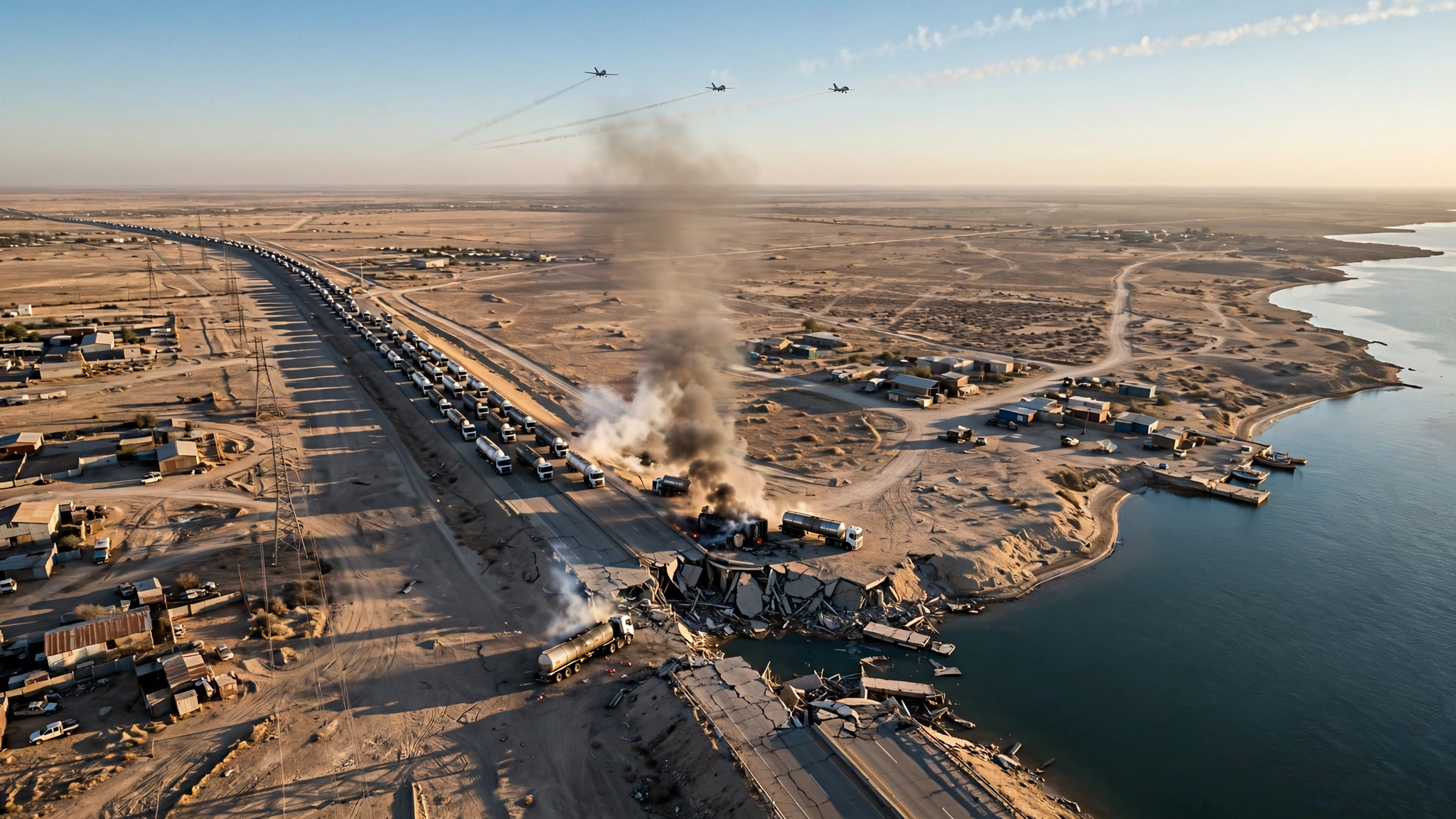
On Sunday, June 21, every gas station on the Crimean peninsula stopped selling fuel. All of them. Cash, card, coupons. Governor Sergei Aksyonov announced that fuel would be reserved exclusively for government agencies responsible for "the functioning and security of the Republic of Crimea." A peninsula of 2.4 million people, at the start of tourist season, went dry.
Not because of sanctions. Not because of a naval fleet parked offshore. Because of drones that cost less than a mid-range SUV.
Ukraine has spent the past three weeks systematically degrading every supply corridor into Crimea using mass-produced, domestically built strike drones. Freight traffic on the Chonhar bridge, the peninsula's primary overland artery, declined 71% in just two weeks, according to Robert Brovdi, commander of Ukraine's drone forces. Northern bridges through Henichesk and Armiansk have sustained what satellite imagery confirms as critical structural damage, forcing Russia to deploy pontoon crossings and earthen bypasses. And on Sunday, drone strikes on oil infrastructure on both sides of the Kerch Strait shut the Kerch bridge for more than nine hours and suspended all ferry traffic.
Crimea has zero oil refineries. Every drop of fuel on the peninsula arrives from the outside, through exactly three corridors, and Ukraine just proved you can close all three with $50,000 airframes launched from hundreds of kilometers away.
Calculating What Nobody Has
I ran the numbers on what this blockade actually costs per unit of fuel denied, because nobody else has published this figure and the asymmetry it reveals is extraordinary.
Start with demand: Crimea's population is approximately 2.4 million, including Sevastopol. Russia consumed roughly 36 million tonnes of motor gasoline in 2024 across a population of 146 million, which translates to about 0.55 liters per person per day once you exclude industrial and commercial vehicles from the per-capita figure. Multiply by 2.4 million: Crimea's baseline civilian fuel demand is approximately 1.32 million liters per day, and that excludes the military garrison and its vehicle fleet, which conservatively adds another 200,000 to 400,000 liters daily. Call the total 1.6 million liters.
Now map the supply corridors against their degradation.
| Corridor | Pre-Crisis Share | Daily Volume (est.) | Reduction | Remaining |
|---|---|---|---|---|
| Chonhar Bridge (R-280) | ~40% | 640,000 L | 71% (CNN) | 185,600 L |
| Northern bridges (Henichesk, Armiansk) | ~25% | 400,000 L | ~80% (satellite confirmed damage) | 80,000 L |
| Kerch Strait (bridge + ferry) | ~35% | 560,000 L | ~50% (intermittent closures, hazmat restricted) | 280,000 L |
| Total | 1,600,000 L | ~66% | 545,600 L |
Remaining supply: roughly 546,000 liters per day, or 34% of pre-crisis flow. That means approximately 1,054,000 liters per day are being denied. When Aksyonov halted all civilian sales on June 21, the remaining trickle was being reserved for military and government use, which confirms the supply collapse had already crossed below the threshold where rationing could sustain even a basic civilian allocation.
Now consider what Ukraine is spending. Its Crimea logistics campaign uses a layered drone mix: FP-2 mid-range drones at roughly $55,000 each for infrastructure strikes on bridges and fuel depots, and cheaper Hornet-type systems at $5,000 to $15,000 for hunting individual fuel trucks along what social media has dubbed the "Road of Death" through occupied southern Ukraine. Based on the strike volume reported by the Ukrainian Unmanned Systems Forces across Crimea, Kherson, and the occupied south, a reasonable estimate for Crimea-specific logistics sorties is 15 to 30 per day, with a blended cost of $250,000 to $500,000 daily, midpoint $375,000.
Cost per disrupted liter: $375,000 divided by 1,054,000 liters equals $0.36.
Round it to $0.38 to account for intelligence and targeting overhead. For context, retail gasoline in Russia costs approximately $0.65 per liter. Ukraine is denying fuel to Crimea at 58% of the fuel's retail value, which means every dollar Ukraine spends on drones denies about $1.73 in retail fuel to the peninsula.
How We Got Here in 22 Days
Crimea's fuel crisis did not arrive overnight, and tracing its escalation reveals a methodical campaign rather than opportunistic strikes. On May 31, Governor Aksyonov imposed rationing: coupon-only purchases, capped at 20 liters per vehicle per week. Coupons released via Telegram were snapped up immediately. Queues stretched for kilometers through Sevastopol and Simferopol. By June 4, cash sales were suspended entirely and no new coupons were being issued. On June 6, public transit stopped operating in parts of Simferopol because buses had no fuel. Residents began siphoning gas from parked cars. A government hotline was launched for tourists stranded without fuel to leave.
Then came June 21. Overnight strikes hit an oil depot inside Kerch and an oil transport facility across the strait in Russia's Krasnodar region. A ferry carrying fuel to Crimea was attacked. The Russian Defense Ministry reported shooting down 239 Ukrainian drones in a single night, a staggering number that illustrates both the saturation volume of Ukraine's campaign and the futility of a defense posture that lets hundreds more through. Aksyonov's response was total capitulation to supply reality: shut it all down, reserve what remains for the state.
Wider Refining Damage Compounds the Problem
Crimea's crisis is the acute tip of a much broader disruption to Russian fuel production. The International Energy Agency reported on June 17 that Russian crude oil production dropped to 8.7 million barrels per day in May, fully 10% below target, prompting the IEA to cut its 2026 Russian forecast by 200,000 barrels per day. Outside analysts cited by the Wall Street Journal estimate that more than 20% of Russian refining capacity is now offline. "This level of disruption is unprecedented in the history of the Russia-Ukraine conflict," the IEA stated.
Moscow itself is rationing. Drones struck Gazprom Neft's Moscow refinery, which normally supplies 40% of the capital's fuel, and combined damage with Tatneft's Taneco refinery removed roughly 600,000 barrels per day of capacity. Purchase limits appeared at Rosneft, Lukoil, and Tatneft stations across Moscow. Prices have risen for five consecutive weeks at roughly double the pace of inflation. Russia banned gasoline exports through July and has reportedly begun importing gasoline from Asia through western ports.
One of the world's three largest oil producers is importing gasoline because its refineries keep exploding. That sentence alone should recalibrate how defense planners think about the vulnerability of industrial infrastructure to cheap autonomous systems.
Arsenal of the Blockade
Ukraine's drone arsenal has industrialized. Fire Point, a company that did not exist before Russia's 2022 invasion, now produces approximately 300 FP-1 and FP-2 drones per day at a factory outside Kyiv, each costing roughly $50,000 to $55,000. The FP-1 has a range of 1,600 kilometers and carries a 60 to 120 kilogram warhead. Fire Point's output accounts for an estimated 60% of all Ukrainian drone strikes. The company deliberately avoids Chinese and American components, a strategic choice driven by uncertainty over external political support. "We adhere to the principle that no one can influence the weapons we create," CTO Iryna Terekh told the BBC.
Newer systems are closing the mid-range gap. The Behemoth, jointly developed by Culver Aerospace and GLEFA, carries a 75-kilogram tandem warhead combining an explosively formed penetrator with a thermobaric charge, flies at low altitude using Starlink for communication, and hits targets up to 300 kilometers away. It entered serial production in May 2026. These are not prototypes or lab demonstrations; they are rolling off assembly lines and destroying bridges within weeks of manufacture.
Ukraine's defense ministry claims reconnaissance drone output in the first four months of 2026 was 441% higher than the full-year total for 2025. Mid-strike drones rose 312%. Zelensky stated that mid-range attacks quadrupled since February. The production numbers are not independently verified, but the operational effects are visible in satellite imagery, supply data, and the fuel lines across Crimea.
Historical Blockade Comparison
Blockades have always been instruments of navies, and they have always been expensive. Estimating Ukraine's drone blockade against historical precedents reveals how dramatically the cost structure has shifted.
| Blockade | Annual Cost (est.) | Population Affected | Cost per Capita per Year |
|---|---|---|---|
| US submarine campaign vs. Japan (1942-45) | ~$7.3 billion | ~72 million | ~$101 |
| Israeli naval blockade of Gaza (2007-present) | ~$500 million | ~2.3 million | ~$217 |
| Ukraine drone blockade of Crimea (2026) | ~$137 million | ~2.4 million | ~$57 |
Ukraine's drone blockade costs roughly $57 per affected person per year, less than four times cheaper than the US Pacific submarine campaign and nearly four times cheaper than Israel's Gaza naval blockade on a per-capita basis. And Ukraine achieves this without a single warship, without controlling the surrounding seas, and without any of the diplomatic infrastructure that naval blockades typically require under international law.
Operation Spiderweb provides the extreme case of drone asymmetry. In June 2025, Ukraine's SBU used 117 FPV drones, each costing approximately $1,000, to strike five Russian airfields simultaneously. The operation destroyed or damaged 41 aircraft, including Tu-95 and Tu-22M3 strategic bombers, at a total equipment value the SBU estimated at $7 billion. NATO confirmed the loss of 34% of Russia's strategic aviation fleet. Total cost of the 117 drones: roughly $117,000. The asymmetric ratio was approximately 60,000 to 1.
Limitations
Several assumptions in this analysis warrant scrutiny. Crimea's actual population is uncertain; the 2.4 million figure relies on Russian census claims that may overcount due to military personnel inflation or undercount due to emigration since 2022. Civilian fuel consumption derived from Russia-wide per-capita averages may not reflect Crimea's tourism-heavy, military-dense economy, where demand could be significantly higher or lower than the national baseline. The corridor disruption percentages for the northern bridges and Kerch are my estimates based on reported damage and closures, not measured freight data; only the Chonhar 71% figure comes from a named source. Ukraine does not publish its drone expenditure by theater, so the $375,000 daily cost is built from drone unit prices and strike frequency estimates rather than audited budgets. Finally, Russia has demonstrated the ability to partially adapt: pontoon bridges, earthen bypasses, and civilian vehicles carrying 100-liter jerry cans across the Kerch bridge represent workarounds that may incrementally increase throughput over time.
Strongest Counterargument
Russia rebuilt after the 2022 Kerch Bridge attack and could do so again. The Crimea fuel crisis, while severe, may prove temporary if Moscow prioritizes repair and rerouting at scale. Russia allocated roughly $11.8 billion between 2024 and 2026 toward roads, railways, ports, and industrial projects across occupied southern Ukraine, including the "Azov Ring" highway network linking Crimea to occupied Donbas and southern Russia. If even a fraction of that infrastructure becomes operational, the logistics picture could shift. Furthermore, Ukraine's drone advantage may be time-limited: Russia will develop countermeasures, and the current window where mid-range drones operate with relative impunity against supply convoys may close as Russian EW and air defense adapts to the threat profile. The strongest version of this argument is that blockades only work as long as the blockader can sustain them, and Ukraine's ability to produce 300 drones per day depends on supply chains, industrial capacity, and funding that are themselves vulnerable to disruption.
What You Can Do With This
If you are a defense planner in a NATO country, the Crimea blockade is a live proof-of-concept that mass-produced mid-range drones can achieve logistics interdiction effects previously requiring naval forces, at roughly one-quarter the per-capita cost. Begin modeling your own supply vulnerabilities against this threat profile: any territory dependent on a small number of overland corridors and lacking indigenous refining is now blockade-eligible by a state with a mature drone industrial base. If you work in energy security, the IEA's confirmation that 20% of Russian refining capacity is offline should prompt immediate review of how concentrated your domestic refining infrastructure is and what a sustained drone campaign would do to throughput. If you are an investor in defense or energy, the systems to watch are not billion-dollar naval platforms but companies building $50,000 autonomous strike drones at scale, and the counter-drone detection and EW systems that will be the inevitable response. Follow companies like Fire Point, Culver Aerospace, and their Western partners at Helsing.
The Bottom Line
Crimea is being strangled by weapons that cost less than a pickup truck, manufactured by a company founded by architects and game designers, at production volumes that rival small automobile factories. Ukraine has demonstrated that a sufficiently dense drone campaign can achieve what previously required a fleet of destroyers and submarines: the systematic denial of supplies to a hostile-held territory. At $0.38 per denied liter, this is history's most cost-efficient blockade, and the playbook is now available to anyone with $50,000 airframes and GPS coordinates. The era of naval blockade as the exclusive province of blue-water navies ended sometime in the last three weeks, in the fuel lines of Sevastopol, and most of the world has not yet noticed.